

(Photo by Lara Jameson via Pexels)
By Stephen Beech
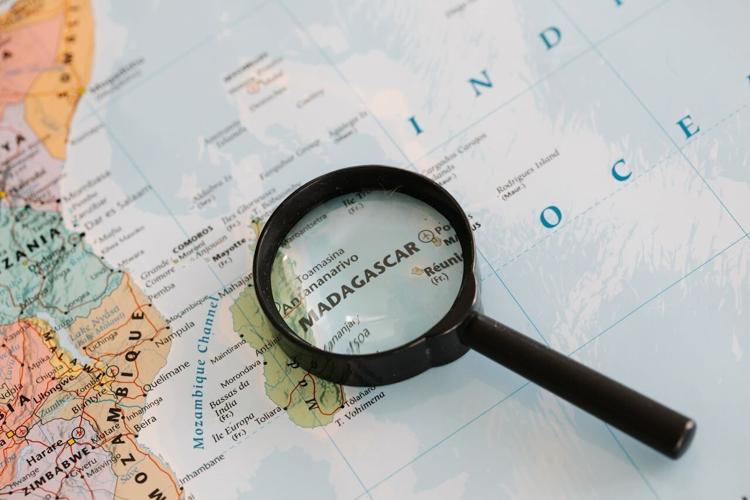
Seven new species of frog have been discovered on an island in the Indian Ocean.
The elusive diamond frogs were identified by an international team of scientists in Madagascar.
The researchers say the discovery on the biodiversity hotspot shows that one of the island's most mysterious groups of amphibians is even more diverse than previously thought.
They explained that knowing where species occur — and even recognizing that they are distinct species — is "fundamental" to understanding biodiversity and protecting it.
Combining museum collections, fieldwork and advanced DNA analysis, the research uncovered previously hidden diversity and also resolved a long-standing puzzle.
By clarifying the identities and distributions of the secretive frogs, the researchers say the study provides an important foundation for future conservation efforts in Madagascar's rapidly disappearing forests.
Study lead author Mark Scherz, curator of herpetology at Denmark's Natural History Museum, said: "Diamond frogs have been hiding their diversity beneath our feet.

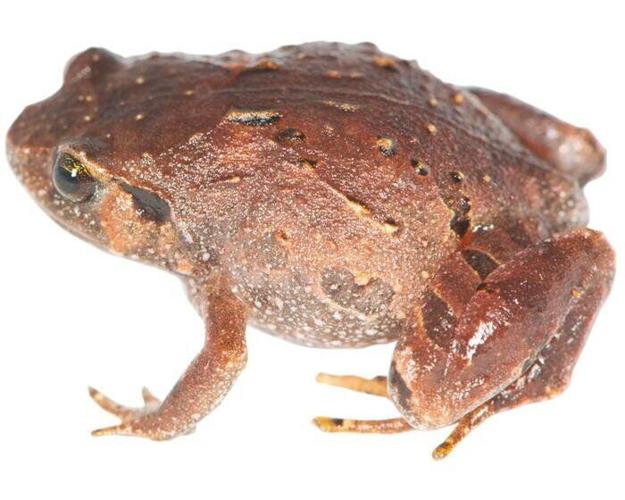
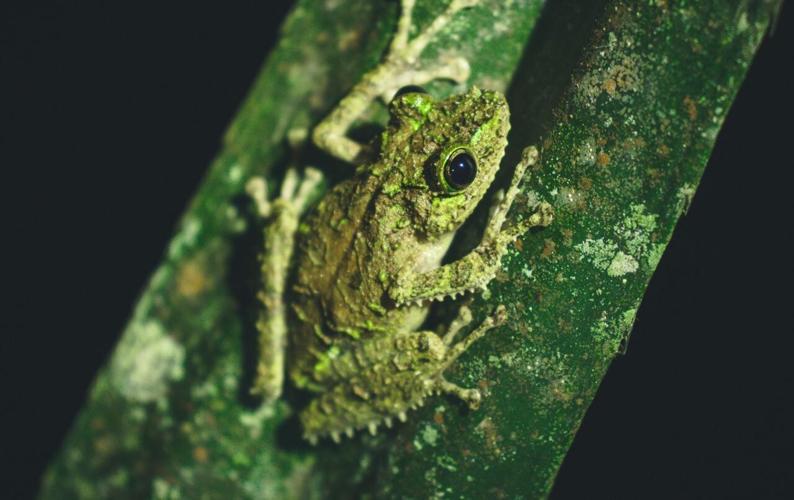
Rhombophryne mavokely, one of the newly described species of diamond frogs from Madagascar. (Mark D. Scherz, Natural History Museum Denmark via SWNS)
"Many species spend most of their lives beneath the leaf litter, and even when they emerge they can look deceptively similar."
He says diamond frogs are among Madagascar's most distinctive amphibians.
Scherz said: "Some species are remarkably round, resembling the rain frogs of mainland Africa, and spend much of their lives hidden beneath the forest floor.
"Others are long-legged moss dwellers or strong-bodied terrestrial species.
"Although most appear brown at first glance, several conceal flashes of orange or striking white or black markings on their thighs and lower backs, which may serve to startle predators.
"These secretive habits make diamond frogs some of Madagascar's least-studied vertebrates."
The project began in 2014 after researchers repeatedly encountered frogs that clearly represented undescribed species.
But resolving their identities proved challenging because scientists could not confidently match historical species names with modern genetic lineages.
Scherz said: "When I started this project 12 years ago, we already knew there were several species waiting to be described, and almost every expedition to Madagascar revealed another one.
"Some were relatively straightforward to describe, but others were complicated by uncertainty surrounding older species names.






"Untangling that puzzle took years."

Graphic Node
The breakthrough came through "museomics" — the sequencing of DNA from historical museum specimens.
By combining genetic data from the historical collections with newly collected material, alongside analysis of external and skeletal anatomy and frog calls, the research team was able to match historical names to the correct evolutionary lineages and resolve decades of taxonomic uncertainty.
Historical museum specimens proved essential for resolving the identities of several species.
Alice Petzold of the University of Potsdam in Germany, led the museomics work.
She said: "Museum collections are far more than archives of the past — they are essential scientific resources for understanding biodiversity today.
"By sequencing historical specimens, including the original type specimens, we were able to answer questions that have persisted for generations."
Scherz said the study, published in the journal Vertebrate Zoology, represents a close collaboration between researchers and institutions in Madagascar and Europe.
He says it also shows how closely biodiversity research and conservation are linked.
Scherz said: "Many diamond frogs inhabit forests that are increasingly fragmented by deforestation, yet scientists still know remarkably little about the biology of many species."

(Photo by Davidson Free Media via Pexels)
Co-author Andolalao Rakotoarison, from the University of Itasy, Madagascar, said: "For many species, we still know almost nothing about their breeding biology, population sizes or ecological requirements.
"Without that knowledge, it becomes much more difficult to assess their conservation status and protect them effectively,"
The findings are already informing conservation planning in Madagascar.
Several of the newly described species — including Rhombophryne quentini — contributed directly to proposals to strengthen and expand protected areas.
But even after describing seven new species — bringing the total number of known Rhombophryne species to 27 — the researchers believe that additional, currently unnamed species almost certainly remain to be discovered and scientifically described.
Scherz added: "Every newly described species represents millions of years of unique evolutionary history.
"The more we learn about Madagascar's remarkable amphibians, the clearer it becomes that there is still an enormous amount left to discover."

(0) comments
Welcome to the discussion.
Log In
Keep it Clean. Please avoid obscene, vulgar, lewd, racist or sexually-oriented language.
PLEASE TURN OFF YOUR CAPS LOCK.
Don't Threaten. Threats of harming another person will not be tolerated.
Be Truthful. Don't knowingly lie about anyone or anything.
Be Nice. No racism, sexism or any sort of -ism that is degrading to another person.
Be Proactive. Use the 'Report' link on each comment to let us know of abusive posts.
Share with Us. We'd love to hear eyewitness accounts, the history behind an article.