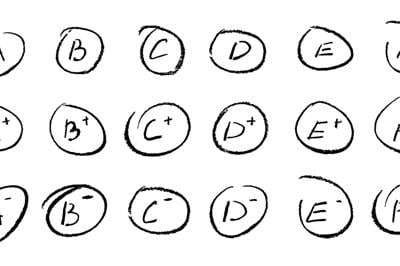
The grades that students receive in high school and college can decide their futures. High school grades shape students’ overall GPA, class rank and the transcripts that colleges read. They can determine who makes the college sports team and who earns the scholarship.
Yet some parents may not realize that in a rising number of U.S. schools, students will never receive a score of zero – even if they never turn in a paper or answer every question wrong on an exam.
Thousands of U.S. schools have adopted some form of “no-zero,” or minimum-grade policy, in recent years. No-zero grading policies prevent teachers from giving zeros on any assignment or test. They also set a grade floor, meaning that teachers cannot assign a score below a certain number, usually 50 or 60 points.
No-zero grading policies have more than doubled over the past decade. While some estimates vary, about half of K-12 teachers in one 2025 study said that their schools had adopted some version of this policy.
In Washington state alone, about 30 of the nearly 70 districts use no-zero grading policies. Across South Carolina, at least 18 districts out of 72 overall districts have adopted a version of this policy.
Those standards are now being upended, as South Carolina recently became the first state to officially restrict no-zero grading policies. The new law, which went into effect on July 1, 2026, bars districts from requiring a minimum grade and allows teachers to assign grades that reflect a student’s actual performance, including a zero when no work is submitted. Districts that require teachers to raise grades will lose 10% of a category of state funding for classrooms, according to this law.
For more than a decade, my research on grading purpose, accuracy and reform has examined what a grade is meant to measure and why report cards so often miss the mark. Districts adopt grade floors for an understandable reason: A single zero can do outsized damage to a student’s overall grade.

Why one zero can sink a semester
On a 0-to-100 scale, a passing grade usually starts at 60. Every letter grade, from D to A, fits inside 40 points at the top, while failure stretches across the 60 points below. And because course grades get averaged, one zero drags a student down more than a perfect score can lift them.
A student who completed four assignments that all received 90 points or above, but also received one zero, will average a 72 grade, or a C. Research into this mathematical imbalance shows a zero on a single assignment can leave a student unable to recover and ultimately fail a course.
The push to ban zeros took off in the early 2000s, when educators and school administrators began rethinking grading practices to better reflect learning and how to help struggling students recover.
Stopping teachers from giving grades below a certain number also promised consistency. Teachers grade so differently that one missing assignment might barely dent one student’s grade and cause another to fail a class. The goal was to keep one rough week from defining a semester.
Critics see grade floors differently. A student who skips an assignment still collects 50 points, so the policy hands out credit for work that doesn’t exist. It also hides missing work. On a report card, a 50 may look like a struggling attempt, when nothing was ever turned in.
Teachers remain divided over assigning grade minimums, and districts continue to wrestle with the trade-offs between helping students recover and grade inflation.
Does banning zeros work?
The evidence is mixed on whether letting teachers give zeros actually helps students.
Some studies find that minimum grades keep struggling students from giving up and are linked to higher graduation rates.
Others find they prop up grades that no longer reflect learning.
In my view, grade floors and the new South Carolina ban both treat the symptom, which is students struggling academically, without addressing the cause of the problem.
A 2024 analysis calls grade floors a “band-aid on a wound that never heals.”
So while South Carolina has banned the band-aid, the actual wound – meaning the underlying grading system and the way traditional percentage grading is structured – remains.






Three simpler fixes
My research points to three changes that could help address this bigger challenge of unfair grading systems.
The first is reaching agreement on what a grade means. In many schools, a B in one classroom reflects only what a student learned, while a B in another class also counts homework habits. When teachers, parents and administrators disagree about a grade’s purpose, identical work earns different marks. Schools can settle it in writing, stating that grades report learning, not compliance.
Second, schools can grade students’ work habits, like effort, participation and punctuality, separately from academics. My research finds that blending the two can move a final course grade by a full letter.
Third, schools can swap the 100-point scale for a simpler four- or five-level scale, where a zero is just the lowest level rather than a 60-point hole.
On this smaller scale, no grade floor or ban is needed.
The beginning of a trend
South Carolina is the first state to allow teachers to give a zero to a student, but it likely won’t be the last.
In North Carolina, there are already calls to follow South Carolina’s lead. A majority of voters in the state show support for this switch.
And in Texas, a state law since 2009 has protected teachers who record the grade a student earned – even if it is zero.
Grading policies keep landing in court, and the policies that hold up share one trait: The grade matches what the student did.
At the higher education level, Harvard’s faculty recently voted to cap the share of A’s it awards, bringing the question of what a grade is for into national view.

Not a quick fix
Real grading reform is slower to roll out than a ban. Replacing the 100-point system could mean issuing new kinds of report cards, teacher retraining and ongoing communication with parents.
The deeper problem, deeper than any single zero, is that one number is supposed to say two things at once: what a student learned and how hard that student worked. There could be two separate lines on a report card, one grade for learning and one for work habits. Each would tell parents, colleges and employers something true and useful.
This article is republished from The Conversation, a nonprofit, independent news organization bringing you facts and trustworthy analysis to help you make sense of our complex world. It was written by: Laura Link, University of North Dakota
Read more:
- A, B, C or D – grades might not say all that much about what students are actually learning
- Every teacher grades differently, which isn’t fair
- Teacher lawsuits over forced grade inflation won’t fix unfair grading – here’s what could
Laura Link consults with school districts through GradingRx.


(0) comments
Welcome to the discussion.
Log In
Keep it Clean. Please avoid obscene, vulgar, lewd, racist or sexually-oriented language.
PLEASE TURN OFF YOUR CAPS LOCK.
Don't Threaten. Threats of harming another person will not be tolerated.
Be Truthful. Don't knowingly lie about anyone or anything.
Be Nice. No racism, sexism or any sort of -ism that is degrading to another person.
Be Proactive. Use the 'Report' link on each comment to let us know of abusive posts.
Share with Us. We'd love to hear eyewitness accounts, the history behind an article.