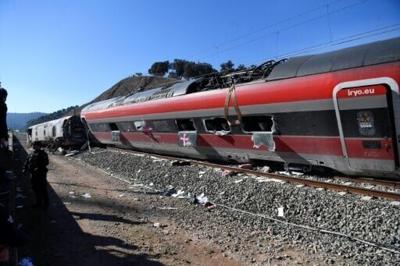
Spain aims to restart within 10 days full service on a key high-speed railway line where a collision between two trains killed 45 people, the transport minister said on Wednesday.
The January 18 disaster in the southern region of Andalusia -- one of Europe's deadliest such accidents this century -- partially shut the line linking Madrid and the city of Seville as investigators cleared the wreckage and collected evidence.
"Today we have received legal permission to proceed with the replacement of the infrastructure in the section of the accident," Transport Minister Oscar Puente wrote on X.
"Our aim is that it is completed in a timeframe of approximately 10 calendar days. After the replacement, the whole of the Madrid-Seville line will resume service," he added.
The line was Spain's first high-speed rail connection when it opened in 1992, with the network expanding to become the world's second-largest after China's and a source of national pride.
But the accident has raised doubts about the safety of rail travel in the country.
A preliminary report released last week suggested the track was cracked before a train run by private firm Iryo derailed and smashed into an oncoming service operated by state company Renfe.
Keep it Clean. Please avoid obscene, vulgar, lewd,
racist or sexually-oriented language. PLEASE TURN OFF YOUR CAPS LOCK. Don't Threaten. Threats of harming another
person will not be tolerated. Be Truthful. Don't knowingly lie about anyone
or anything. Be Nice. No racism, sexism or any sort of -ism
that is degrading to another person. Be Proactive. Use the 'Report' link on
each comment to let us know of abusive posts. Share with Us. We'd love to hear eyewitness
accounts, the history behind an article.
...COLD WEATHER ADVISORY IN EFFECT FROM MIDNIGHT FRIDAY NIGHT TO
NOON CST SATURDAY...
...EXTREME COLD WATCH NOW IN EFFECT FROM SATURDAY AFTERNOON THROUGH
SUNDAY MORNING...

* WHAT...For the Cold Weather Advisory, very cold wind chills as low
as 1  expected in the north to 10 to 15 in the southeast. For the
Extreme Cold Watch, dangerously cold wind chills as low as 1 above
possible in the north to 5 to 10 in the southeast.

* WHERE...Autauga, Barbour, Bibb, Blount, Bullock, Calhoun,
Chambers, Cherokee, Chilton, Clay, Cleburne, Coosa, Dallas,
Elmore, Etowah, Fayette, Greene, Hale, Jefferson, Lee, Lowndes,
Macon, Marengo, Montgomery, Perry, Pickens, Pike, Randolph,
Russell, Shelby, St. Clair, Sumter, Talladega, Tallapoosa,
Tuscaloosa, Walker, and Winston Counties.

* WHEN...For the Cold Weather Advisory, from midnight Friday Night
to Saturday morning. For the Extreme Cold Watch, from Saturday
afternoon through Sunday morning.

* IMPACTS...Frostbite and hypothermia will occur if unprotected skin
is exposed to these temperatures. An extended period of
subfreezing temperatures could cause pipes to burst.

PRECAUTIONARY/PREPAREDNESS ACTIONS...

Dress in layers including a hat, face mask, and gloves if you must
go outside.

Keep pets indoors as much as possible.

Make frequent checks on older family, friends, and neighbors. Ensure
portable heaters are used correctly. Do not use generators or grills
inside.

If you do not have heat in your home or lack shelter, you can call
211 or visit 211connectsalabama.org for assistance locating
appropriate shelter from the cold.

To prevent freezing and possible bursting of pipes they should be
wrapped, drained, or allowed to drip slowly.

Use caution while traveling outside. Wear appropriate clothing, a
hat, and gloves.

&&
...COLD WEATHER ADVISORY IN EFFECT FROM MIDNIGHT FRIDAY NIGHT TO
NOON CST SATURDAY...
...EXTREME COLD WATCH NOW IN EFFECT FROM SATURDAY AFTERNOON THROUGH
SUNDAY MORNING...

* WHAT...For the Cold Weather Advisory, very cold wind chills as low
as 1  expected in the north to 10 to 15 in the southeast. For the
Extreme Cold Watch, dangerously cold wind chills as low as 1 above
possible in the north to 5 to 10 in the southeast.

* WHERE...Autauga, Barbour, Bibb, Blount, Bullock, Calhoun,
Chambers, Cherokee, Chilton, Clay, Cleburne, Coosa, Dallas,
Elmore, Etowah, Fayette, Greene, Hale, Jefferson, Lee, Lowndes,
Macon, Marengo, Montgomery, Perry, Pickens, Pike, Randolph,
Russell, Shelby, St. Clair, Sumter, Talladega, Tallapoosa,
Tuscaloosa, Walker, and Winston Counties.

* WHEN...For the Cold Weather Advisory, from midnight Friday Night
to Saturday morning. For the Extreme Cold Watch, from Saturday
afternoon through Sunday morning.

* IMPACTS...Frostbite and hypothermia will occur if unprotected skin
is exposed to these temperatures. An extended period of
subfreezing temperatures could cause pipes to burst.

PRECAUTIONARY/PREPAREDNESS ACTIONS...

Dress in layers including a hat, face mask, and gloves if you must
go outside.

Keep pets indoors as much as possible.

Make frequent checks on older family, friends, and neighbors. Ensure
portable heaters are used correctly. Do not use generators or grills
inside.

If you do not have heat in your home or lack shelter, you can call
211 or visit 211connectsalabama.org for assistance locating
appropriate shelter from the cold.

To prevent freezing and possible bursting of pipes they should be
wrapped, drained, or allowed to drip slowly.

Use caution while traveling outside. Wear appropriate clothing, a
hat, and gloves.

&&
Currently in Selma
52°
Sunny
55° / 23°
5 PM
51°
6 PM
46°
7 PM
41°
8 PM
37°
9 PM
34°
Get Black Belt News headlines for free in your inbox every day!
Success! An email has been sent to with a link to confirm list signup.
Error! There was an error processing your request.



(0) comments
Welcome to the discussion.
Log In
Keep it Clean. Please avoid obscene, vulgar, lewd, racist or sexually-oriented language.
PLEASE TURN OFF YOUR CAPS LOCK.
Don't Threaten. Threats of harming another person will not be tolerated.
Be Truthful. Don't knowingly lie about anyone or anything.
Be Nice. No racism, sexism or any sort of -ism that is degrading to another person.
Be Proactive. Use the 'Report' link on each comment to let us know of abusive posts.
Share with Us. We'd love to hear eyewitness accounts, the history behind an article.