
Giulia Salvaterra
By Stephen Beech
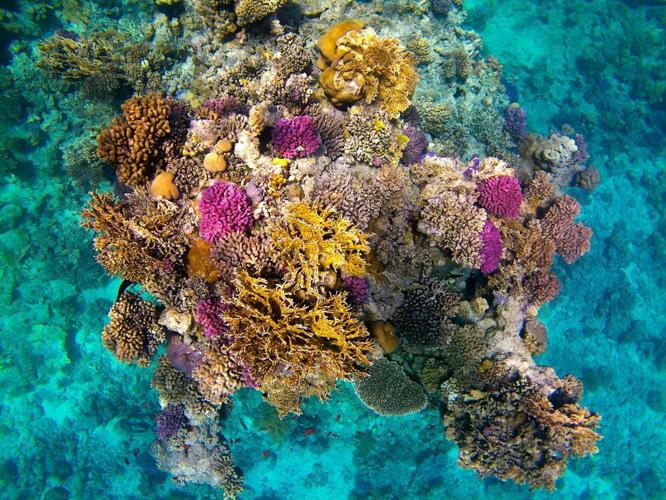
Endangered coral reefs could be saved by a special ink, according to new research.
The bio-ink, called SNAP-X, was engineered by American scientists to help promote coral larvae settlement and restore the threatened underwater ecosystems.
Coral reefs are in "crisis" worldwide due to warming oceans, say ecologists.
But a new study, published in the journal Trends in Biotechnology, shows that the ink could boost coral settlement by more than 20 times.
The research team hopes it could contribute to rebuilding coral reefs around the world.
says author Dr. Daniel Wangpraseurt, of the University of California, San Diego, said: “When people think about a coral reef, they often think about how beautiful it is.
“What we sometimes forget is that coral reefs are one of the best structures in protecting our coasts.
"We are hoping to develop technologies to restore not just the ecosystem but the natural structures that will buffer shorelines against waves, storms, and floods.”

Francesco Ungaro
Scientists have previously tried to restore coral reefs - which have halved around the world since the mid-20th Century - mainly through planting nursery-grown corals.
But Dr. Wangpraseurt says those lab-grown corals are "genetically identical" - meaning that they’re susceptible to the same threats.
He said: “If there’s a warming event or a disease outbreak, it can wipe out the whole population.
"Ideally, we want to recruit corals naturally, which can introduce genetic diversity to the population and enhance their resilience."





Biologists recently discovered that certain rocky pink algae - called crustose coralline algae (CCA) - play an important role in attracting coral larvae and encouraging them to settle on the reef.
It appears that CCA emits metabolites into the surrounding sea, and coral larvae follow those chemical signals.
Inspired by that discovery, Dr. Wangpraseurt and his team developed a transparent ink material infused with metabolites derived from CCA.
Dubbed SNAP-X, the ink slowly releases the natural chemical cues into seawater over the course of a month.

Veronica Reverse
By applying SNAP-X to rocks or other surfaces, scientists can create an "inviting" microhabitat that helps coral larvae settle and grow.
The research team tested SNAP-X outdoors using natural seawater and continuous water flow to simulate the ocean environment.
They found that the larvae of Montipora capitata, a primary reef-building coral in Hawaii, were 20 times more likely to settle on substrates sprayed with SNAP-X, and the settlements became denser when the team increased the concentration of the metabolites in SNAP-X.
Given that some species of coral reproduce by releasing their eggs and sperm at the exact same time every year, the researchers recommend syncing SNAP-X deployment with the coral’s spawning cycle to support natural coral recruitment.
Depending on the species of coral, they say the ingredients of SNAP-X can be tweaked to include different metabolites and chemical signals that support the development of coral reefs.
The team is now working on methods to scale up the production of SNAP-X.
Because the ink contains no living materials, they hope that it will soon be approved for application in the real world.
Dr. Wangpraseurt said: “It’s really exciting to be able to learn from adjacent disciplines like materials science and bioengineering."
He added, “I think a lot of the technologies for restoring and protecting our environment are already there, we just need to look outside the box into other fields of study.”

(0) comments
Welcome to the discussion.
Log In
Keep it Clean. Please avoid obscene, vulgar, lewd, racist or sexually-oriented language.
PLEASE TURN OFF YOUR CAPS LOCK.
Don't Threaten. Threats of harming another person will not be tolerated.
Be Truthful. Don't knowingly lie about anyone or anything.
Be Nice. No racism, sexism or any sort of -ism that is degrading to another person.
Be Proactive. Use the 'Report' link on each comment to let us know of abusive posts.
Share with Us. We'd love to hear eyewitness accounts, the history behind an article.