



(SWNS)
By Stephen Beech
A whale's dive shapes its song patterns, suggests new research.
The study using data from suction caps attached to the aquatic mammals is the first to connect an entire humpback whale song structure to a complete dive cycle.
The findings could help infer whale behavior from acoustic recordings alone, say scientists.
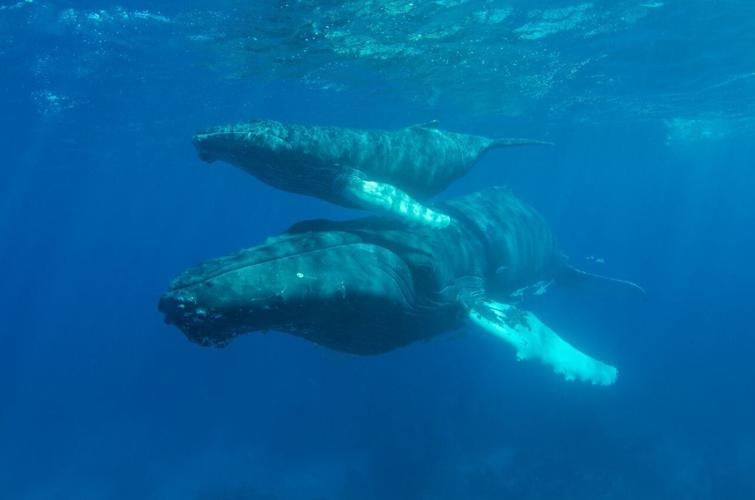
The haunting, complex songs of male humpback whales can last for hours and travel for miles underwater, playing a central role in reproduction during the winter breeding season.
But despite decades of research into what the songs sound like, scientists have had far less insight into what the whales are physically doing while they sing.
Understanding that connection could reveal how singing affects a whale's energy use, oxygen management and vulnerability to underwater noise and vessel strikes.
The new study by Julia Zeh reveals a previously unknown link between the structure of a humpback whale's song and the whale's movement through the water.
The findings, published in the journal Current Biology, show that specific song themes are tied to specific parts of a dive.
Zeh says the study offers a new window into the biology and evolution of one of the animal kingdom's most elaborate acoustic displays.
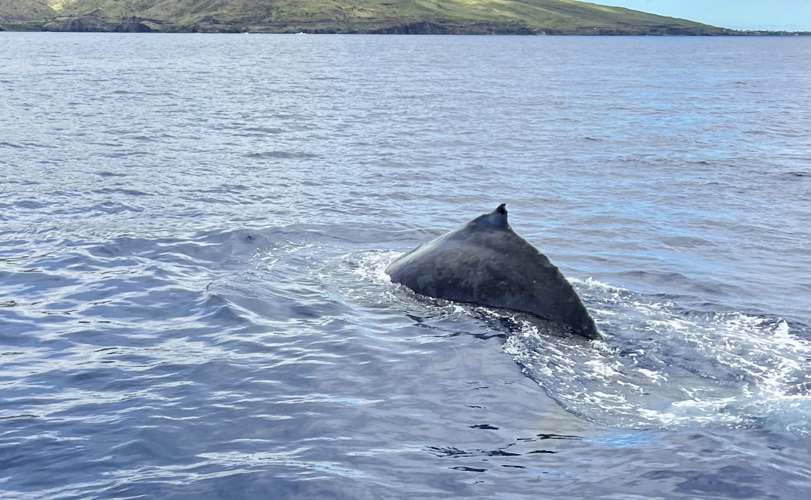
To gather the data, she and her colleagues temporarily attached sound-and-movement recording tags to singing humpback whales off the coast of Maui, part of a research project spanning six years from 2018 to 2024.

Photo by Ben Phillips via Pexels
The non-invasive tags are small suction-cup devices about the size of a tablet.
The research team attached them from small boats using long poles and, more recently, drones.
Once affixed, the tags recorded both the whale's underwater sounds and its movement before eventually losing suction and detaching, allowing the researchers to retrieve the devices and download the data.
In total, the team tagged 16 whales, a substantial sample from a tagging perspective and one selected to be broadly representative of the larger Hawaiian breeding population.
The team was surprised to find that some whales repeated their songs continuously for up to 16 hours without stopping.
More importantly, recurring song elements known as themes lined up consistently with specific portions of a dive.






While earlier researchers had noticed that certain themes tended to appear as a whale approached the surface, no one had previously connected an entire song structure to an entire dive cycle.
Zeh says the connection between song and depth points to something deeper than coincidence.
She said themes sung while whales remained at a relatively constant depth during the deepest part of a dive showed different levels of variability than themes sung elsewhere, suggesting those sections may be more strongly shaped by sexual selection.
Zeh says that means they could serve as signals of a male's individual quality.
Themes tied to other parts of the dive, by contrast, may be constrained by physiological or environmental factors, such as the demands of managing oxygen and buoyancy while singing.
Zeh said: "This gives us direction for which parts of the song to investigate if we're interested in variation, which is likely driven by sexual selection."
She noted that variation concentrated near a whale's deepest points in the water column may be where a male's song is doing the most work to stand out.
Zeh says the findings also have practical applications.

Photo by Frans van Heerden via Pexels
Because acoustic monitoring is already a common tool for tracking whale populations, understanding how song relates to movement could allow researchers to determine a whale's depth or position directly from a recording.
That, in turn, could help scientists establish a clearer baseline for normal humpback behavior, an essential reference point for detecting when whales are disturbed by human activity such as shipping traffic or ocean noise.
Whether the same patterns hold for humpback populations outside Hawaii remains an open question, according to Zeh.
She noted that while she would expect similar physiological constraints to apply broadly, documented differences in song evolution between hemispheres raise the possibility that different populations experience different pressures on song structure.
Testing that would mean collecting comparable tag data from singing whales on breeding grounds around the world.
Zeh carried out the research during her doctoral studies at Syracuse University's College of Arts and Sciences and while a member of Susan Parks' Bioacoustics and Behavioral Ecology Lab.
Her time in the lab gave her the tools to combine bioacoustic analysis with biologging technology in a way that had not previously been applied to humpback whale song.
Zeh said: "My time at Syracuse changed the way I think about what's possible in this field.
"Projects like this one, where we combined acoustics with movement data, gave me the tools to ask exciting questions about whale behavior and the opportunity to be creative in how we look at well-studied phenomena like humpback whale song."
She added: "These experiences inform how I conduct research and have given me the foundation for my current work in ecological monitoring and conservation."

(0) comments
Welcome to the discussion.
Log In
Keep it Clean. Please avoid obscene, vulgar, lewd, racist or sexually-oriented language.
PLEASE TURN OFF YOUR CAPS LOCK.
Don't Threaten. Threats of harming another person will not be tolerated.
Be Truthful. Don't knowingly lie about anyone or anything.
Be Nice. No racism, sexism or any sort of -ism that is degrading to another person.
Be Proactive. Use the 'Report' link on each comment to let us know of abusive posts.
Share with Us. We'd love to hear eyewitness accounts, the history behind an article.