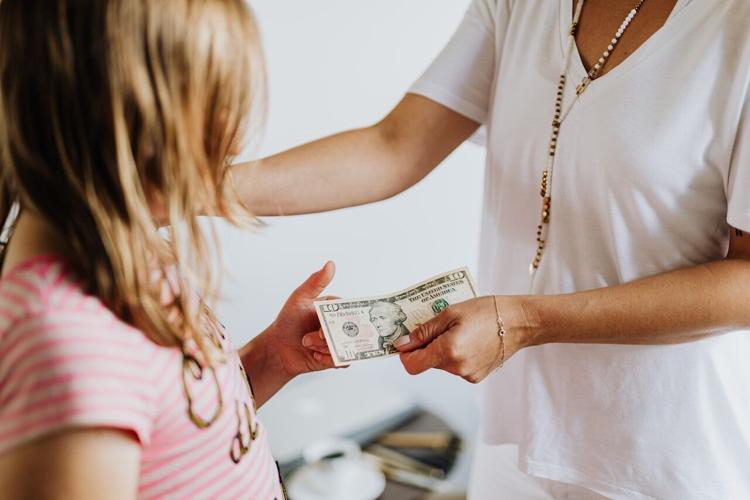






Photo by Karola G via Pexels
Is allowance-flation happening in 2025? A new study has found the average kid is raking in up to $52 per month in allowance — $36 more than their parents did at the same age, adjusting for inflation.
The poll of 2,000 U.S. parents of school-aged children revealed three in four parents give their kids a monthly allowance, stating their children should start learning about financial responsibilities as early as age 10, on average.
More than three in four (78%) believe their kids are responsible with money. In fact, 61% of them believe their kid is even more fiscally responsible than they are.
Commissioned by Acorns Early and conducted by Talker Research, the survey found parents currently give their kids an allowance in either cash (56%), digital payment apps (17%) or pre-loaded debit cards (14%).
Others, meanwhile, said they like to pay their kids by non-monetary means, either in experiences (6%) or screen time (6%).
Two in three parents believe they've got allowance down to a science — they know exactly what they're doing and teaching with it. Meanwhile, 31% are a little less confident, often needing to consult with other parents for reassurance.
Nearly nine in 10 (88%) believe in assigning more allowance money to harder tasks for their kids to complete. Those harder tasks include babysitting siblings ($13 average allowance), earning good grades ($12) and yard work ($11).
More common tasks tend to earn less: being courteous to guests ($10), helping to clean the home ($10), cleaning their room ($9), general daily chores ($9) and vacuuming or sweeping ($8).

Annie Spratt
Even the going rate for the Tooth Fairy has netted kids $9 per baby tooth.
When asked what motivates them to give their kids an allowance, two in three parents agreed it was to help teach them financial responsibility. Many others also agreed it was to reward them for what they've accomplished (59%) or help them save up for specific things they want (55%).
“Kids don’t learn about money by reading about it—they learn it by living it. Allowance is an easy way to grow kids’ money smarts through experience,” said Noah Kerner, CEO & Chairman, Acorns. “Before they’re out on their own, they get years of hands-on exposure to the connection between earning, spending, and saving. As adults, instead of confusion, they feel confidence.”
Some parents have their reservations around allowances. Nearly a quarter (24%) said they don't give their kids an allowance, with many of them citing their kids are either too young (31%), don't understand how to use it (22%) or already have a job (16%).






Some parents have also had some issues giving their kids allowances, seeing their kids spend their allowances all in a day (32%), complain that they don't get enough (23%), don't like the tasks that are assigned to them (19%) or spend it on weird, strange items (17%).
Over half (55%) said their kids have spent their allowance on some downright strange, weird stuff.
One respondent said: "My child came home from school with a spider. He said his classmate at school sold it to him for one dollar."
Other parents have seen their kids use their allowance on items like bags of cheese, slime, fish, a baby chicken, expensive toys, Labubus and their knock-off cousins, Labobos.

cottonbro studio
Survey methodology:
Talker Research surveyed 2,000 American parents of school-aged children; the survey was commissioned by Acorns and administered and conducted online by Talker Research between Sept. 22 and Sept. 29, 2025.
We are sourcing from a non-probability frame and the two main sources we use are:
- Traditional online access panels — where respondents opt-in to take part in online market research for an incentive
- Programmatic — where respondents are online and are given the option to take part in a survey to receive a virtual incentive usually related to the online activity they are engaging in
Those who did not fit the specified sample were terminated from the survey. As the survey is fielded, dynamic online sampling is used, adjusting targeting to achieve the quotas specified as part of the sampling plan.
Regardless of which sources a respondent came from, they were directed to an Online Survey, where the survey was conducted in English; a link to the questionnaire can be shared upon request. Respondents were awarded points for completing the survey. These points have a small cash-equivalent monetary value.
Cells are only reported on for analysis if they have a minimum of 80 respondents, and statistical significance is calculated at the 95% level. Data is not weighted, but quotas and other parameters are put in place to reach the desired sample.
Interviews are excluded from the final analysis if they failed quality-checking measures. This includes:
- Speeders: Respondents who complete the survey in a time that is quicker than one-third of the median length of interview are disqualified as speeders
- Open ends: All verbatim responses (full open-ended questions as well as other please specify options) are checked for inappropriate or irrelevant text
- Bots: Captcha is enabled on surveys, which allows the research team to identify and disqualify bots
- Duplicates: Survey software has “deduping” based on digital fingerprinting, which ensures nobody is allowed to take the survey more than once
It is worth noting that this survey was only available to individuals with internet access, and the results may not be generalizable to those without internet access.


(0) comments
Welcome to the discussion.
Log In
Keep it Clean. Please avoid obscene, vulgar, lewd, racist or sexually-oriented language.
PLEASE TURN OFF YOUR CAPS LOCK.
Don't Threaten. Threats of harming another person will not be tolerated.
Be Truthful. Don't knowingly lie about anyone or anything.
Be Nice. No racism, sexism or any sort of -ism that is degrading to another person.
Be Proactive. Use the 'Report' link on each comment to let us know of abusive posts.
Share with Us. We'd love to hear eyewitness accounts, the history behind an article.