

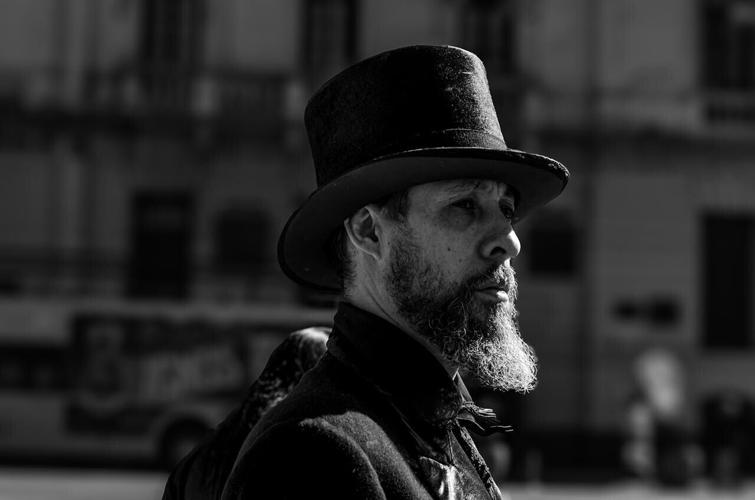


(Photo by RDNE Stock project via Pexels)
By Stephen Beech
Hat etiquette was both a status symbol and a source of conflict in 17th century Britain, reveals new research.
From refusing to doff headwear in court to resisting hat-snatching highway robbers, historians say the relationship with hats goes far deeper than fashion.
While "hatiquette" today is a matter of personal choice, the study shows that 400 years ago social conventions were very different.
Refusing to doff one's hat could be a potent act of political defiance, according to the findings published in The Historical Journal.
In 1630, a feisty oatmeal maker hauled before England's supreme church court was informed that some of his judges were privy councillors as well as bishops.
Unimpressed, he replied, "as you are privy councillors..I put off my hat; but as ye [bishops] are rags of the Beast, lo! – I put it on again."
The research shows he was one of many hat-wearing rebels to emerge during the turbulent reign of Charles I.
Refusal to doff one's hat became a widespread act of political defiance throughout the Civil War era and beyond.

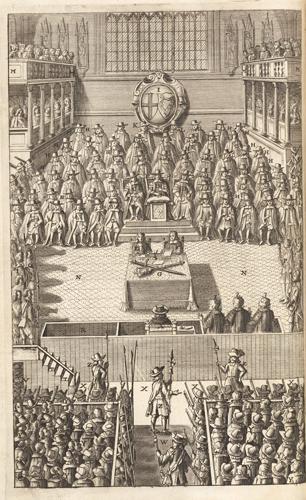
Hat battles at the trial of King Charles I. (John Nalson via SWNS)
For the aptly named Bernard Capp, emeritus professor of history at the University of Warwick, such episodes reveal an important transformation in the meaning of "hat-honour."
Capp, an expert on the Civil War period, said: "Long before the civil wars, men and boys were expected to doff their hats, indoors or out, whenever they met a superior.
"That was about respecting your place in society, but in the revolutionary 1640s and 1650s, hat-honour became a real gesture of defiance in the political sphere."
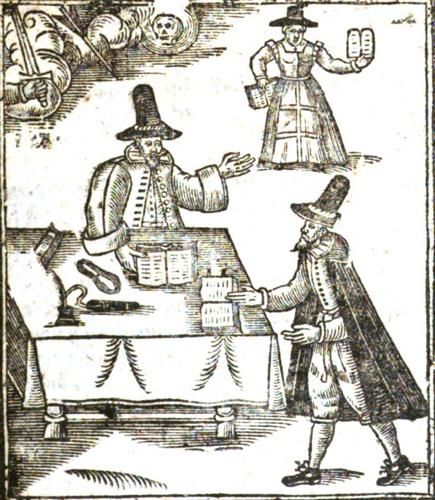
When the radical Leveller John Lilburne, jailed in Newgate in 1646, was ordered to appear at the House of Lords, he resolved to "come in with my hat upon my head, and to stop my eares when they read my Charge, in detestation."
In April 1649, the proto-communist Digger leaders William Everard and Gerrard Winstanley also refused to take their hats off when brought before General Fairfax, commander of the New Model Army, telling him he was "but their fellow Creature."
Capp says that once defeated, eminent royalists adopted the same tactic.
Charles I kept his hat on when he appeared before the High Court of Justice in January 1649, refusing to respect a court whose legitimacy he rejected.
And the Earl of Peterborough's son, tried for treason in 1658, similarly refused to remove his hat or to plead.
Capp said elite men could also choose to reverse conventional practice and strategically doff their hats to social inferiors.
Some royalist leaders, including Lord Capel, theatrically removed their hats when they were on the scaffold waiting to be executed.
Capp said: "This was a sort of populist political gesture, essentially inviting the moral support of the crowd."

Levellers wearing their hats, woodcut from The Declaration and Standard of the Levellers of England (1649). (Bodleian Libraries / University of Oxford via SWNS)
His favorite discovery relates to the home of a father and teenage son.
In 1659, shortly before the restoration of the monarchy, Thomas Ellwood's father took drastic measures to ground the 19-year-old: confiscating all of his hats.
Decades later, Thomas recalled: "I was still under a kind of Confinement, unless I would have run about the Country bare-headed, like a Mad-Man."
Capp says Thomas had repeatedly flouted his father's command to stay away from the Quakers, a group well-known for refusing to remove their hats for people on principle.






His behavior provoked family quarrels and a beating, until his father realized the power of hats.
Thomas' autobiography, published in 1714, reveals that he spent months trapped in his house merely by the power of cultural convention.
Capp said: "It makes no sense to us today.
"But in 1659, father and son just saw this as common sense.
"Thomas couldn't leave the house without a hat – it would have brought too much shame on himself and his family."
Some experts have argued that the rise of handshaking was responsible for the decline of hat-doffing but Capp sees it differently.
He said: "The handshake evolved very slowly as a mode of greeting and had no bearing on hat-honour as a gesture of deference."
Capp believes that the decline of hat-doffing was partly a consequence of manners becoming more informal, but suggests other likely factors.
He said: "The rising popularity of wigs made hat-wearing itself less ubiquitous, and repeatedly doffing one's hat to acquaintances in increasingly busy urban streets may have become too irritating.
"Conventions gradually change over generations and are usually multicausal."

(Photo by Paul Espinoza via Pexels)
Capp discovered that an Englishman's hat remained a powerful symbol and highly prized layer of personal protection in the relative stability of the 18th century.
Analyzing Old Bailey court records, he found "startling" evidence of highway robbery victims prioritizing their hats over valuables and large sums of money.
For example, in May 1718, William Seabrook was crossing Finchley Common in London when he was attacked by three thieves, who robbed him of all the money he was carrying, amounting to around £15.
The court record notes that "they also took away his Hat, upon which he begg'd of them not to take away his Hat and make him go home bare-headed; then they threw down his Hat in the Road and left it."
Capp said: "There seems to have been an unwritten convention that if victims meekly surrendered their valuables, they deserved at least a small favour.
"So some highwaymen were willing to let men keep their precious hats.
"The behavior of robber and robbed might seem bizarre today, but it's got a lot to do with health concerns.
"Men wearing periwigs often had their head shaved, so they were more susceptible to the cold.
"And 18th century medical guides were obsessed with keeping the head warm and warned that going outside bareheaded risked illness."
Capp's research found that being seen bareheaded in the 18th century was associated with abject poverty and madness.
Court records reveal that suspects were desperately anxious not to be hatless when they appeared before a magistrate or jury.
Capp said: "Even in London's seedy underworld, a hat felt essential."
He says when Thomas Ruby was tried for burglary at the Old Bailey in 1741, he "begged very hard" for the return of his hat, lost at the time of his arrest, "for he had none to wear."
Capp added: "What you wear says something about how you see yourself and the world.
"And the hat is so eloquent because it's so versatile – you can position it in so many ways, take it off, wave it around, and attach messages to it."
(0) comments
Welcome to the discussion.
Log In
Keep it Clean. Please avoid obscene, vulgar, lewd, racist or sexually-oriented language.
PLEASE TURN OFF YOUR CAPS LOCK.
Don't Threaten. Threats of harming another person will not be tolerated.
Be Truthful. Don't knowingly lie about anyone or anything.
Be Nice. No racism, sexism or any sort of -ism that is degrading to another person.
Be Proactive. Use the 'Report' link on each comment to let us know of abusive posts.
Share with Us. We'd love to hear eyewitness accounts, the history behind an article.