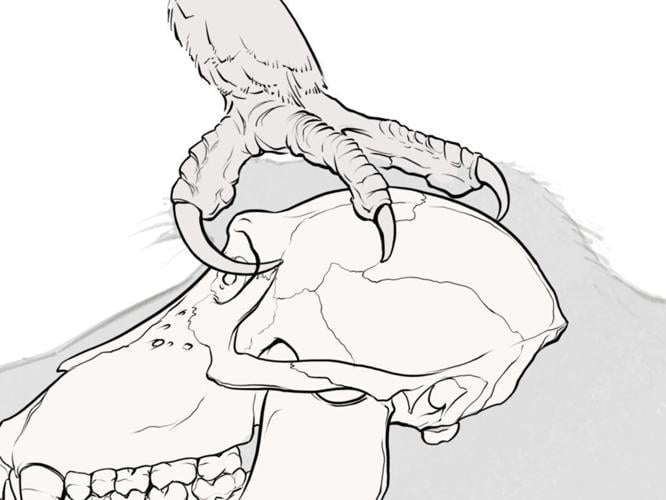
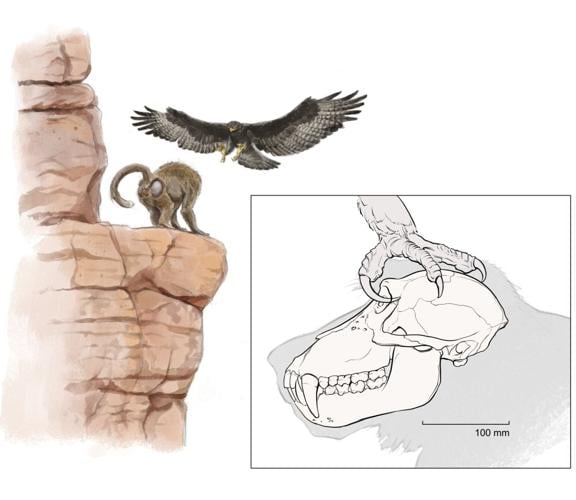


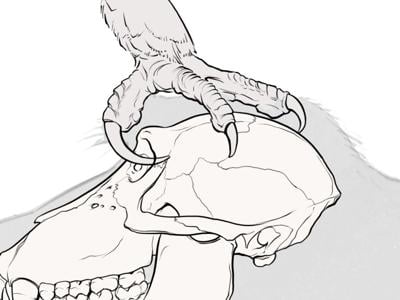

Hunting scene illustration of speculative face- off between an adult male baboon and Verreaux's eagle, drawn to scale. (Javier Lázaro via SWNS)
By Stephen Beech
Giant eagles may have preyed on early humans, suggests a new study.
Researchers found that raptors have been feeding on human-sized baboons in central Africa for centuries.
The discovery could change the understanding of how early humans developed defenses against potentially deadly attacks by other species, say scientists.
Researchers from the University of St. Andrews in Scotland were among an international team who discovered that early human-sized baboons are being preyed on by eagles.
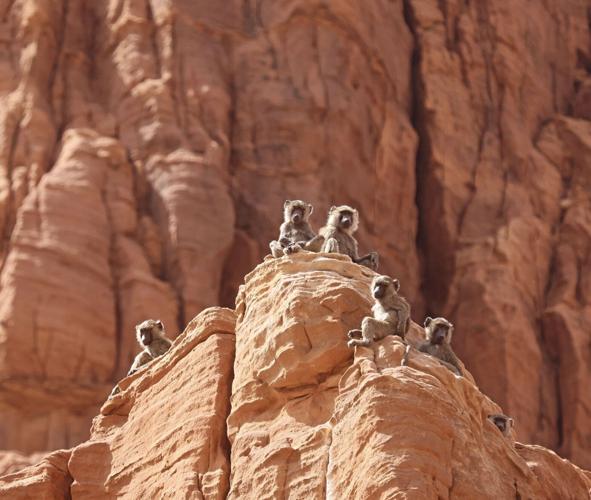
The baboons of the Ennedi Plateau in Chad are an isolated population of primates living in the middle of the Sahara.
But the research team found that their deaths may be even more unusual.

Young baboons in the cliffs of Ennedi. (Catherine Hobaiter via SWNS)
Eagles have hunted primates for millions of years, but humans and our hominin ancestors were thought to have escaped the raptors for the past 2.5 million years.
No primate over 13 kilograms (28.6 pounds) has been confirmed to be killed by raptors and so, like the other large primates, our body sizes were judged too heavy for even the giant eagles of the past to lift.
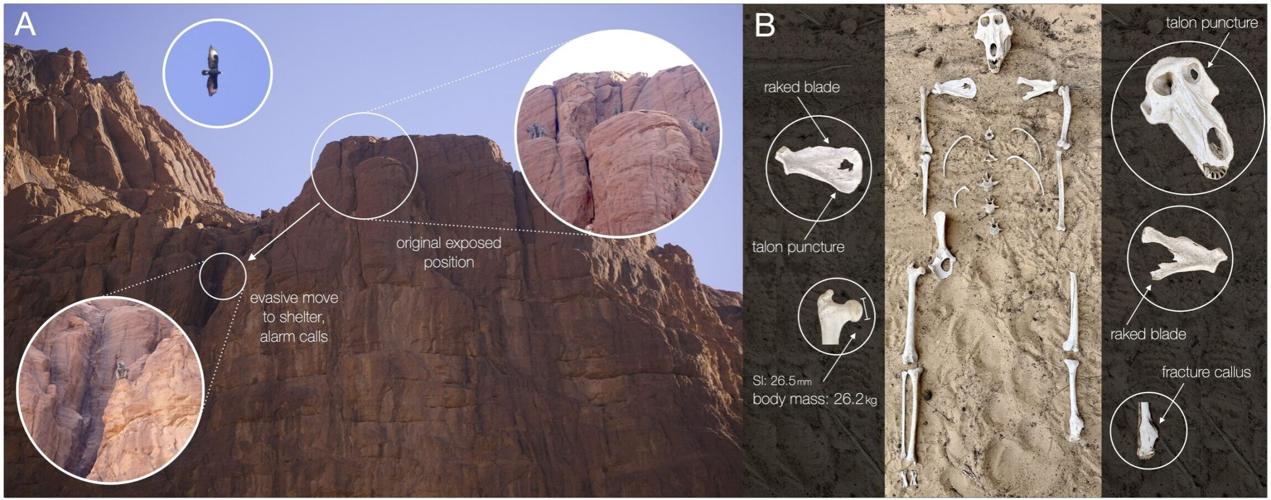
But the team discovered skulls and bones of adult male baboons with the “signature” marks of eagle predation.
The telltale signs included talon punctures to the skull and characteristic scrapes and “rakes” to the shoulder bones, according to a study published in the American Journal of Biological Anthropology.
The research team was able to calculate the baboons’ weight, with one individual coming in at over 26 kilograms (57.3 pounds), well within the range of hominin species.
While human ancestors were vulnerable to many predators such as big cats and crocodiles, the research team says primate defense strategies against land predators are quite different to those from aerial predators.
Study lead author Catherine Hobaiter explained that primates respond to eagle attackers by “mobbing,” particularly the larger adult males who will charge the attacker to try to drive them off.

ONLINE EMBARGO 09.00 GMT, 18/11/26 Figure from the paper describes an eagle baboon encounter and shows the bone markings associated with eagle predation. // Giant eagles may have preyed on early humans, suggests a new study.Researchers found that raptors have been feeding on human-sized baboons in central Africa for centuries.The discovery could change the understanding of how early humans developed defences against potentially deadly attacks by other species, say scientists.Researchers from the University of St Andrews in Scotland were among an international team who discovered that early human-sized baboons are being preyed on by eagles.
She said knowing that our ancestors may have been vulnerable to eagles, changes how we think about the evolution of key behaviors — from communication to group cooperation.
Modern primates that live in areas with eagle predators often move in large mixed groups with other primate species.






For most of evolutionary history our early ancestors lived alongside other hominin species as well as other primates.
Hobaiter, from the University of St. Andrews’ School of Psychology and Neuroscience, says that are often thought of as being in competition, but there may have been cooperative advantages to sticking together.
She said: “This was such an extraordinary expedition, any primatologists dream!
“Some of the baboons there are so remote they rarely, if ever, see people, and so after a couple of days they ended up following us around.
“We were probably the most interesting thing they’d seen for a while.”
Hobaiter added: “We saw the eagles while we were searching for the baboons, but we never imagined that they might be a threat to them.
“Then we found the first skull with a puncture mark, and then another, and another.”
Study senior author Nathaniel Dominy, from Dartmouth College in New Hampshire, said: “At first, the idea of eagles hunting adult male baboons seemed to exist on the thin edge of possibility, until it didn’t.
“Our skepticism slowly gave way to acceptance. The evidence was convincing.”
Hobaiter said: “One of the most exciting observations was seeing the baboons respond when a pair of Verreaux’s eagles swept overhead — primates are very specific about only responding to eagles that are a genuine threat.

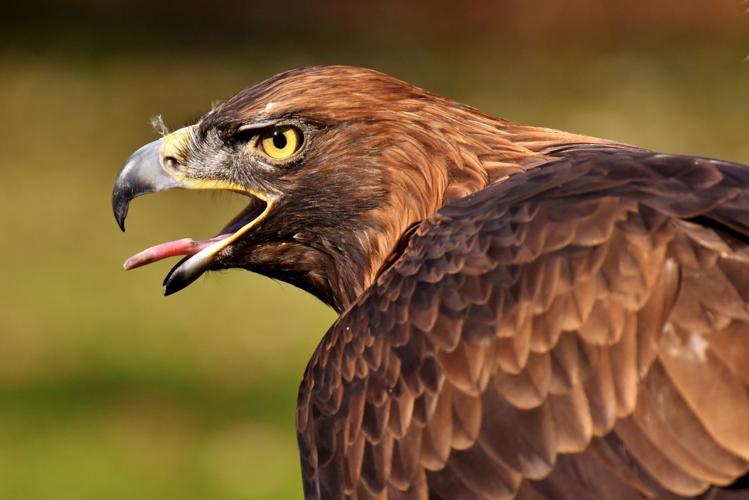
(Photo by Alexas Fotos via Pexels)
“We’d seen them very relaxed around other big birds of prey, but as soon as the Verreaux came into view they alarm called and dropped down to safety.”
Gisela Kopp, from the Max Planck Institute of Animal Behavior, Germany, said: “Primatology often focuses on regions with a high diversity of primates, but shifting our attention to a place where no primatological data has ever been collected before, proved to be extremely rewarding.”
Jean Didier Akpona, of African Parks, said: “Having worked in this region for about three years, I had the opportunity to visit these gueltas — pockets of water that form within rock formations — and often observed Verreaux’s eagles.
“I had never imagined that these predators would target primates of this size until the research team stumbled upon evidence.
“This discovery leads us to explore further the mystery that surrounds the gueltas of the Sahara Desert.”
The researchers are keen to learn more about the lives of the Ennedi baboons.
Hobaiter added: “Baboons are some of the best studied monkeys in Africa, but our very first observations from Ennedi upended all sorts of notions about what these baboons should be doing.
“From their diet to their social lives, I can’t wait to see what new ‘rules’ they’ll break next.”
(0) comments
Welcome to the discussion.
Log In
Keep it Clean. Please avoid obscene, vulgar, lewd, racist or sexually-oriented language.
PLEASE TURN OFF YOUR CAPS LOCK.
Don't Threaten. Threats of harming another person will not be tolerated.
Be Truthful. Don't knowingly lie about anyone or anything.
Be Nice. No racism, sexism or any sort of -ism that is degrading to another person.
Be Proactive. Use the 'Report' link on each comment to let us know of abusive posts.
Share with Us. We'd love to hear eyewitness accounts, the history behind an article.