“Snackpacking” puts a name to a travel habit food-focused travelers have practiced for years: building part of a trip around a destination’s everyday food culture. About 89% of millennials and Gen Z say leaving room for local snacks is an important part of any trip, making neighborhood bakeries, market stalls and supermarket aisles as important to many itineraries as restaurants. For many travelers, the real food story starts at a snack counter, not a tasting menu.
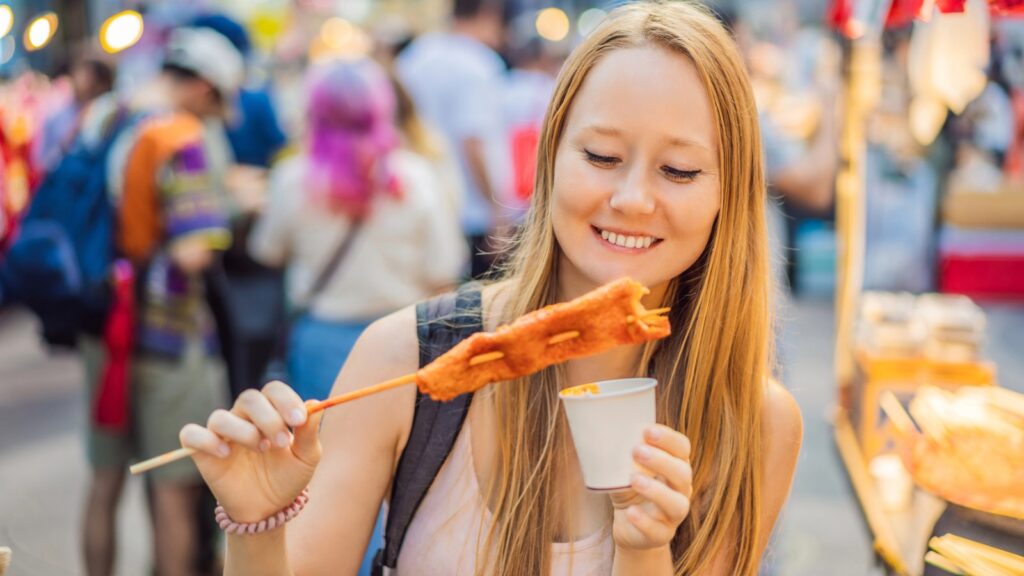
Street food stalls and carts draw 69% of global travelers looking for local snacks, while bakeries attract 53% and grocery stores 50%. TikTok accelerated the trend, with viral convenience-store hauls, Korean snack unboxing content and supermarket-crawl videos that made a longtime traveler habit into a mainstream trip-planning strategy. More than 75% of millennials and Gen Z now say they are likely to seek out a food item that has gone viral while traveling.
Among repeat visitors, the behavior carries a particular cachet. Tracking down a specific regional snack in a non-tourist neighborhood has become its own marker of travel knowledge and local familiarity.
Hanoi: The night market as the itinerary
About 66% of travelers say trying items they cannot find at home is a key reason they seek out local food, and Hanoi’s Old Quarter concentrates that experience into a few walkable blocks. Every Friday through Sunday evening, streets from Hang Dao Street to Dong Xuan Market are closed to traffic and open to food stalls serving grilled pork skewers, bánh mì, sticky rice, chè, roasted chestnuts and coconut ice cream.
There is no seating, no menu and no signage with fixed prices. You eat while walking, standing or queuing. It is street food at its most concentrated and one of the clearest expressions of what snackpacking actually looks like.
Seoul: The convenience store as a destination
Korean convenience store chains and large-format grocers like Emart specifically draw snack-motivated travelers. K-pop brand collaborations, limited-edition seasonal flavors and rotating menus give them a reason to return on every trip.
The interest is large enough that foreign visitor spending at GS25 surged 74.2% year over year in 2025. In Mangwon-dong, a low-tourist neighborhood anchored by Mangwon Market, the draw shifts from branded collaborations to the ordinary: the local snack aisle, the neighborhood rice cake vendor and the drink no one imports.
Barcelona: 2 ways to snackpack
Barcelona offers the same trend at two price points. La Boqueria is dotted with more than 300 stalls of fresh produce, jamón, seafood and tapas-sized snacks along Las Ramblas. A few blocks away, Mercadona, the chain where most Spaniards do their everyday shopping, draws food-curious travelers who build meals from Iberian cured meats, local cheeses and Hacendado-brand staples for 3 to 7 euros. The Mercadona aisle is the grocery store category made tangible.





Berlin: No single anchor required
Berlin does not need one snackpacking destination because it has the whole circuit. Markthalle Neun in Kreuzberg runs Street Food Thursday every week from 5 p.m. to 10 p.m., with independent vendors operating out of a market hall built in 1891. On Sundays, Mauerpark runs 20 to 30 street food stalls alongside its flea market in Prenzlauer Berg. Turkish döner, Vietnamese bánh mì, German currywurst and Thai street food from Preußenpark vendors make up an informal food circuit that no single restaurant district could replicate.
Cairo: Go deeper than the main lanes
At Cairo’s Khan El-Khalili, a 14th-century bazaar in Islamic Cairo, the snackpacking experience lives in the margins. The central lanes cater largely to tourists, while the real circuit follows the roaming vendors selling ta’ameya, Egyptian fava-bean falafel, alongside basbousa, konafa, sugarcane juice, hibiscus tea, roasted peanuts and termes, the lupin beans sold in paper cones throughout the market.
El Fishawy, a cafe that has been operating since the late 18th century, anchors the surrounding side streets. Its mint tea and backgammon tables have remained largely unchanged across generations.
Los Angeles: No passport needed
The San Gabriel Valley combines grocery stores, markets and food vendors into a food landscape built for grazing, with San Gabriel Superstore, Shun Fat Supermarket and the seasonal 626 Night Market all within a few miles of one another. Across town, the Original Los Angeles Farmers Market near The Grove has attracted snack-motivated travelers since 1934. More than 500 workers speaking 23 languages serve stalls ranging from Singaporean noodles to Brazilian grilled meats. Together, these areas offer the full snackpacking toolkit: street food, grocery stores and open markets within a single city’s sprawl.
Food discovery goes off script
Food tourism is becoming less top-down and more exploratory. Travelers still care about acclaimed restaurants, but they are also building trips around smaller discoveries that happen between major attractions. Markets, local bakeries and neighborhood food counters fit naturally into that approach because they reward curiosity instead of reservations. Snackpacking turns that curiosity into part of the itinerary. The meal may be the goal, but the wandering is where the value lies.
Mandy is a luxury travel, fine dining and bucket-list-adventure journalist with expert insight from 46 countries. She uncovers unforgettable experiences around the world and brings them to life through immersive storytelling that blends indulgence, culture and discovery, and shares them with a global audience as co-founder of Food Drink Life. Her articles appear on MSN and through the Associated Press wire in major U.S. outlets, including NBC, the Daily News, Boston Herald, the Chicago Sun-Times and many more.
The post The biggest food travel trend isn’t fine dining — it’s the snack aisle appeared first on Food Drink Life.

(0) comments
Welcome to the discussion.
Log In
Keep it Clean. Please avoid obscene, vulgar, lewd, racist or sexually-oriented language.
PLEASE TURN OFF YOUR CAPS LOCK.
Don't Threaten. Threats of harming another person will not be tolerated.
Be Truthful. Don't knowingly lie about anyone or anything.
Be Nice. No racism, sexism or any sort of -ism that is degrading to another person.
Be Proactive. Use the 'Report' link on each comment to let us know of abusive posts.
Share with Us. We'd love to hear eyewitness accounts, the history behind an article.