
(Wahyu Trilaksono/MZB via SWNS)
By Stephen Beech
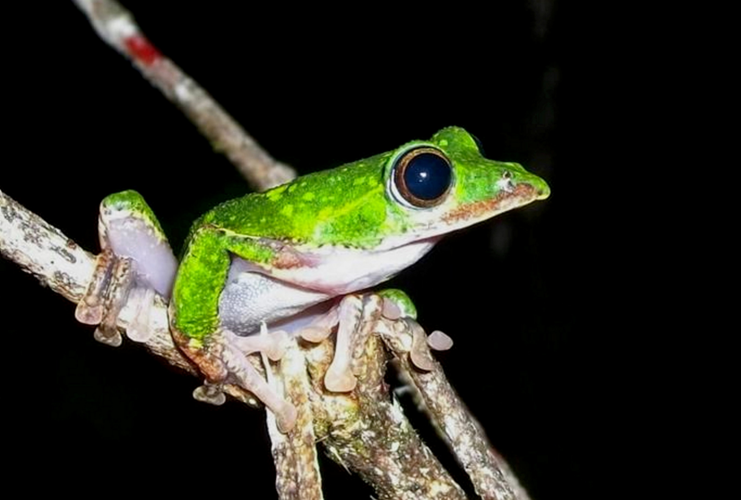
A tiny new species of Asian flying frog has been found living in a remote part of Indonesia.
The bright green amphibian can fit on a person's cheek and has distinctive calls and unusual egg-laying habits.
The species was identified during an expedition in the unsurveyed Mekongga Mountains of Sulawesi.
The team — including researchers from Indonesia's Museum Zoologicum Bogoriense and the University of California, Davis — hiked along rivers and climbed through dense rainforest to survey the mountains' biodiversity, from near sea level to its highest peak.
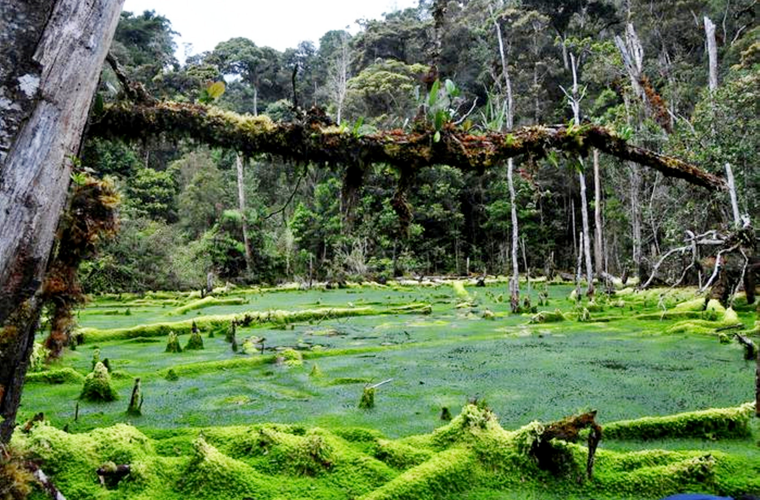
At more than 6,100 feet above sea level, the team found thousands of the frogs near a small seasonal mountain lake known as Danau Coca-Cola.

(Wahyu Trilaksono/MZB via SWNS)
The discovery is described in the journal Zootaxa.
Lead author Wahyu Trilaksono, a herpetologist with Museum Zoologicum Bogoriense, collected the frogs and immediately suspected they were something never before detected.
Co-author Alan Hitch, a research affiliate with the UC Davis Museum of Wildlife and Fish Biology, led the field team as a postdoctoral researcher.
He described seeing the frogs and hearing their chorus of calls for the first time as a "super special" moment.
Hitch said: "We were moving up the mountain, and we came across this big pond covered in these green frogs; they were all over.
"You don't really see frogs in big congregations like that.
"This was something super special."
Researchers knew the frogs were a type of Rhacophorus: amphibians known as flying frogs because their large, webbed feet help them glide between trees.

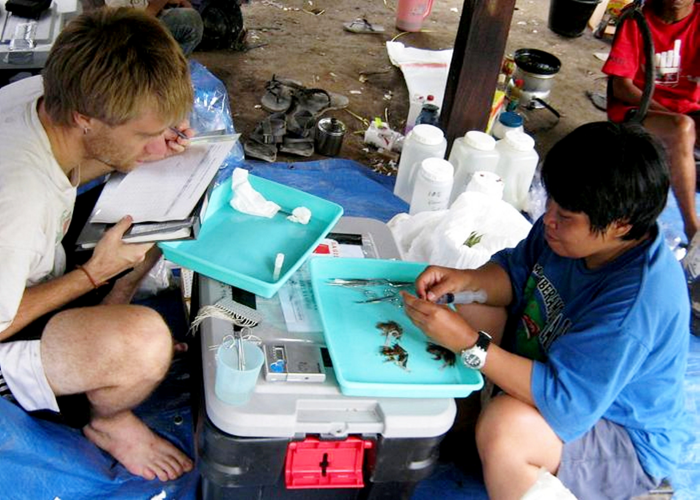
(Wahyu Trilaksono/MZB via SWNS)
To determine whether the frog represented a new species, the team compared their physical features, DNA and behavior to other known Rhacophorus.




The researchers measured 28 physical characteristics and analyzed genetic information and audio recordings.
The comparisons revealed several differences, including pointed snouts, distinctive calls and, most importantly, a new egg-laying behavior.
Study co-author Alamsyah Elang Nusa Herlambang, a researcher with Museum Zoologicum Bogoriense, said: "This Rhacophorus has a different reproductive strategy from all other Asian flying frogs.
"It's the first time we have seen Rhacophorus with gelatinous matrix for its reproduction strategy. It's unique."
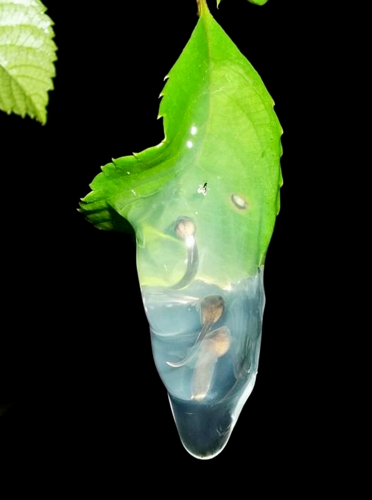
The team described how the frogs lay their eggs in a "jelly-like" mass on vegetation that hangs above or near water.
The eggs and tadpoles develop inside the gel, which is different from related species' foam nests, which create frothy, protective coverings around their eggs to keep them moist as larvae develop.
Andrew Engilis Jr., curator of the UC Davis Museum of Wildlife and Fish Biology, said: "The team looked at hundreds and hundreds of specimens of frogs to describe the new species.
"Sometimes species can look the same, but their behavior is different and their genetics are different — these are called cryptic species.

(UC Davis MWFB Archives via SWNS)
"This frog is an example of that. It looks very similar to other Rhacophorus, but its genetics and behavior show that it's very distinctive."
The Indonesian scientists named the new frog Rhacophorus kurniatiae to honor the late herpetologist Hellen Kurniati, who was a long-serving staff member at the Museum Zoologicum Bogoriense.
Hitch said: "She had a heart of gold, and I think that's part of what drove her to do such great work."
New species are still being discovered on Sulawesi and its surrounding islands, where a large percentage of wildlife is endemic — found nowhere else on Earth.
Engilis said it is the second new frog species the team has identified during the expedition, along with a newly described gecko and two new species of fish.
He added: "When you're a conservation biologist, your ultimate goal is conserving biodiversity.
"As a result of all the work we did in defining the Mekongga's unique diversity, including these new species, this region of Sulawesi is now under consideration to become a national park.
"Continuing our species discovery will hopefully help accelerate that process."
(0) comments
Welcome to the discussion.
Log In
Keep it Clean. Please avoid obscene, vulgar, lewd, racist or sexually-oriented language.
PLEASE TURN OFF YOUR CAPS LOCK.
Don't Threaten. Threats of harming another person will not be tolerated.
Be Truthful. Don't knowingly lie about anyone or anything.
Be Nice. No racism, sexism or any sort of -ism that is degrading to another person.
Be Proactive. Use the 'Report' link on each comment to let us know of abusive posts.
Share with Us. We'd love to hear eyewitness accounts, the history behind an article.