


(Photo by Karam Alani via Pexels)
By Stephen Beech
Teeth from people buried in a cemetery over 250 years ago have identified climate shocks as a driver of disease during the Industrial Revolution.
Analysis of tooth defects along with a burial register provided scientists with a fuller picture of factors contributing to childhood vitamin D deficiency and related diseases in late 18th century England.
When the country’s farm-based economy transformed into an industrial one between around 1760 and 1840, pollution, harsh working conditions, inadequate housing, and limited access to sunlight drove disease.
Rickets, when the growing skeleton fails to properly mineralize, was commonplace among children.
Urbanization, latitude, and socioeconomic status have been traditionally considered the main drivers.
But scientists say climate is a factor that has largely been overlooked.
The new study reassessed teeth from a long-disused Quaker cemetery at Coach Lane in North Shields, Tyne and Wear, to investigate whether climatic fluctuation contributed to childhood vitamin D deficiencies during the Industrial Revolution.

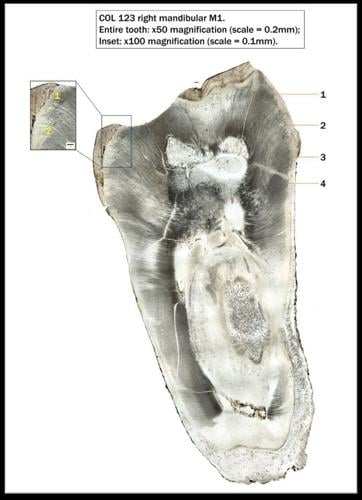
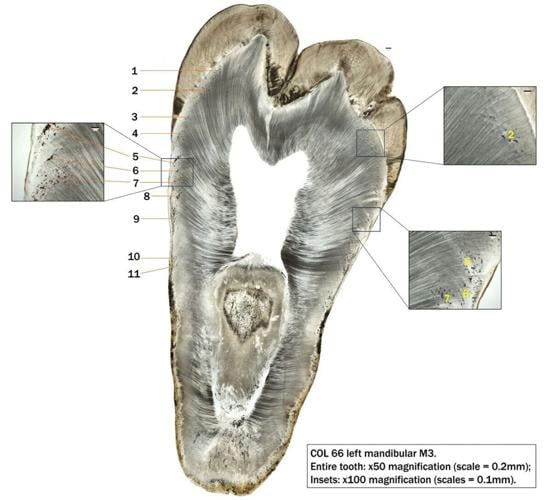
The image shows multiple scattered bands of dark scalloped defects down the length of the tooth, which indicate voids where tissue formed poorly due to vitamin D deficiency. (Kendall et al., 2026.via SWNS)
Study first author Ellen Kendall said: “Most people buried at Coach Lane lived during periods affected by environmental differences in UV light availability, which may explain the high rates of rickets and defects in tooth dentin, and suggest a major problem with vitamin D deficiency.
“Realizing that burial registers would allow us to reconsider the climatic chronology of this population felt like a new approach to understanding historical childhood vitamin D deficiency.”
She says that the Little Ice Age — an extended cooling period between the 13th and 19th centuries caused by heightened volcanic and low solar activity — limited UV exposure.
But how climatic fluctuation may have impacted human health during that period hadn’t been previously examined in detail.
Kendall, an archaeological researcher at Durham University, said: “Human bioarchaeologists’ primary area of expertise is understanding health from the human skeleton.
“To do that, we have to consider a wide range of issues: political, environmental, dietary, social, and more.
“The complex range of interacting factors may have put climate off the radar of many human bioarchaeologists.”

(Photo by T6 Adventures via Pexels)
She said the Coach Lane cemetery was actively used between 1711 and 1829 — around when North Shields transformed from a fishing village into an industrial port.






The cemetery was excavated in 2010, recovering 236 burials.
Using 30 teeth from 21 unidentified individuals, the research team examined mineralization failures — when dentin, the inner layer of the tooth, fails to fully turn into hard, calcified tissue.
Kedall said the mineralization failures can be a normal part of tooth growth, but may suggest vitamin D deficiency if they appear at regular intervals and are separated by normal dentin.
Because teeth form and grow on a set natural schedule, the research team could determine at what ages dentin failed to mineralize within the community: mostly during infancy and childhood.
Because that didn’t tell the researchers about the calendar years when mineralization failures happened, they used Coach Lane’s burial register.
It chronicles ages and years of death for many of the 197 individuals listed, and birth years could be estimated for 109 community members by subtracting age at death from year of death.

Multiple scattered bands of dark scalloped defects down the length of the tooth are visible. They indicat voids where tissue formed poorly due to vitamin D deficiency. (Kendall et al., 2026.via SWNS)
Because the dates could not be matched to individuals — the graves weren’t marked — the research team looked at the community as a whole.
The data revealed that out of the 109 people with known birth years, 91 were born within 10 years after a major volcanic eruption.
The findings, published in the journal Frontiers in Environmental Archaeology, showed that 41 were born during periods when low solar output and volcanic activity co-occurred.
Kendall said: “The Quakers were known to keep precise records, which makes them an important source of information about themselves, but also about the northeast of England, where they were very prominent in local history.
“That they carefully recorded names, years of death, and ages at death provided us a window into what was going on with the environment when most of the people buried at Coach Lane were growing up and forming teeth.”
She says adding climate to the mix of factors — both natural and human-made — that affected people’s health is important to gain a complete picture.
Kedall said: “Humans are incredibly complicated.
“We’re physical creatures defined by our biology. We’re cultural creatures defined by beliefs and the systems they reinforce. And we’re products of our environment.
“No part overrides another; they all interact.
“When we assess one aspect of human biology – vitamin D deficiency during the Industrial period – it’s going to be in the context of needing to grapple with the full dynamics of the human experience.”
She added: “We think of climate instability as a modern challenge, but it’s really nothing new as human problems go.
“Whether it’s pandemics, economic crises, or climate change, it’s important to understand the ways that people have adapted to similar issues in the past and use that information to help people thrive in the future.”
(0) comments
Welcome to the discussion.
Log In
Keep it Clean. Please avoid obscene, vulgar, lewd, racist or sexually-oriented language.
PLEASE TURN OFF YOUR CAPS LOCK.
Don't Threaten. Threats of harming another person will not be tolerated.
Be Truthful. Don't knowingly lie about anyone or anything.
Be Nice. No racism, sexism or any sort of -ism that is degrading to another person.
Be Proactive. Use the 'Report' link on each comment to let us know of abusive posts.
Share with Us. We'd love to hear eyewitness accounts, the history behind an article.