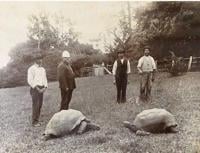



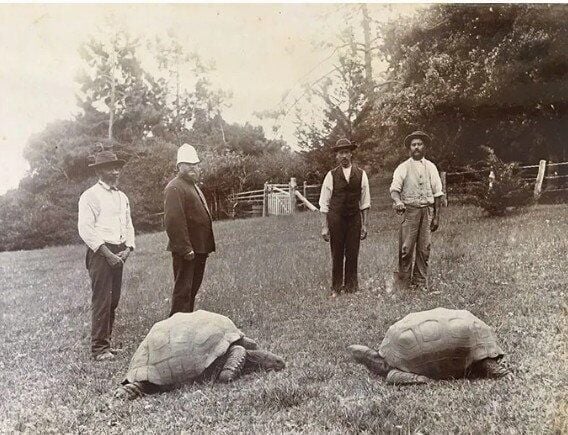
Jonathan arrived in St. Helena as a gift to Sir William Grey-Wilson in 1882, who later became governor of the island. This image was taken around that time - Jonathan is on the left. (A.L. Innes via SWNS)
By Stephen Beech
A giant tortoise called Jonathan could hold the key to living to 200 years of age, say scientists.
Researchers have been conducting genetic tests on Jonathan who, at an estimated 194 years old, is believed to be the world's oldest living land animal.
They say their findings suggest that it's not just down to good genes, but a lack of genetic wear and tear that have kept him going for nearly two centuries.
The study pinpointed 287 unique gene variants that reduce the usual effects of aging in Jonathan, who was born five years before Queen Victoria succeeded to the throne.
The researchers explained that those variants control "key" processes in the body including repair of DNA damage, reducing inflammation, regulating insulin and suppressing cancer.
Jonathan, an Aldabra giant tortoise, is believed to have hatched in 1832 — making him a contemporary of Charles Darwin and Charles Dickens as well as Queen Victoria.
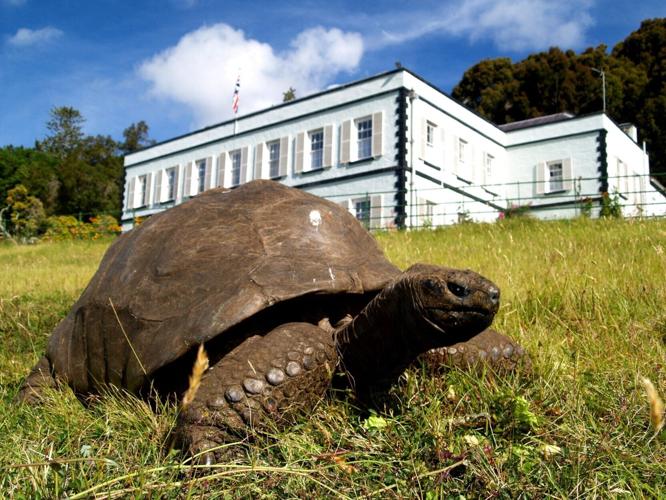
He has lived most of his life on the island of St. Helena, a British overseas territory in the South Atlantic Ocean, in the grounds of Plantation House — the governor's residence.

Jonathan, an Aldabra giant tortoise (Aldabrachelys gigantea), is estimated to be 194 years old. This makes him the oldest living giant tortoise, and oldest land animal, in the world today. (Joe Holland via SWNS)
He arrived on St. Helena, already fully grown, from the Seychelles 144 years ago as a gift to the governor.
The giant tortoises of the Galapagos and Seychelles islands are the last survivors of animals that used to dominate the ecology of many of the world's islands.
Researchers also compared Jonathan's epigenome — the "on/off" switches on his genes — with those of younger giant tortoises of the same species.
They found the switches controlling Jonathan's DNA repair and metabolism genes were remarkably "very similar" to those in his younger relatives.






Usually, the epigenome changes over time, contributing to the aging process — a key reason why things start to go wrong in older bodies.

Jonathan has lived most of his life on the island of St Helena, a British Overseas Territory in the South Atlantic Ocean, in grounds of Plantation House - the residence of the governor of St Helena. He arrived from the Seychelles 144 years ago, already fully grown, as a gift to the governor. (Joe Holland via SWNS)
The study, published in the journal Science Advances, marks the first time the epigenome of a giant tortoise has been investigated.
It was led by scientists at longevity research nonprofit organization Kallel, who say that cracking the genetic code of a multicentury life offers "unprecedented" insights into extreme lifespan.
Cambridge University scientist Justin Gerlach, who was involved in the study, said: "We found that the gene regulators involved in energy production and DNA repair have remained incredibly stable in Jonathan over almost two centuries.
"There are few creatures that could tell us more about aging than the giant tortoises of the Galapagos and Seychelles islands."

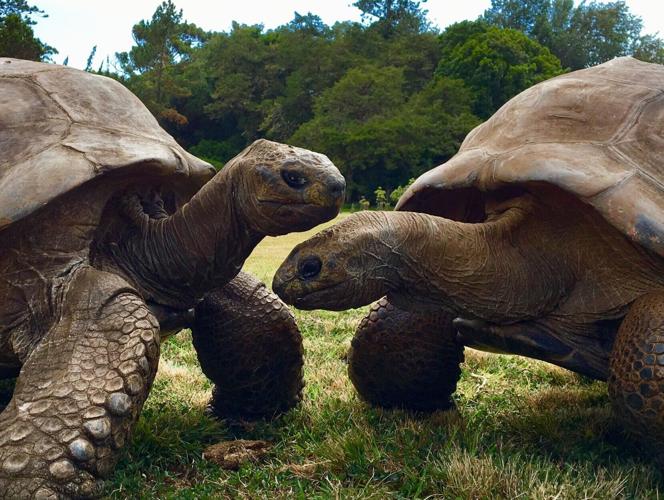
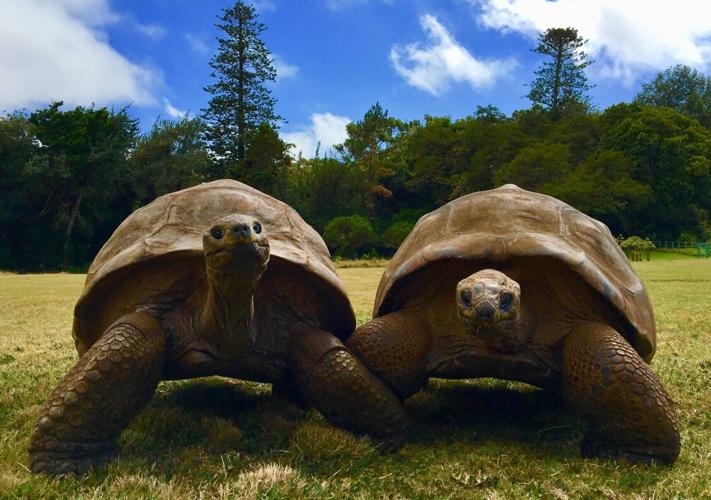
Researchers say it's good genes and lack of genetic wear and tear that have kept Jonathan living for nearly two centuries. (Joe Holland via SWNS)
Gerlach has studied the ecology and conservation of giant tortoises for several decades, but the new paper is the first time he has analyzed their exceptionally long lives.
He added: "Working with a really old giant tortoise is such a privilege: you get a sense of the tortoise being your collaborator, not your study subject."
Study senior author Dr. Stephen Clark, founder of Kallel, said: "Nature has already solved the puzzle of aging in remarkable ways, and Jonathan's genome provides a blueprint for cellular resilience."
He added: "Our goal is to take these evolutionary insights and immediately translate them into practical, affordable treatments for everyday people.
"Aging is the greatest risk factor for nearly every chronic disease we face, and through the generosity of philanthropic partners, we can democratize access to longevity medicine."
(0) comments
Welcome to the discussion.
Log In
Keep it Clean. Please avoid obscene, vulgar, lewd, racist or sexually-oriented language.
PLEASE TURN OFF YOUR CAPS LOCK.
Don't Threaten. Threats of harming another person will not be tolerated.
Be Truthful. Don't knowingly lie about anyone or anything.
Be Nice. No racism, sexism or any sort of -ism that is degrading to another person.
Be Proactive. Use the 'Report' link on each comment to let us know of abusive posts.
Share with Us. We'd love to hear eyewitness accounts, the history behind an article.