


(Photo by Christian Velitchkov via Unsplash)
Over eight in 10 Americans don’t fully trust what AI tells them — and they opt to still explore original sources by themselves, according to new research.
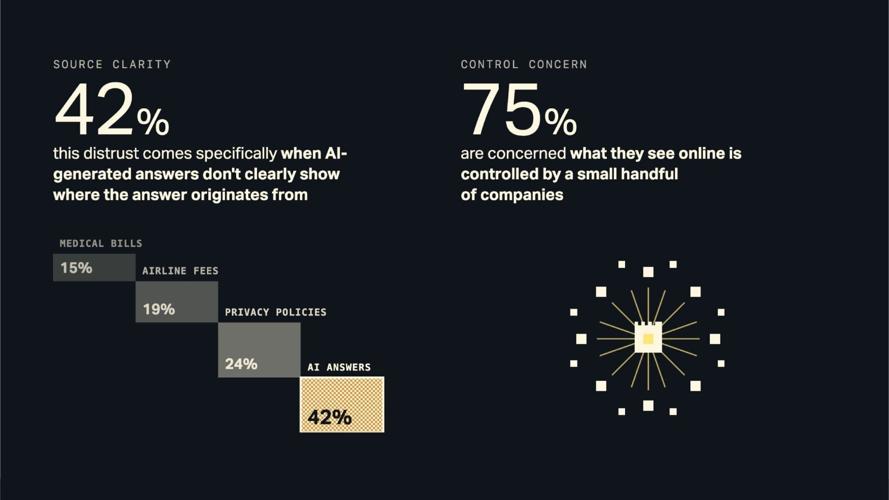
The poll of 1,200 U.S. adults revealed 86% are distrustful of AI results, and for 42%, this comes specifically when AI-generated answers don't clearly show where the answer originates from.
People said they distrust AI-generated search results without clear attribution (42%) more than medical bills (18%), confusing legal print (17%) and airline fees (10%).
Adding to their concerns, 75% are also concerned that what they see online is being controlled by a small handful of companies. Four out of five (81%) think it's important that the information they get online remains openly available — not kept behind a paywall or owned by big organizations.
Commissioned by WordPress VIP and conducted by Talker Research, 75% of Americans said they find humans much more helpful than AI (15%) when interacting with or consulting for help on a business's website.
And if they ever suspect who they're talking to isn't real, 56% are confident in determining if their chat is AI or a human.
When asked which business uses AI best in its brand messaging, 61% said they were not sure or could not think of one, and another 16% said they do not believe any business uses AI well at all. Only about one in four could name a company at all.
Compared to the internet a decade ago, three in four believe the internet today feels less human.

(Talker Research)
The average person believes 55% of all internet interactions they have is AI. Similarly, they believe 54% of all interactions they have on a business's website are also AI.





Nearly all of those polled (92%) said they've come across AI or bots when using social media, and 63% said it happens frequently. It takes them just 40 minutes before they start to feel fatigued by the amount of bot-made content they see.
“Brands cannot afford to treat visibility and trust as separate things anymore,” said Steph Yiu, CEO of WordPress VIP. “If people cannot understand where information came from or connect it back to a brand they trust, being visible is not enough. Companies need digital experiences that give them more control over how they appear online and help them keep a direct relationship with their audience. More than ever, the website is where a brand provides context and earns trust.”
The study also polled 800 U.S. marketing executives and digital experience experts to find how they perceive the same issues about AI, their messaging and marketing efforts, and the open web.
Three in four (74%) said ensuring their organization's website content is discoverable and clearly attributed when surfaced by AI search and answer engines is a main or significant priority. And nine in 10 (91%) believe it's important their content takes on a more human tone.
Nearly four in 10 (39%) of marketing executives and digital experience experts are "kept up at night" by misinformation from AI-generated responses.
And if it's not openly available and structured for the public, 69% believe their website will be completely invisible to AI search and answer engines.
“People used to build websites for other people,” said Brian Alvey, CTO of WordPress VIP. “Now you have to build websites for AI agents acting on behalf of those people. If your site’s content isn't legible to AI, you are invisible to a growing share of how people search. You don’t exist. And if your content doesn't feel human and trustworthy for the tiny percentage of people who actually click past the AI answer engines, they won't come back a second time. Most CMSes were built for one of those jobs. The next decade belongs to the ones that do both.”
Research methodology:
Talker Research surveyed 800 DMs/CMOs for CMS and Digital Experience Platforms and 1,200 general population Americans who have access to the internet; the survey was commissioned by WordPress and administered and conducted online by Talker Research between Apr. 15 and Apr. 20, 2026. A link to the questionnaire can be found here.
To view the complete methodology as part of AAPOR’s Transparency Initiative, please visit the Talker Research Process and Methodology page.

(0) comments
Welcome to the discussion.
Log In
Keep it Clean. Please avoid obscene, vulgar, lewd, racist or sexually-oriented language.
PLEASE TURN OFF YOUR CAPS LOCK.
Don't Threaten. Threats of harming another person will not be tolerated.
Be Truthful. Don't knowingly lie about anyone or anything.
Be Nice. No racism, sexism or any sort of -ism that is degrading to another person.
Be Proactive. Use the 'Report' link on each comment to let us know of abusive posts.
Share with Us. We'd love to hear eyewitness accounts, the history behind an article.