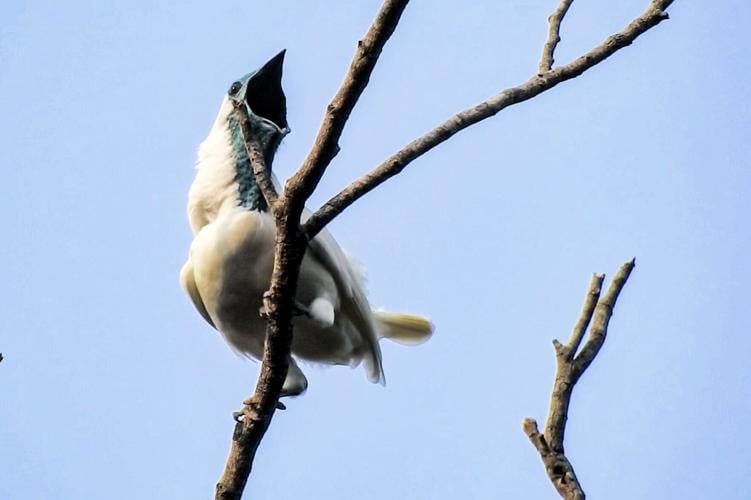

Bare throated bellbird. (João Menezes via SWNS)
By Stephen Beech
Two new contenders for the world's loudest bird have been identified in a study of more than 120 species.
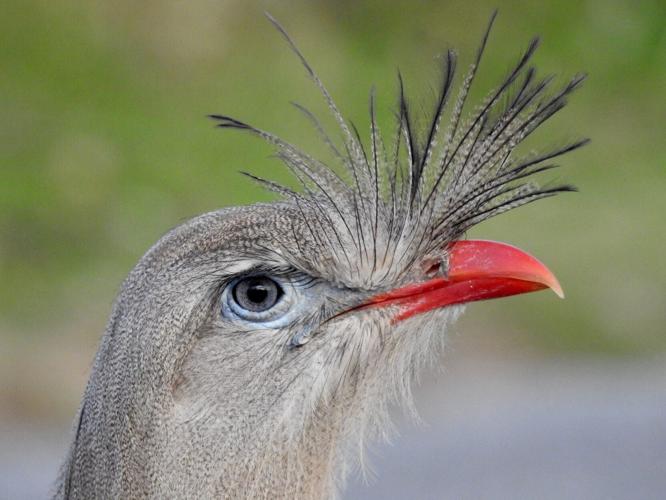
The bare-throated bellbird and the red-legged seriema both make a racket above 120 peak decibels — louder than chainsaws and jackhammers, according to American biologists.
Their "unprecedented" study of 123 species' volume also provides new clues as to why some birds can be so much louder than others.
The research, published in the journal Evolution, was led by University of Massachusetts Amherst professor Jeff Podos and his former graduate student João Menezes.
Previously, in 2019, Podos discovered that the Amazon's white bellbird had the world's loudest bird call at 125.4 decibels — louder than standing next to a revving chainsaw — a claim ratified by Guinness World Records.
But setting world records is only the byproduct of the researchers' work.

Red Legged Seriema. (João Menezes via SWNS)
The new study is the latest in their career-long quest to understand the role evolutionary biology plays in how birds communicate with one other.
The researchers wanted to know if there are physical characteristics of a bird's body that can predict how loud its call will be, and how, or if, loudness is related to a bird's ecological niche and specific social organization.
Doctoral candidate Menezes said: "Figuring out how loud a bird call is should be pretty easy in the lab.
"But until very recently, it has been very challenging to do in the field, and there's very little data to draw on."
He explained that it is because volume, or amplitude, is dependent on distance. For example, a scream that is ear-splitting up close might barely register a few hundred yards away.
One method to gauge the amplitude of a bird is to capture it, take it to the lab and run controlled experiments there.
But the researchers say that is just not practical, especially when working internationally and comparing large numbers of birds.
Podos, who accompanied Menezes in measuring the amplitudes of 123 birds in the areas around Amherst and across Brazil, said: "You have to get your boots on the ground."






Previously, it wasn't practical for ornithologists to reliably measure amplitude and distance at the same time.

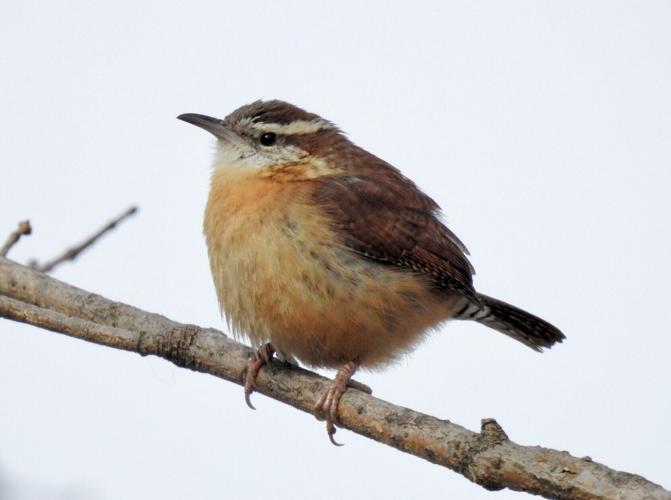
Carolina Wren. (João Menezes via SWNS)
But Podos says that changed when golfers invented accurate laser rangefinders and those monitoring workplace safety built high resolution, portable sound meters.
He and Menezes have been early adopters of the new tools, and, once properly equipped, were able to gather reliable amplitude data on 123 birds species, 113 of which had never before had their volume cataloged.
Podos said: "We've been able to vastly increase the number of species for which there is amplitude data.
"This is basic, foundational research that no one else has managed to do on this scale, and it points to all sorts of other questions that would be fun to follow up."
The duo discovered an "enormous" 58-decibel variability in the volume of bird calls, from the hummingbird's 64 decibels — around the volume of a normal conversation — to bare-throated bellbirds and red-legged seriema, both of which rose above 120 peak decibels.
They also found that, as expected, the loudest birds are typically bigger, with bulky muscles that may allow greater air compression for explosive volume, and have wider beak openings.
But the data didn't support any clear, broad predictions about why amplitude might serve an ecological and evolutionary purpose.
The researchers had hypothesized that the loudest birds would be weaker flyers with volume making up for limited mobility, live in dense forests and practice polygamy — as a mating call travels, attracting more mates.

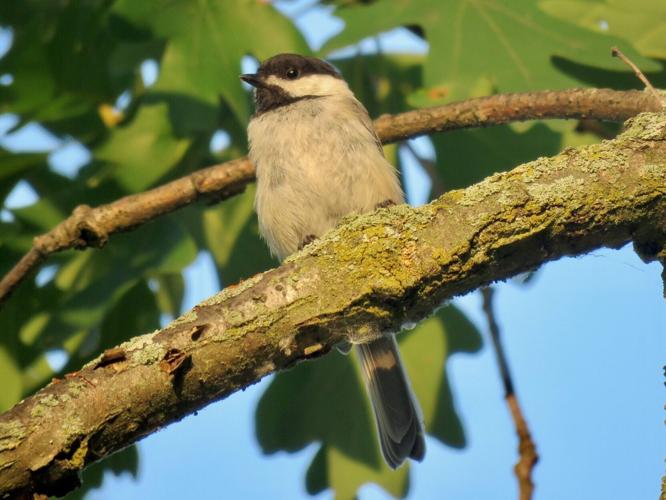
Black capped chickadee. (João Menezes via SWNS)
Menezes said: "We now know some of the hows.
"Bigger bodies and wider beaks, but we've yet to discover the whys, and we probably need much more data from many more species to be able to tease out what's going on the ecological and evolutionary front."
Podos added: "The world has some beautiful things to see.
"You can't do this kind of work in the lab, or by scraping data from the internet.
"You have to get out into the world, you have to pay careful attention to what you're seeing and hearing, and anything you do in the field that forces you to observe more carefully is really fun.
"It takes you back to the roots of why we do science in the first place."
(0) comments
Welcome to the discussion.
Log In
Keep it Clean. Please avoid obscene, vulgar, lewd, racist or sexually-oriented language.
PLEASE TURN OFF YOUR CAPS LOCK.
Don't Threaten. Threats of harming another person will not be tolerated.
Be Truthful. Don't knowingly lie about anyone or anything.
Be Nice. No racism, sexism or any sort of -ism that is degrading to another person.
Be Proactive. Use the 'Report' link on each comment to let us know of abusive posts.
Share with Us. We'd love to hear eyewitness accounts, the history behind an article.