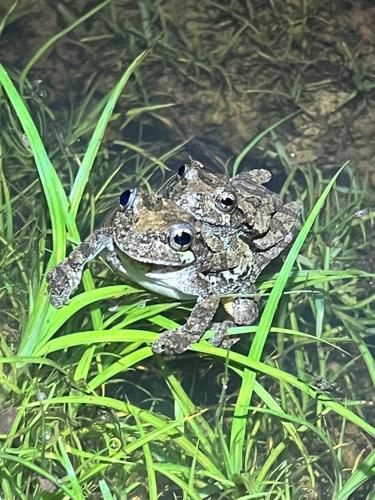

(Jessie Tanner via SWNS)
By Stephen Beech
Female tree frogs have trouble picking mates when they're spoiled for choice, reveals new research.
They struggle to pick the most desirable partners when male suitors abound - much like an indecisive single person on a dating app, say scientists.
Their findings show that when female Cope's gray treefrogs gather around ponds during mating season to listen to large groups of males chirping in noisy "choruses," they struggle to pick the most desirable mate.
The phenomenon, described in the journal iScience, has been dubbed "choice overload" by the American research team.
And they say it may impact the way species evolve over time.
Study first author Claire Hemingway, of the University of Tennessee, Knoxville, said: "There are many animals that are confronted with a lot of different options simultaneously and have to compare them."
She says Cope's gray treefrogs live across wide swaths of the United States, ranging from Virginia, west to Texas, and north into Canada.
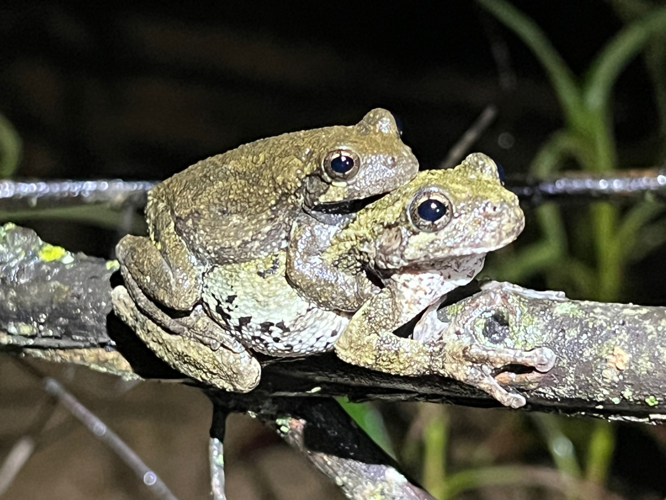
They can grow to about two inches long and have bumpy gray or green skin that resembles tree bark.

(Jessie Tanner via SWNS)
During mating season, males serenade females by puffing up their throats and emitting a series of high-pitched vibrations.
Study lead author Jessie Tanner, also of the University of Tennessee, said: "You may encounter them coming up to your window at night to eat the insects that fly toward the light."
To study how female treefrogs choose the best mates, the research team built a dating arena fit for amphibians: a two-meter-wide enclosure in a soundproof, temperature-controlled room.
The team placed female frogs one by one in the middle of that enclosure.
The serenade then began: a series of speakers spread around the enclosure played recordings of real male frogs calling.
Females could choose which call they preferred by hopping toward a speaker.





Because previous research has shown that female treefrogs tend to prefer males with longer calls, the researchers mostly played those longer "target" calls, as well as one or more "distractor" calls that were much shorter.
The research team observed that more male calls led to more confusion for the females.
When females had just two options to choose from - for example, one target and one distractor - they hopped toward the longer target call 77% of the time.
When females had to listen to eight different males' calls, they selected the target call just 25% of the time.

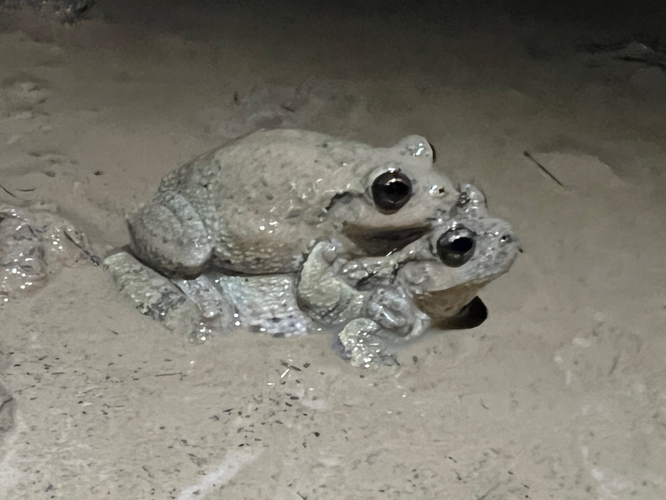
Gray treefrogs engage in a mating behavior called amplexus in which a smaller male frog attaches himself to the back of a larger female frog as she searches for a site to lay her eggs.
In some cases, the females got so overwhelmed that they didn't make any choice at all.
The research team doesn't believe that the females were simply having trouble hearing individual males, similar to what happens when people try to have a conversation in a crowded restaurant.
To test the idea, they ran an identical experiment but added in background noise - the sound of numerous male calls overlapping - which played from an overhead speaker.
The noisy environment had little effect on how females chose mates, suggesting that they were instead struggling with the number of options available.
The researchers say "choice overload" could shape the genetics of animal species in profound ways.
For example, evolutionary theory suggests that if females have strong preferences for males with long calls, males with short chirps should disappear from populations over time.
But that hasn't happened yet.
The researchers say the new study offers a possible explanation as choice overload could be keeping the males with short calls in the gene pool by causing enough confusion that the females choose a mate who is, in theory, less optimal.
Tanner added: "The decisions that females make are really biologically important.
"By choosing a male with a good-sounding call, the females can get genetic benefits for their offspring.
"But maybe they're not able to exercise that choice effectively all the time."

(0) comments
Welcome to the discussion.
Log In
Keep it Clean. Please avoid obscene, vulgar, lewd, racist or sexually-oriented language.
PLEASE TURN OFF YOUR CAPS LOCK.
Don't Threaten. Threats of harming another person will not be tolerated.
Be Truthful. Don't knowingly lie about anyone or anything.
Be Nice. No racism, sexism or any sort of -ism that is degrading to another person.
Be Proactive. Use the 'Report' link on each comment to let us know of abusive posts.
Share with Us. We'd love to hear eyewitness accounts, the history behind an article.