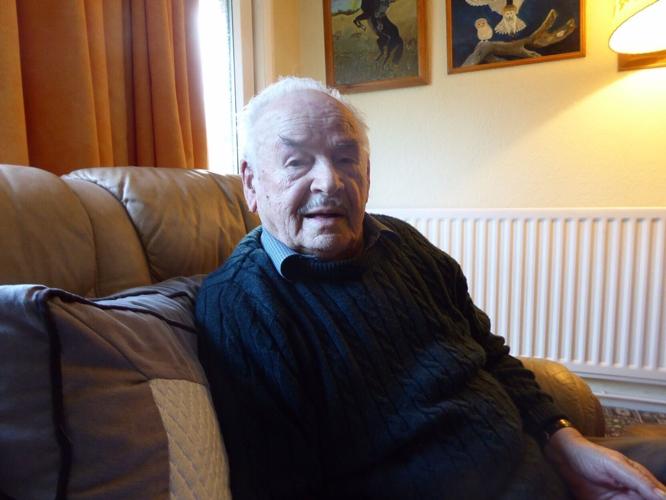

A man kidnapped by the Germans in World War Two has revealed he was ordered to dig Hitler's bunker. (Graham Drucker via SWNS)
By Filipa Gaspar
A man kidnapped by the Germans in World War II has revealed he was ordered to dig - Hitler's bunker.
Ches Black, 100, was taken to Berlin due to a shortage of manual labor there - but had no idea he would be working for the dictator.
He says the Germans took him on a lorry in 1944 to support Organization Todt - which was part of the Nazi war effort for construction work using forced workers.
Hundreds of slaves, German soldiers and others including Black were sent off to dig a deep hole into the ground by the Berlin Reich Chancery.
He said he never understood what they were building and who it was intended for.
It was only when the war came to an end that Black realized the hours of sweat and hard labour were put into building Hitler's bunker.
Black, who now lives in Chiltern Hills, Oxfordshire., said: "I didn’t know what it was for - only afterwards.
"We had no idea what it was for and no interest what it was for. We were just made to work there.

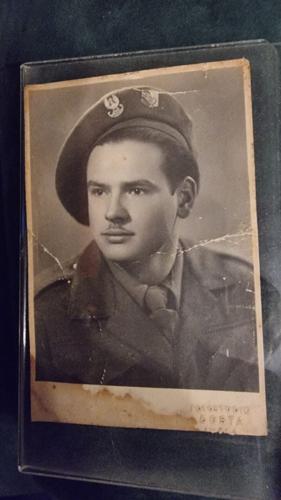
Ches Black when in uniform. (Graham Drucker via SWNS)
"We were just digging a hole and didn't know we were protecting Hitler.
"It was quite a deep dug hole into the ground, as a person in the hole you looked up and up.
"There were lots of people, maybe hundreds, slaves, all kinds of German soldiers all working there.
"It was sandy and we just had a wheelbarrow and shovels and worked only by hand.
"Only after the war we found out.
"I later found out that Hitler didn’t go there into the finished bunker till January 1945 and by then I had escaped in Italy and was a free Polish soldier fighting against the Germans."
He added: "I am amazed I was digging for Hitler.
"But we were given orders by the Germans, we were forced labor.
"We didn’t want to know. So we never understood it was intended for Hitler himself.
"I was just forced to dig a hole for the Germans in Berlin.
"Organisation Todt kept the secret completely from us."
Black, who changed his name after moving to England, was born Czeslaw Blachucki on December 10, 1925, in a small village called Gnezdzysk in Poland.
When he was about 10 his parents moved to Vilnius, then Polish and now part of Lithuania, which was occupied by the Germans in 1941.

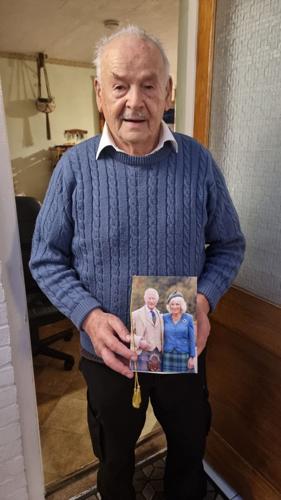
Ches holding a photograph of King Charles III and Queen Camilla. (Graham Drucker via SWNS)
After Christmas in 1944 the Nazis started rounding up young men and women in Vilnius to transport them to Germany for work.
When the Nazis arrived at his family home, Black, then aged just 19, hid in nearby woods to evade capture.
He said: "I remember two Lithuanians came to force me to go to Germany - they were in the military under the Nazi SS.
"They were capturing young men and women to send to Germany due to a shortage of manual labour.
"I was hiding in the forest and they didn’t find me so they took my mother hostage and my father came to tell me 'if you come to give yourself up then they will let your mother out’ I knew I had to go.
"So the Nazis forced me into a big hall in Vilnius."
Black was then loaded into a cattle wagon with about 40 other people and transported to Berlin.
He said the doors of the wagons were left open before departure to let those inside say their goodbyes.






It would be the last time he ever saw his mother - who later died in 1947.
He said: "The Germans shut us in the cattle wagons, just like animals, and sent us to Germany.
"We made a hole in the truck and the older men said anyone who wants to get out can risk their life to jump out of the train but we didn’t like Germans any better than the Russians.
"Best thing was to not think what was going to happen to us."
Black was then deployed to Italy where he worked transporting timber to the front line.
To avoid being bombed by the Allies, Black had to complete his journeys through the mountains at night.

Ches Black, 100, was captured and taken to Berlin due to a shortage of manual labor there. (Graham Drucker via SWNS)
One day, Black and the men he was stationed with identified themselves as Poles to the local villagers, who told them a Polish division had taken Monte Cassino.
On hearing the news Black left the Germans and headed to the Mountains alone.
He managed to join a group of resistance fighters and lived with them for a short while.
Black spent the last part of the war with the Polish 5th division as part of the British Forces where he served in the 15th battalion, first company.
When the war came to an end in 1945, the Yalta Agreement left Poland under Soviet influence, preventing Black from going back to his country.
He spent a period in Italy, where he undertook engineering training, before being relocated to Glasgow and later settling in Highmoor.
At that time, a number of Polish families were housed in an American-built camp in Checkendon, and Black would often cycle there to visit.
He met his wife, June, in 1947 at a dance held in Stoke Row village hall.
He said: "The local villages always had bands, dances every Saturday and that’s where I first met my wife, June King she was 17 and we married in 1947.
"Soon after lots of Polish refugee families moved to the Checkendon camp coming from Africa and India.
"In England, nobody here could make sense of my name so then I changed my name to Ches Black.
"Our first two children initially went to school at the Checkendon Polish camp which had a shop, church, restaurant and library."
Black has worked numerous jobs throughout his life, including as a gardener and for 29 years in a car factory in Cowley in Oxford.

(Photo by Eric Smart via Pexels)
He has four children, seven grandchildren and nine great grandchildren with another one due in May 2026.
Black concluded: "I was married to June for 72 years until she started to become ill, when I had to learn to cook and try to write for the first time in English when she died.
"I now write love stories to keep people together and happy, romance really.
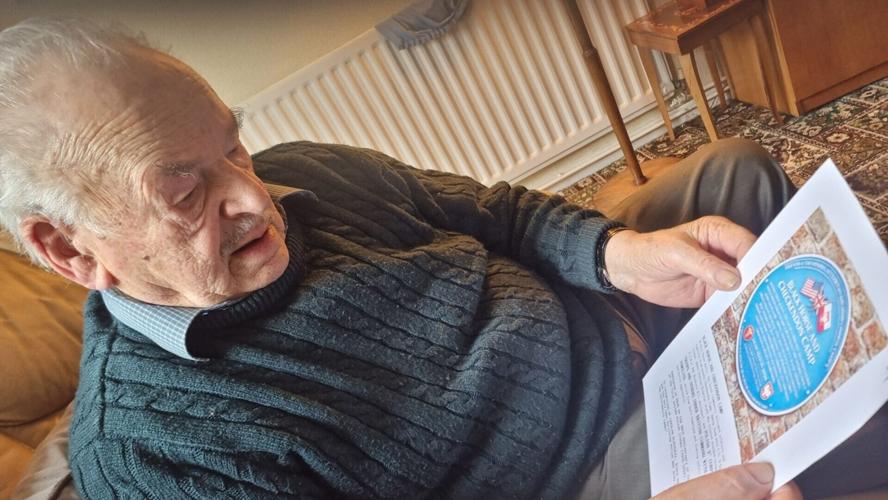
"Recently I became part of the Friends of Checkendon, Nettlebed and Kingwood camps, trying to keep alive the memory and heritage of the Polish soldiers and polish refugees at these camps and I hope to commemorate the first Polish soldiers who arrived here 80 years ago this year."
The Führerbunker was an air raid shelter located near the Reich Chancellery in Berlin, Germany.
It was part of a subterranean bunker complex constructed in two phases in 1936 and 1944.
The bunker was the last of the Führer Headquarters (Führerhauptquartiere) used by Adolf Hitler during World War II.
Hitler took up residence in the Führerbunker on January 16, 1945, and it became the centre of the Nazi regime until the last week of World War II in Europe.
Hitler married Eva Braun there on April 29, 1945, less than 40 hours before they committed suicide.
Ches is telling his story with the help of friend and history enthusiast Graham Drucker, Director of Commonwealth Family History Research.
Graham is a biographer, archivist, heritage conservationist with 40 years experience working with family heritage, genealogy & ancestral DNA research, and military history.



(0) comments
Welcome to the discussion.
Log In
Keep it Clean. Please avoid obscene, vulgar, lewd, racist or sexually-oriented language.
PLEASE TURN OFF YOUR CAPS LOCK.
Don't Threaten. Threats of harming another person will not be tolerated.
Be Truthful. Don't knowingly lie about anyone or anything.
Be Nice. No racism, sexism or any sort of -ism that is degrading to another person.
Be Proactive. Use the 'Report' link on each comment to let us know of abusive posts.
Share with Us. We'd love to hear eyewitness accounts, the history behind an article.