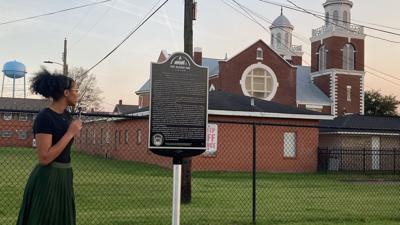

A patch of concrete where nearly 600 voting rights marchers assembled before the 1965 Selma-to-Montgomery march was formally recognized Monday with the unveiling of a historical plaque at George Washington Carver Homes.
The ceremony, held on the site’s old basketball court, drew local officials, Civil Rights foot soldiers, residents and a busload of visitors traveling with the Common Power Institute. The dedication fulfilled a four-decade effort by the late Jo Ann Bland to preserve and mark what she called “this concrete” – the last remaining ground where marchers lined up before crossing the Edmund Pettus Bridge on what became known as Bloody Sunday.
Bland, a Selma native and former child marcher who died Feb. 19, had pressed for years to see the site formally acknowledged. According to organizers, she approached the Institute for Common Power seeking help to erect a marker recognizing the court’s role as the staging area for Bloody Sunday, Turnaround Tuesday and the ultimately successful march to Montgomery to gain equal voting rights.
“She told us, whether or not she’d be here, please do it,” Celestria Hill of Common Power said during opening remarks.
Former Selma Mayor James Perkins Jr. recalled playing basketball on the same court as a child and witnessing the aftermath of Bloody Sunday at Brown Chapel AME Church when he was 12. “The smell of tear gas, the faces, the trauma – you can’t erase it,” Perkins said. He credited Bland for persistently advocating for the marker and thanked the city and the Selma Housing Authority for supporting the effort.
Mayor Johnny Moss called the dedication a “full circle moment,” noting he was baptized, married and raised at Brown Chapel. He honored Bland as “a true foot soldier whose life embodied resilience, faith, and unwavering commitment to justice.”





Foot Soldier Charles Mauldin, who was 17 during the marches, reflected on the days following the fatal shooting of Jimmie Lee Jackson in Marion and the decision to march to Montgomery. “We were determined to win our freedom,” he said.
City Council President and CEO of Selma Housing Authority Kennard Randolph highlighted ongoing redevelopment at GWC Homes through a federal grant and stressed the importance of protecting the historic ground. “I’m excited about our past, but I’m even more excited about our future,” he said. “Come back to Selma – you will see Selma rise.”
Hill led the crowd in one of Bland’s signature traditions: picking up a rock from the ground. Bland often told visitors that the rocks beneath their feet once held the weight of John Lewis, Hosea Williams, Charles Mauldin and countless unnamed foot soldiers.
“This rock represents justice,” Hill said, holding the same stone she picked up on her first visit. “Whatever you do with it, know you’re carrying their legacy.”
The plaque, placed at the faint outline of the former basketball hoop where Bland wanted it, recounts the chain of events from Jackson’s killing to the violence on the Edmund Pettus Bridge and the eventual passage of the Voting Rights Act of 1965.
As the cloth dropped and the marker was revealed, attendees – locals and visitors from across the country – stood together on the same concrete where history once gathered, marched and helped change the nation.

(0) comments
Welcome to the discussion.
Log In
Keep it Clean. Please avoid obscene, vulgar, lewd, racist or sexually-oriented language.
PLEASE TURN OFF YOUR CAPS LOCK.
Don't Threaten. Threats of harming another person will not be tolerated.
Be Truthful. Don't knowingly lie about anyone or anything.
Be Nice. No racism, sexism or any sort of -ism that is degrading to another person.
Be Proactive. Use the 'Report' link on each comment to let us know of abusive posts.
Share with Us. We'd love to hear eyewitness accounts, the history behind an article.