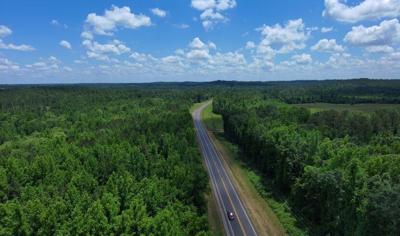

State policymakers should invest in improving rural roads as well as interstate highways, according to a report from the Education Policy Center at The University of Alabama.
The state has invested millions of dollars in rural highway projects, most notably the West Alabama Corridor project. But “senior state leaders have actively contested the prioritization of highway projects, often reflecting an urban–rural split in infrastructure preferences,” the report says.
Lt. Gov. Will Ainsworth and House Pro-Tem Chris Pringle, R-Mobile, have criticized the use of state funds for the West Alabama Corridor. Ainsworth has said the funds would be better used to widen Interstate 65, a major north-south interstate that carries traffic through Birmingham, Montgomery and Mobile.
“Persistent debates over whether to prioritize high-traffic interstates or rural corridors illustrate that infrastructure allocation remains a policy choice about whose mobility matters most,” the report says. “In the Black Belt, where poverty rates are higher and local tax bases are smaller, underinvestment compounds existing socioeconomic disparities.”
The report urges state policymakers to “adopt a funding framework that accounts for rural conditions, fiscal capacity and reliance on cross-county commuting rather than relying primarily on traffic volume” when deciding which highway projects to fund.
“For decades, underinvestment in highways, bridges and utility systems (in the Black Belt) has constrained economic mobility and reinforced geographic isolation, making infrastructure not simply a matter of convenience, but of equity and access,” the report states.
The report cites research showing that one in three Black Belt residents must travel outside their county for work, while nearly one-fifth face commutes of more than 45 minutes.


![States Most Impacted by Food Recalls in Recent Years [2026 Edition]](https://bloximages.chicago2.vip.townnews.com/blackbeltnewsnetwork.com/content/tncms/assets/v3/editorial/1/44/144510e3-4e76-5a91-8904-d3bb5f8cadcd/69cad323763ce.image.jpg?crop=889%2C667%2C55%2C0)



“Highways in the region function as essential economic infrastructure rather than optional conveniences,” the report states. “When routes are narrow, indirect or underfunded, the costs are born directly by households through longer travel times, higher transportation expenses and reduced job access.”
ALDOT said in a statement responding to the UA report that the agency has invested in projects like the West Alabama Highway while making improvements on interstate routes, including Interstate 65.
“These investments reflect a balanced strategy: strengthening rural mobility while maintaining our high-capacity corridors,” ALDOT Chief of Communication Tony W. Harris said. “Alabama’s transportation system works best when it connects every community – large and small – to opportunity.”
The report also suggests that policymakers should expand grant-based funding rather than loans to support rural communities “with limited tax bases and borrowing capacity.”
State and federal agencies should also give more technical support to help Black Belt governments write grants and comply with federal laws, according to the report.
Water and wastewater systems in the Black Belt also need “sustained and focused intervention” from state and local government because of the region’s distinctive non-permeable soil, low population density and limited local revenue.


(0) comments
Welcome to the discussion.
Log In
Keep it Clean. Please avoid obscene, vulgar, lewd, racist or sexually-oriented language.
PLEASE TURN OFF YOUR CAPS LOCK.
Don't Threaten. Threats of harming another person will not be tolerated.
Be Truthful. Don't knowingly lie about anyone or anything.
Be Nice. No racism, sexism or any sort of -ism that is degrading to another person.
Be Proactive. Use the 'Report' link on each comment to let us know of abusive posts.
Share with Us. We'd love to hear eyewitness accounts, the history behind an article.