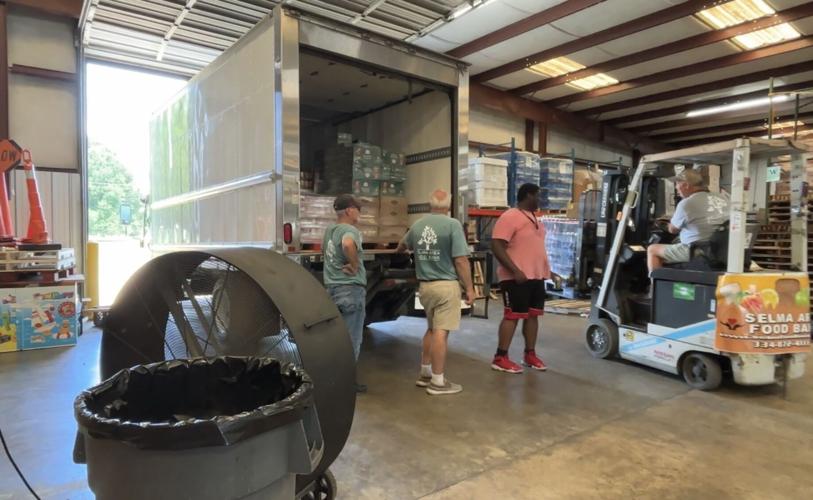

Selma Area Food Bank leaders are on a Summer Advocacy Tour across the Black Belt to highlight growing food insecurity needs and asking for additional help.
Since Memorial Day, Selma Area Food Bank Executive Director Ryan Johnson has visited local governments in Marengo, Dallas and Perry and plans to meet with Wilcox in August. After the counties, he will visit cities including Selma, Demopolis and Linden to update local leaders on the growing need.
“The whole aim is just to continue to tell the story of what the impact is and just how the numbers, the need continues to go up,” he said.
Johnson said the organization is moving more food, serving more people and relying on a growing network of volunteers and partner agencies as food insecurity continues to rise across the Black Belt.
Despite the rising demand, Johnson said the food bank’s capacity remains strong.
“Our donors are sticking with us. Our volunteer commitment from the community and groups is just absolutely off the charts,” he said, adding that volunteers from six states have already come to Selma this year. “We almost have reached the point where we feel like we ought to say no. But at the same time, we’re like, come on, we’ll find something for you.”
With more than 50 partner agencies, the food bank often connects volunteers to churches and nonprofits closer to home. “It really feeds into that neighbors helping neighbors concept,” he said. “The most effective people serving one another are the neighbors of their very own communities because they’re the ones that see each other. They know the stories.”
Food insecurity, Johnson said, is not easing. “Food insecurity rates are not subsiding,” he said. “The reality is, the more you dig into the needs of the community, the more needs you find.” He said food banks often uncover related needs such as clothing, education or transportation.
The food bank finished last year distributing about 1.6 to 1.7 million pounds of food. This year, Johnson said the organization is on pace to reach 2 million pounds, which would be the largest non-COVID year in its history. As of June 30, the food bank had already moved more than 1 million pounds.
Dallas County alone has seen a dramatic increase. Johnson said the food bank averaged 476,000 pounds a year in Dallas County from 2020 through 2024. “As of June 30 of this year, we’ve done 480,000 pounds,” he said. “The need is going through the roof.”
To meet that demand, the food bank expanded its food sourcing strategy, working with the Heart of Alabama Food Bank for additional pickups, increasing retail rescue routes and benefiting from new grant funding. The Mormon church also provided an extra truckload of food through its America 250 campaign.
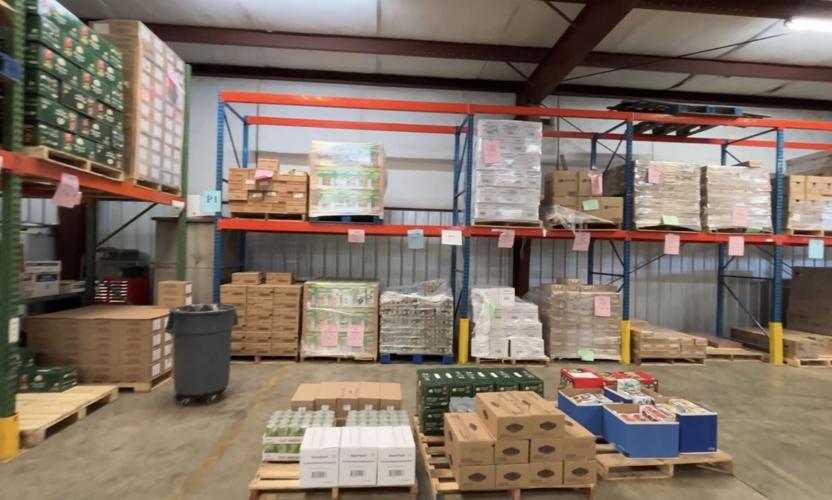
Partner agencies have also increased their capacity. Johnson said small churches that once distributed 4,000 pounds are now handling 6,000. Storage is limited, but the mobile pantry program allows agencies to receive food, sort it and distribute it within hours. “Most everything that comes in is here for less than a week,” he said. Produce moves even faster. “If we get produce on Monday, it’s out the door on Tuesday.”






The food bank will conduct about 170 mobile pantry events this year. Johnson described visiting Orrville Baptist Church last week. “They received a trailer load of food around 8.30 a.m. I stopped by at 11.30 a.m. and they only had a couple hundred pounds left out of about 6,000. They had given it away that fast.”
He said agencies must be careful about advertising giveaways because demand can overwhelm them. Many rely on word of mouth. “There’s so much interest in mobile pantries or giveaways that agencies have to be very strategic where they advertise,” he said.
Marengo County is another focus area. The food bank set a goal of 400,000 pounds there this year and reached 217,000 by midyear. Johnson said the county’s size and population mean more agencies are needed in communities such as Sweet Water, Putnam and Myrtlewood. “We’re still looking for agencies to partner with us,” he said.
Johnson said the food bank’s work is strengthened by community engagement, especially after last fall’s federal SNAP funding issues and the government shutdown. “It really helped renew the spotlight of advocacy,” he said. “Thankfully, a lot of those people just picked up the phone and called.”
At SAFB, 45% of the food supply comes from government programs such as the senior commodity program. The remaining 55% comes from retail rescue partnerships with Walmart, Kroger, Publix, Target, Aldi and others.
Traditional food pantries rely heavily on government food purchased through the food bank at 19 cents per pound. Johnson said the Demopolis Food Pantry receives 9,000-11,000 pounds every other week for its weekly distribution.
He emphasized that individuals seeking food should contact the food bank for information rather than showing up at the warehouse. “The best thing an individual who needs food can get from us is information on where food is the closest to them,” he said. “If somebody were to show up at our front door, we’re going to try to get to the bottom of the need as quickly as possible, but we’re looking to connect them to short term and long-term help.”
Johnson said the food bank’s mission is rooted in dignity and compassion. “Our simple goal is to treat people with dignity, kindness and respect,” he said. “We’re not food detectives. Our place is to help.”
With Hunger Action Month approaching in September, the food bank will introduce a mobile pantry sponsorship program allowing churches, businesses and families to sponsor a pantry for $250. “We’re looking for ways to stretch our budget so that we can get more food out the door,” Johnson said.
He encouraged donations, noting that financial contributions go further than food drives. “For every dollar somebody donates, we can purchase roughly four and a half pounds of food,” he said. Donations can be mailed to 101 Avenue C in Selma or made online at SelmaFoodBank.com.
“Our goal is to connect,” Johnson said. “We want to be willing to listen. We want to be willing to help. And we want to get as much food in the front door and out the back door as quickly as possible.”

(0) comments
Welcome to the discussion.
Log In
Keep it Clean. Please avoid obscene, vulgar, lewd, racist or sexually-oriented language.
PLEASE TURN OFF YOUR CAPS LOCK.
Don't Threaten. Threats of harming another person will not be tolerated.
Be Truthful. Don't knowingly lie about anyone or anything.
Be Nice. No racism, sexism or any sort of -ism that is degrading to another person.
Be Proactive. Use the 'Report' link on each comment to let us know of abusive posts.
Share with Us. We'd love to hear eyewitness accounts, the history behind an article.