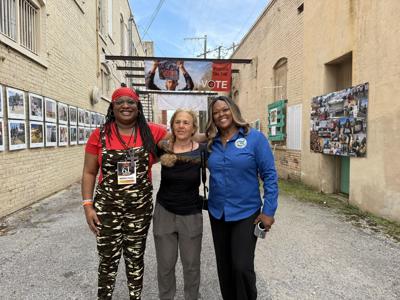
Voting and democracy took center stage in a photo exhibit at Selma Social on March 6 during the annual Selma Bridge Crossing Jubilee.
Amid fairy lights along the alley on Lauderdale Street next to Selma Social, large photos documented the fight to vote in action across two dozen states, including in Selma.
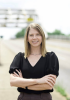
The photographs were the work of independent photographer Sue Dorfman, who took the images from 2018 through 2025 to document people working to protect, advance and participate in democracy through voting.
The exhibit was hosted by Selma Social owner Tasha Dangerfield, who said the work resonated deeply with Selma’s history and the ongoing national conversation about voting rights.
Dangerfield said she first encountered Dorfman’s work at Photographic Nights at Arts Revive in Selma and was immediately struck by the images.
“When she showed me these photographs, I was floored,” Dangerfield said. “To be able to see what democracy is, what voting is, and what people have to do – how long they wait in line, bringing their children, older people on crutches and in wheelchairs – it shows the commitment people have to making their voices heard.”
Dorfman said her interest in voting rights and democracy dates back decades.
In 1986, she first traveled to the Mississippi Black Belt from Boston to help monitor elections and encourage voter turnout during a campaign involving then Alabama state Sen. Hank Sanders. Although the Voting Rights Act of 1965 had been passed two decades earlier, Dorfman said voting remained contentious in the region.
Her visit came shortly after she had spent time documenting life in apartheid-era South Africa, where she witnessed struggles over voting rights.
“A lot of the conditions that were here in this part of the South very much mimicked what I was seeing in apartheid South Africa,” Dorfman said. “Much of that struggle was about the right to vote and the right to participate in democracy.”
She later worked on a documentary called Dying to Vote and collaborated with organizations involved in election protection and voter education.
Dorfman said her recent photography project began in 2018 when she returned to Mississippi to observe how voting conditions had changed since the 1990s. That effort expanded into a larger effort to document an entire election cycle beginning with the 2020 Iowa caucuses.




“What could possibly happen in 2020 that would be any different than any other election cycle?” Dorfman recalled thinking. The year soon brought the malfunctioning caucus reporting app in Iowa and the onset of the COVID-19 pandemic, which dramatically changed the voting process across the country.
Since then, Dorfman has continued photographing election events, polling places and voter education efforts across the nation.
One section of the Selma exhibit focused on voter education inside jails and prisons. Dorfman documented work by Dr. Brenda Williams, who helped register incarcerated people to vote and guided them through the absentee ballot process in a South Carolina jail.
Many of the individuals Williams worked with had never voted before, Dorfman said.
Dangerfield said that photograph series was particularly powerful.
“(Williams) goes in and meets them where they are and lets them know they have rights, because many of them don’t know they still have the right to vote,” Dangerfield said.
The exhibit also included a photograph of Selma civil rights leader Jo Ann Bland, which was added shortly before the show. Bland, who died in February just before the Jubilee, played a key role in the 1965 voting rights movement in Selma.
Dangerfield said hosting the exhibit aligns with her vision for Selma Social as a community gathering space.
“My intention is for people to come here and gather, create and inspire,” she said. “If you come in that building, I want you to be moved by something that happens there and then go out and continue to plant seeds.”
In addition to running Selma Social, Dangerfield works for the city of Selma as a community engagement coordinator and is involved in community gardening and other local initiatives.
She said bringing the photography exhibit to Selma during Jubilee helped connect the city’s historic role in the fight for voting rights with ongoing efforts across the country to protect democracy.
“This work shows how people are still fighting for the vote,” Dangerfield said. “You plant a seed and it grows. You never know what’s going to come from it.”

(0) comments
Welcome to the discussion.
Log In
Keep it Clean. Please avoid obscene, vulgar, lewd, racist or sexually-oriented language.
PLEASE TURN OFF YOUR CAPS LOCK.
Don't Threaten. Threats of harming another person will not be tolerated.
Be Truthful. Don't knowingly lie about anyone or anything.
Be Nice. No racism, sexism or any sort of -ism that is degrading to another person.
Be Proactive. Use the 'Report' link on each comment to let us know of abusive posts.
Share with Us. We'd love to hear eyewitness accounts, the history behind an article.