
This is the third of a three-part series on Alabama school districts under state intervention. Part 1 on Bessemer City Schools is here. Part 2 on Dallas County Schools is here.
On a recent June day, Sumter County Schools students went to the front office to get permission slips signed on one of the last days of summer school.
While parents work, the kids are able to get a head start in their new grade through the summer bridge program. As Sumter County Schools Superintendent Marcy Burroughs was walking down the hall, a student called after her asking for summer learning to be extended.
“I’m bored inside the house,” he said.
Burroughs teased the student.
“So you want to do year-round school?” She asked him. He shook his head, seemingly wishing he never said a word.
Burroughs continued on, explaining the upgrades made to the school, like a new camera system and new HVACs throughout the school.
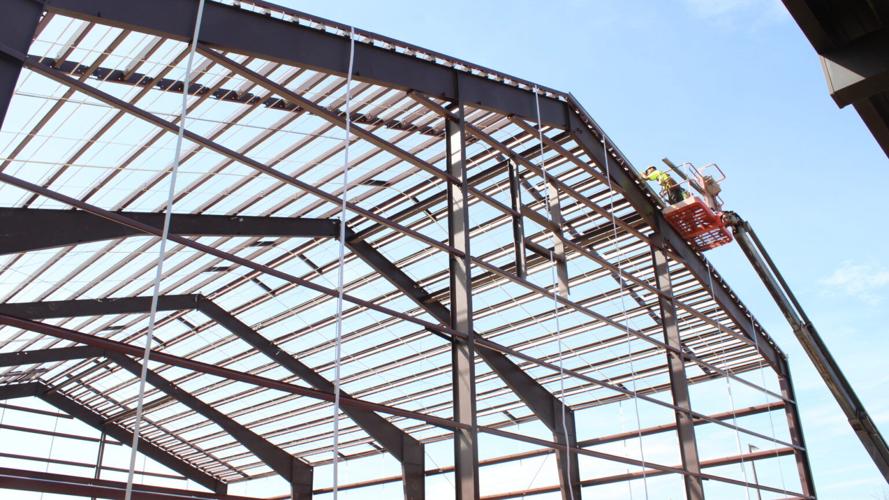
Sumter is consolidating all its schools on the campus of Sumter Central High School. The high school itself lies in the shadow of a new elementary school wing.
When the Alabama State Department of Education took over Sumter County Schools in August 2023, the district had 923 students between its four schools, a drop of more than 100 from the year prior.
Intervention takes many different forms around the state; in Sumter, it will end in school closures and new construction. State Superintendent Eric Mackey plans to close three schools and move them to the York Central High School campus, into a new facility for elementary students.
The $14 million construction is set to be completed by December, Burroughs said.
“We’re hoping to be in by January, but with the weather and the rain,” Burroughs said. “We will definitely be in by next August.”
The school closures, Mackey said in a phone interview Thursday, were necessary due to the condition of the facilities and low membership.
“York West End (Junior High School) has a whole wing that is not available to be occupied because of structural problems, but it’s a big school that was built decades ago, so you still had plenty of room because there were so few students,” Mackey said. “Nevertheless, you’ve got this whole section of the building that you can’t even go in, and which always is, to me, that’s a safety concern, even though we don’t have students housed there. And then Livingston Junior High, the other school, actually was condemned.”
Even Sumter Central High School, where the consolidated campus will be, is an older building, but HVAC replacements and minor renovations will keep it updated. Burroughs said the state replaced 30 HVACs in the building when they intervened two years ago, and the process was still ongoing during the summer.
Sumter County Schools was the first of three school systems under Mackey’s control, joined by Bessemer City Schools south of Birmingham and Dallas County Schools in Selma.
Why the state intervened
The Sumter intervention, Mackey said, is unique because of how rural the county is. Sumter County, like many Black Belt counties, has seen significant population loss over the last few decades. The county lost 10.3% of its population from 2010 to 2020, according to the U.S. Census Bureau.
That creates challenges. The falling population and difficulty accessing Sumter, on the state’s western border with Mississippi, makes it difficult to recruit teachers and staff. York Central High School has had three principals since the state intervened, Mackey said.
“There’s been a lot of teacher turnover too, and it’s hard to get people to drive there,” Mackey said. “There’s not a lot of housing in the community, so that’s been a struggle for them for a long time, and it’s been a little bit of a struggle even with the intervention.”
Although the construction of the consolidated campus is set to be completed in the next six months, Mackey said there will still be more work to do before the system’s autonomy is restored. One of those things is finances.
John Heard, the state appointed chief administrative officer for the intervention, said in a recent interview that the system did not have their financials in line before intervention. Now, though, the school system has about four months worth of expenses in reserve, Heard said, about $6.2 million.
“That means they’re gonna have longevity in being able to do a good job keeping up with their finances,” Heard said.
Kinterbish Junior High School in Cuba, Alabama, the first school that was closed in 2023, had less than 70 students in 2022, according to state data. Mackey said the low membership overextended the school system’s staff and cost the district money. Those students were consolidated with York West End Junior High School in December 2023, which brought membership up to 276 students at the end of the 2023-24 school year, according to state data.
“They were overextended in the number of schools. That’s one of the real issues why they got into so many financial issues,” Mackey said. “It’s been one of their academic problems because they were trying to get teachers at all these different little schools and and it was really too much to staff.”




Another issue Mackey had was board governance. He said 18-24 months before the state intervened it recommended the closure of Kinterbish. The board, Mackey said, did not act on the recommendation.
“They were headed toward bankruptcy, and the things that had to be done to keep the system, solve it, mostly closing schools,” Mackey said. “I’m not saying they’re not willing. They were not able to get to the place where they could do it on their own.”
Even with consolidating schools, the system’s membership continues to decline. In the 2021-22 school year, Sumter County Schools had 1,068 students, according to state data. At the end of the 2023-24 school year, the school system had 910 students. Mackey said that some of the student movement is due to students attending University Charter School in the county, which enrolls 691 students.
Academics were also a concern. Sumter County Schools has been one of the state’s lowest performing schools for years, he said. In 2022, the system scored a 70 on the state report card and a 74 in 2024, according to state data. In 2024, the state average was an 85.
In this year’s state reading test for second and third graders, 47% of Sumter’s second graders and 34% of third graders scored below the proficiency mark, which was raised nine points last year. Third graders system-wide are in the bottom ten school systems in proficiency. In the 2024 test, 40% of Sumter’s second graders and 19% of third graders scored below the proficiency mark.
“That’s a concern for all of us, that we make sure that we reach that goal and exceed it, really,” Heard said. “So there’s gonna be a lot of effort this year to spend more time working on that, to have some side by side coaching with students and teachers.”
Although focus is currently on construction and renovations, Mackey said that once the elementary school wing on Sumter Central High School’s campus is done they will be focusing more on academics.
He said Burroughs, who was appointed superintendent of Sumter County Schools two months before intervention, has an “academic mind” and will be able to improve the system’s academics.
“I think if we can get the other pieces taken care of, then she’ll be able to manage the academics,” he said.

Sumter County Superintendent Marcy Burroughs talking with a group of elementary schoolers as they play in the Sumter Central High School gymnasium in York, Alabama, on June 26, 2025. Burroughs started as superintendent at Sumter County Schools a month before the state intervened in 2023. (Anna Barrett/Alabama Reflector)
Staff and community support
Burroughs and Heard said that they have not heard of any outright opposition to the intervention; however, they have heard some community members say they feel they’ve lost their voice.
“I think just the idea that the state is actually running the system does have some angst in some people,” Heard said. “I think a lot of people are excited about the fact that they’re getting a new facility.”
Board President Elanor James said in a recent interview that the progress the schools system has made would not have been possible without the state, but parents are wary of the future.
“There’s pros and cons to anything. Some say that they are happy that the state is here because we’re getting a new school, which we probably wouldn’t have gotten if the state intervention hadn’t come in,” James said. “Then some are kind of wary about it, they feel that the schools were doing OK.”
Sumter County teachers and staff said in interviews that they supported the intervention.
Carla Landrum, a first grade teacher in the district, said she’s noticed teachers being more focused since intervention started.
“Everybody came in with a purpose. We knew what our kids needed. We wanted to make sure that that’s what they were getting,” Landrum said during the June site visit.
Natalie Adams, a second grade teacher, said the additional hands-on resources from the state have yielded a noticeable difference in the kids’ learning and engagement.
“I like them to collaborate so they can get an understanding that if they work together, someone may know something that someone else may know, may not know,” Adams said. “When they work together, it seems to work better for them.”
Burroughs said in a phone interview in June that intervention stabilized “finance, governance and academic oversight.”
“I had just gotten hired in July, and the state intervened in August, so it was kind of sort of like we came in both at the same time and we were able to develop a partnership.”
Heard accredits the success of the intervention to Mackey and the support from state personnel.
“Dr. Mackey had really committed his staff to just support us 100% whatever we needed, whether it was federal programs, whether it was a finance department, whether it was career tech,” Heard said. “He pretty much made his entire staff available to us for whatever we needed to make certain that we were doing the best possible approach for whatever we were doing.”
Mackey said he plans for the intervention to last another year or two, and hopes to be out in 2027.
(0) comments
Welcome to the discussion.
Log In
Keep it Clean. Please avoid obscene, vulgar, lewd, racist or sexually-oriented language.
PLEASE TURN OFF YOUR CAPS LOCK.
Don't Threaten. Threats of harming another person will not be tolerated.
Be Truthful. Don't knowingly lie about anyone or anything.
Be Nice. No racism, sexism or any sort of -ism that is degrading to another person.
Be Proactive. Use the 'Report' link on each comment to let us know of abusive posts.
Share with Us. We'd love to hear eyewitness accounts, the history behind an article.