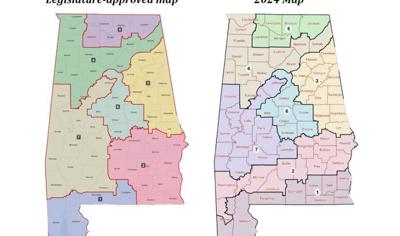
WASHINGTON — Alabama Republicans want to redraw the state’s congressional map in the wake of the monumental Supreme Court decision against race-drawn districts in Louisiana, and they likely have the power to do so. The question is when.
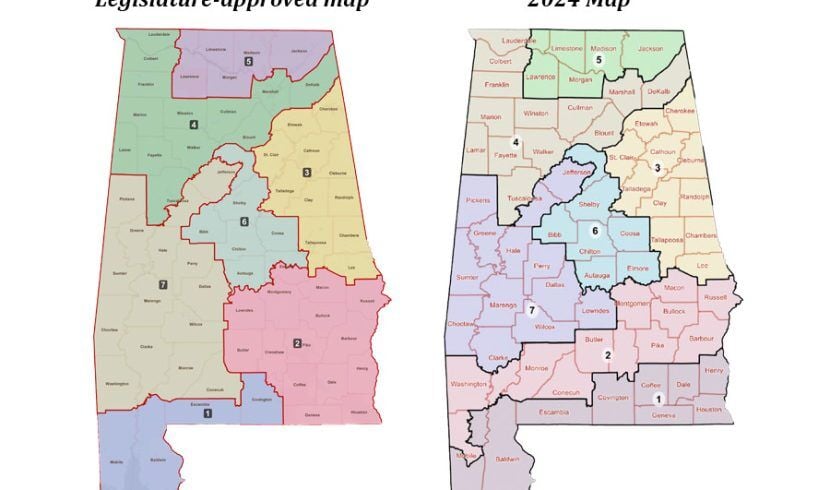
The 6-3 ruling limits the consideration of race when drawing congressional districts, stemming from a majority-minority district in Louisiana. Alabama’s two Democrat-held seats in Congress are the result of Voting Rights Act litigation and are the target of calls to redistrict.
Some are calling on the process to begin right away in time for GOP pick-ups to help the party retain its majority in the House of Representatives, but changing the map for the 2026 cycle could prove difficult. For one, ballots for the state’s May 19 primaries are already set, with qualifying having ended in January and absentee voting already underway.
Also, after a 2023 Supreme Court ruling involving Alabama’s map, federal judges ruled that the state cannot alter its map before 2030, the year of the next census. But the state has asked the high court to review that decision and Attorney General Steve Marshall said this ruling will help make the state’s case.
“We will act as quickly as possible to apply this ruling to Alabama’s redistricting efforts and ensure that our congressional maps reflect the will of the people, not a racial quota system the Constitution forbids,” Marshall said in a statement.
Under the Alabama constitution, only the governor can convene a special session of the Legislature. Gov. Kay Ivey on Wednesday referenced the limitations from the court and said she would not call a special session unless that restriction was lifted.
“Litigation surrounding Alabama’s congressional districts is pending before the U.S. Supreme Court, and Alabama is currently under a court order prohibiting the use of new congressional districts until after the 2030 census,” Ivey said in a statement. “While we are not in position to have a special session at this time, I hope in light of this new decision, the court is favorable to Alabama.”
Alabama House Speaker Nathaniel Ledbetter and Alabama Senate President Pro Tem Garlan Gudger also weighed in, signaling their willingness to take action to redraw — at some point.
“Racial gerrymandering disguised as justice has no place in our country, and we have every intention of ensuring that, moving forward, Alabama’s congressional and state legislative maps are drawn in a way that respects the Constitution and reflects the values of Alabamians,” the lawmakers said in a joint statement.
Swift Democratic outcry
Alabama Democratic U.S. Reps. Terri Sewell of Birmingham and Shomari Figures of Mobile quickly decried the Supreme Court’s ruling and vowed to fight back. It will be their seats on the line if and when the map is redrawn.
As a native of Selma and the state’s only Black representative for 13 years, Sewell said the decision is a “devastating blow to our democracy” and the Voting Rights Act of 1965.
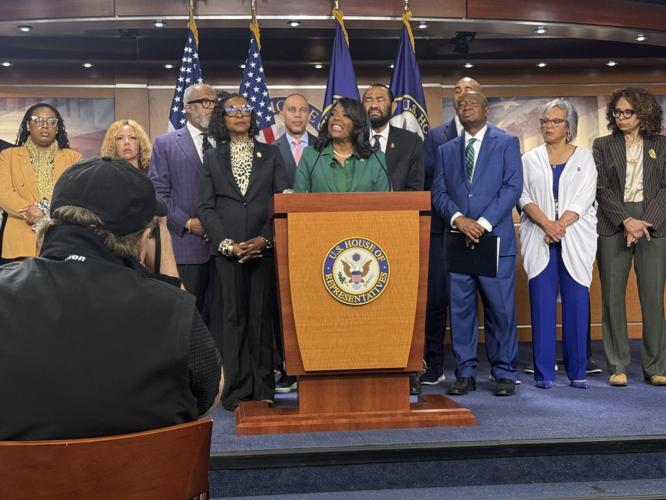
“The foot soldiers who marched across that bridge were my neighbors, my church members, my parishioners and my babysitters,” Sewell said during a press conference after the ruling. “I am here to tell you that the progress secured by those foot soldiers is being erased before our very eyes.”






Rep. Terri Sewell and members of the Congressional Black Caucus speak after the Supreme Court’s decision. (Alex Angle/Alabama Daily News)
Figures, who won his seat in 2024 after a court ordered a new map to create a second majority-Black district in the state, told Alabama Daily News the case is “certainly damaging” to voting rights nationwide. But he noted his case is different.
“I’m certainly optimistic that the district will at least stay the same through the 2030 census,” Figures said, referring to the court order to keep the state’s map in place until then.
The first-term congressman added that the ruling will only lead to more litigation as efforts in Alabama and across the country spring up to “redraw these districts in a way that dilutes the Black vote.”
Many want immediate redistricting
Many of the state’s top Republicans came out Wednesday publicly calling for a special session to redraw the map in time for the 2026 election.
U.S. Rep. Barry Moore, R-Enterprise, and a U.S. Senate hopeful, whose district was redrawn as a result of the 2023 Supreme Court case, called on the Legislature “to begin the process of redistricting.”
“Alabama has stood with President Trump and the America First majority 100% of the way, and it’s time our Congressional delegation reflects that,” Moore said in a statement.
Just last night, U.S. Sen. Tommy Tuberville, R-Ala., and the GOP frontrunner to become Alabama’s next governor, wrote an op-ed urging Marshall and the Secretary of State’s office to file a motion to vacate the injunction that required the current map to be in place until 2030.
On Wednesday, Tuberville emphasized that push, posting on social media, “LET’S GO!”
LET'S GO! https://t.co/IXOtFiOODk
— Tommy Tuberville (@CoachForGov) April 29, 2026
This story has been updated with additional context.

(0) comments
Welcome to the discussion.
Log In
Keep it Clean. Please avoid obscene, vulgar, lewd, racist or sexually-oriented language.
PLEASE TURN OFF YOUR CAPS LOCK.
Don't Threaten. Threats of harming another person will not be tolerated.
Be Truthful. Don't knowingly lie about anyone or anything.
Be Nice. No racism, sexism or any sort of -ism that is degrading to another person.
Be Proactive. Use the 'Report' link on each comment to let us know of abusive posts.
Share with Us. We'd love to hear eyewitness accounts, the history behind an article.