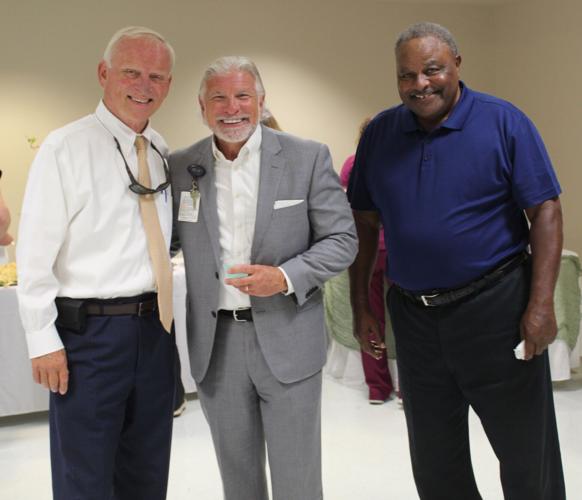
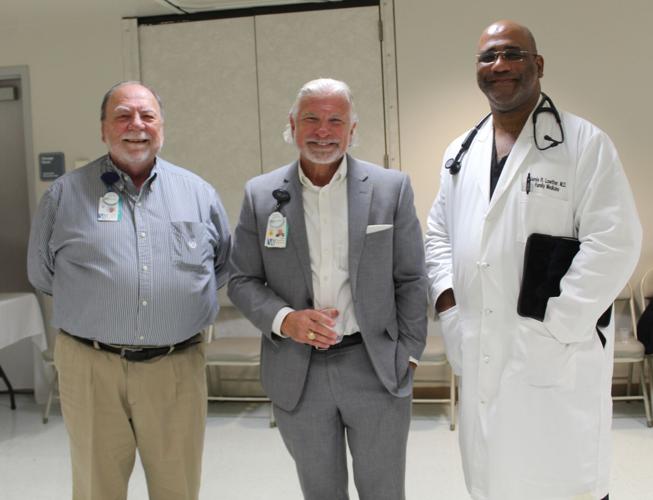

After eight years at the helm of Whitfield Regional Hospital, CEO Doug Brewer is preparing to retire.
During his tenure, Brewer led the Demopolis hospital's expansion of services aimed at improving some of Alabama’s most pressing health challenges while navigating the financial realities of rural healthcare.
Hospital staff, board members and community leaders gathered Wednesday to honor Brewer during a retirement celebration recognizing his service to Whitfield and the surrounding region.
Brewer, who spent much of his career managing larger urban hospitals before arriving in Demopolis, said he developed a deep appreciation for the mission of rural healthcare during his time at Whitfield.
“It’s a struggle worth fighting,” Brewer said. “That’s why I’ve stayed here for eight years. There were many times when I thought, man, I just need to go back to large urban hospitals. It’s easier, quite frankly. But it’s worth every fight that this staff and this team have to know that there are people alive today because of the services we’re providing.”
Among his proudest accomplishments, Brewer pointed to Whitfield’s efforts to address chronic health conditions that are prevalent throughout the region.
“We really began focusing on being able to take care of the chronic care patients,” Brewer said. “We live in an area with the highest concentration of COPD, obesity, diabetes, hypertension – you name it. If it’s chronic, we have it.”
Brewer said the hospital developed multiple programs aimed at managing chronic illnesses and educating residents about their health.
“We’ve actually begun to see decreases in the amount of diabetes and things in our county,” he said. “We’re the only county in the state that’s seeing that, and I think it’s due to the work of these people here who have really bought into those programs and have begun trying to educate the community and provide care for those chronic care issues.”
While celebrating successes, Brewer also acknowledged the challenges facing rural hospitals across Alabama. He cited reimbursement rates and the lack of Medicaid expansion as significant obstacles for healthcare providers in economically disadvantaged counties.
“The biggest barrier to care in rural Alabama is the financial system we have,” Brewer said. “We literally get paid less than anybody in the nation for what we do here because of the way that it works.”
He said the system often assumes hospitals in rural areas can hire workers at lower wages, while in reality facilities frequently must offer higher compensation to attract qualified healthcare professionals from outside the area to relocate to a rural market like Demopolis.






Financial disparities have led to shortages of specialists and place ongoing strain on rural hospitals, he said.
Looking ahead, Brewer said Whitfield’s future will continue to involve difficult financial decisions, particularly when it comes to replacing aging equipment and investing in new technology.
“A good month for us is breaking even,” he said. “A bad month is when something happens that we don’t expect and we need a new chiller or a new boiler or something like that.”
Still, Brewer said the hospital’s impact on local residents makes the work worthwhile.
He pointed to Whitfield’s wound care program as an example.
“You know how many people are walking around Walmart instead of riding in one of those motorized carts because we didn’t have to cut off their foot?” Brewer said. “These people can’t drive an hour and a half for five appointments a week to treat a wound, but here we can get them here and we can take care of them. So it’s meaningful work.”
Brewer will retire in the coming weeks. Since Whitfield is a member of the UAB Health System, UAB has appointed Patrick Trammell as interim CEO. Trammell previously served as CEO of UAB’s hospital in Greenville and will lead Whitfield while UAB and the Tombigbee Healthcare Authority Board conduct a national search for a permanent replacement. Brewer said UAB’s involvement should help attract a strong pool of candidates.
As for his own future, Brewer said he plans to enjoy retirement initially, including spending more time fishing, but does not expect to leave healthcare behind completely.
“I love healthcare,” he said. “Healthcare gets in your blood, and it’s something you can’t just stop doing. It’s addictive because it’s such meaningful work.”
Brewer said he hopes to eventually take on interim leadership assignments and consulting opportunities around the country while enjoying a slower pace of life.
“I turned 65 about six months ago,” he said. “It is time to slow down a little bit.”
(0) comments
Welcome to the discussion.
Log In
Keep it Clean. Please avoid obscene, vulgar, lewd, racist or sexually-oriented language.
PLEASE TURN OFF YOUR CAPS LOCK.
Don't Threaten. Threats of harming another person will not be tolerated.
Be Truthful. Don't knowingly lie about anyone or anything.
Be Nice. No racism, sexism or any sort of -ism that is degrading to another person.
Be Proactive. Use the 'Report' link on each comment to let us know of abusive posts.
Share with Us. We'd love to hear eyewitness accounts, the history behind an article.