

The number of abortions in the U.S. rose by 21% between 2020 and 2025 – despite the fact that 20 states have passed laws banning or severely restricting abortion care, overturned the constitutional right to abortion.
The increase is largely due to the growing adoption of medication abortion and the use of telehealth. States that have banned or limited abortion are seeking to disrupt the trend.
Louisiana, for example, sued the federal government to block doctors nationally from prescribing mifepristone, one of the two drugs used for abortion in the U.S., via telehealth. The U.S. Supreme Court ruled on May 14, 2026, that providers could continue dispensing the medication via telehealth, for now.
Another, lesser-known strategy that states are using is to restrict drugs that can be used for an abortion, even if they also have other uses. In 2024, Louisiana passed Act 246, the first state law to classify mifepristone and misoprostol, the second drug used for medication abortion, as controlled substances. The controlled substances designation had previously been reserved for drugs like Xanax and fentanyl, drugs that can be abused.
Act 246 did not make abortion illegal in Louisiana. It has been illegal in the state since the Supreme Court’s 2022 decision.
Several other states are seeking to follow suit in trying to pass similar laws.
As legal and medical researchers at the Advancing Impact on Maternal and Reproductive Health Lab at Brown University, we track how state reproductive health laws affect patient care. We have seen that placing unnecessary restrictions on medications through this law can harm maternal and reproductive health.
Not-just-abortion drugs
The process recommended by the American College of Obstetricians and Gynecologists for medication abortion in the U.S. is for a pregnant person to take two drugs in sequence.
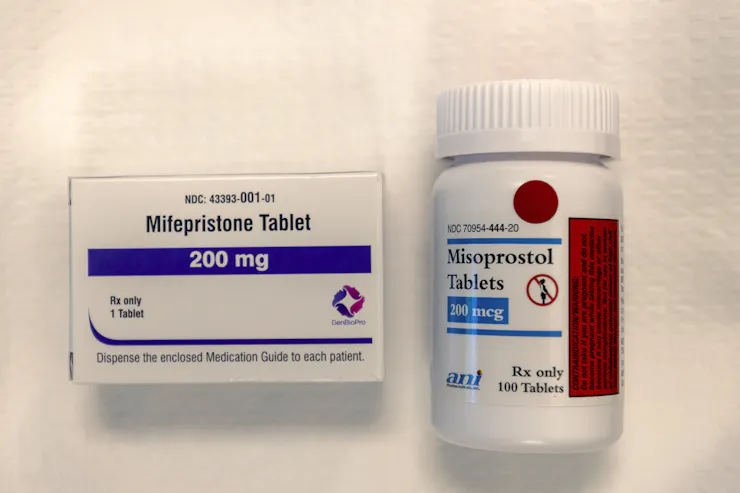
The first drug, mifepristone, is a pill taken by mouth. It works by blocking the hormone progesterone, which stops a pregnancy from growing and prevents the lining of the uterus from thickening.
Then, 1-2 days later, patients place four tablets of the second medication, misoprostol, on the inside of their cheeks or in their vagina. This drug causes contractions in the uterus, causing it to empty its contents, similar to a period.
But both medications have uses other than abortion.
The American College of Obstetricians and Gynecologists recommends the same combination of mifepristone and misoprostol to treat a miscarriage. Misoprostol is also used to treat patients who are bleeding significantly after giving birth.
These medications aren’t just used for reproductive healthcare. Mifepristone can be used to treat a hormonal condition called Cushing’s disease, and misoprostol is approved to treat stomach ulcers.
A break from precedent
Traditionally, federal agencies categorize drugs as controlled substances when they have addictive or abuse potential. The agency establishes five distinct categories, which it refers to as schedules, based on how the drug is prescribed and how likely it is to be abused.
Schedule I drugs have no medically acceptable use and a high potential for abuse. For example, heroin is a Schedule I drug. Schedule V medications, on the other hand, are unlikely to be abused and are commonly found in medicine cabinets. Some cough medications like Robitussin AC are classified as Schedule V.
Louisiana’s Act 246 classified mifepristone and misoprostol as Class IV controlled substances. Class IV is a category that includes Xanax and Ambien, prescription drugs that can be abused.
This decision was such a break from standard classification that the American College of Medical Toxicology issued a statement publicly disagreeing with it.
Impeding patient care





A Schedule IV classification makes it more difficult for providers to give these medications to patients who need them.
For example physicians caring for a patient in Louisiana who is experiencing bleeding after childbirth may want to quickly administer misoprostol. Widely used guidelines for reducing maternal deaths clearly recommend that misoprostol be available in an emergency. They specifically recommend the medication be ready for use in a cart at the patient’s bedside.
But because of Act 246, the drug must instead be stored in a locked, secure cabinet. To retrieve it, a nurse must find a second staff member who can witness the nurse unlocking a cabinet, and then must document the transaction in a state-monitored system.
Before Act 246 was passed, Louisiana was closely adhering to these guidelines, and dangerous pregnancy complications were declining. Postpartum hemorrhage – bleeding after childbirth – fell by nearly 40% between 2018 and 2021.
Just before the law took effect, a New Orleans hospital conducted timed drills showing it might take up to two extra minutes to get the medications from a locked cabinet. Health officials expressed concern at this potential delay.
The real-time delay was even longer. One OB/GYN reported it took nearly 10 minutes to get the medication, a delay that could have life-threatening consequences.
Proliferating bills
Similar bills restricting access to these drugs are popping up across several states.
In South Carolina, for example, a bill introduced in April aimed to reclassify not just mifepristone and misoprostol but also a medication called methotrexate as controlled substances.
Although technically, methotrexate ends pregnancies, it is not used for medication abortion. It is the primary drug used to treat ectopic pregnancy, which is when a fertilized egg implants outside the uterus. Although South Carolina has an abortion ban, there are no legal restrictions on treating ectopic pregnancy.
The medication is also used widely for conditions like lupus and rheumatoid arthritis. Making it a controlled substance would make it harder for patients with those common conditions to access.
Bills that aim to restrict these medications in a variety of ways have also been proposed in Texas, Kentucky, Mississippi, Missouri and Iowa.
As legislators discuss these bills, we feel it’s important for people to know that if enacted, they may have unintended consequences, hampering patients’ access to many forms of legal, safe and necessary care.
This article is republished from The Conversation, a nonprofit, independent news organization bringing you facts and trustworthy analysis to help you make sense of our complex world. It was written by: Dara Kass, Brown University; Elizabeth Tobin-Tyler, Brown University, and Stephanie Psaki, Brown University
Read more:
- Supreme Court preserves access to mifepristone via telehealth – at least for now
- Abortion laws show that public policy doesn’t always line up with public opinion
- What is a medication, or medical, abortion? 5 questions answered by 3 doctors
Dara Kass consults for the FemInEM Foundation which receives funding from private foundations and academic programs.
Stephanie Psaki is affiliated with the Council on Foreign Relations, the Center for Strategic and International Studies, the AIDS Vaccine Advocacy Coalition, and the Global Center for Gender Equality.
Elizabeth Tobin-Tyler does not work for, consult, own shares in or receive funding from any company or organization that would benefit from this article, and has disclosed no relevant affiliations beyond their academic appointment.


(0) comments
Welcome to the discussion.
Log In
Keep it Clean. Please avoid obscene, vulgar, lewd, racist or sexually-oriented language.
PLEASE TURN OFF YOUR CAPS LOCK.
Don't Threaten. Threats of harming another person will not be tolerated.
Be Truthful. Don't knowingly lie about anyone or anything.
Be Nice. No racism, sexism or any sort of -ism that is degrading to another person.
Be Proactive. Use the 'Report' link on each comment to let us know of abusive posts.
Share with Us. We'd love to hear eyewitness accounts, the history behind an article.