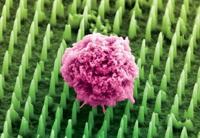
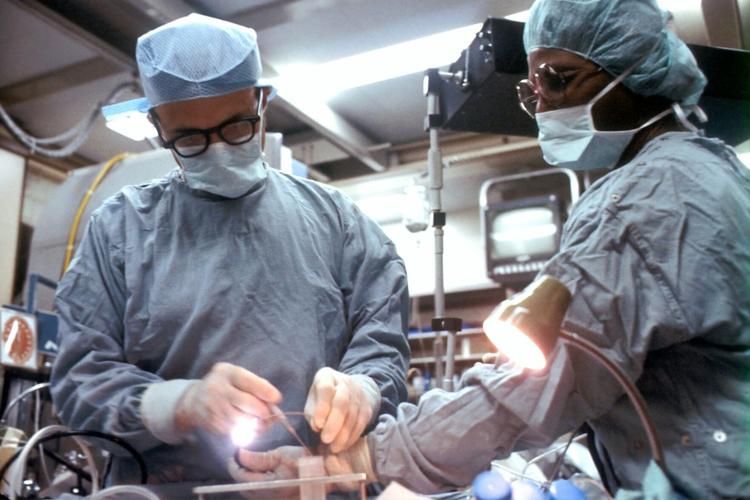
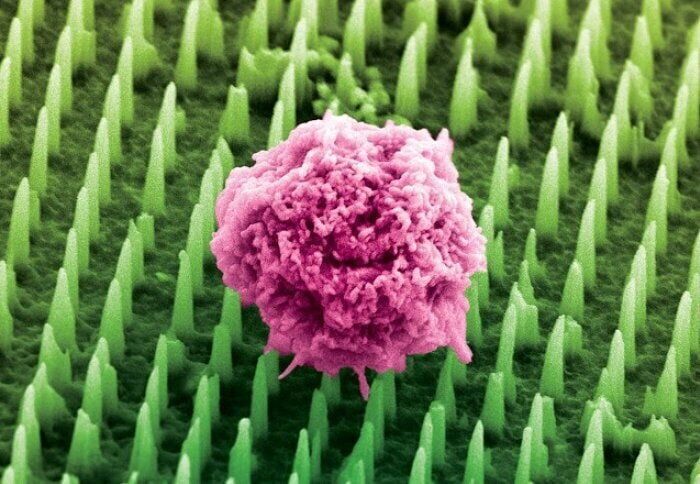
Patches containing tens of millions of "nanoneedles" will supersede traditional methods of diagnosing diseases, according to the study. (Chippani/King's College London via SWNS)
By Stephen Beech
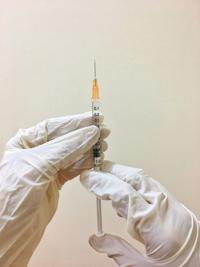
Needles 1,000 times thinner than a human hair could replace painful cancer biopsies, suggests new research.
Patches containing tens of millions of "nanoneedles" will supersede traditional methods of diagnosing diseases, according to the study.
Scientists say the patch offers a "painless and less invasive" alternative for millions of patients worldwide who undergo biopsies each year to detect and monitor diseases, including cancer and Alzheimer’s.
Biopsies are among the most common diagnostic procedures, performed millions of times every year.
But they can cause pain and complications, and can deter patients from seeking early diagnosis or follow-up tests.
Traditional biopsies also remove small pieces of tissue, limiting how often and how comprehensively doctors can analyse diseased organs.

National Cancer Institute
Now, scientists at King’s College London have developed a nanoneedle patch that painlessly collects molecular information from tissues, without removing or damaging them.
They say it could allow healthcare teams to monitor disease in real time and perform multiple, repeatable tests from the same area – something impossible with current biopsies.
Because the nanoneedles are so thin and don't remove tissue, the research team found that they cause no pain or damage, making the process less painful for patients compared to standard biopsies.
Research leader Dr. Ciro Chiappini said: “We have been working on nanoneedles for 12 years, but this is our most exciting development yet.






"It opens a world of possibilities for people with brain cancer, Alzheimer’s, and for advancing personalized medicine. It will allow scientists – and eventually clinicians – to study disease in real time like never before.”
He explained that the patch is covered in tens of millions of nanoneedles.
In preclinical studies, the team applied the patch to brain cancer tissue taken from human biopsies and mouse models.

Kristine Wook
The nanoneedles extracted molecular ‘fingerprints’ - including lipids, proteins, and mRNAs - from cells, without removing or harming the tissue.
The tissue imprint is then analyzed using mass spectrometry and artificial intelligence, giving doctors detailed insights into whether a tumor is present and how it is responding to treatment.
Dr. Chiappini said: “This approach provides multidimensional molecular information from different types of cells within the same tissue. Traditional biopsies simply cannot do that. And because the process does not destroy the tissue, we can sample the same tissue multiple times, which was previously impossible.”
He says the patch, described in the journal Nature Nanotechnology, could be used during brain surgery to help surgeons make faster, more precise decisions.
For instance, by applying the patch to a suspicious area, results could be obtained within 20 minutes and speed up decisions about removing cancerous tissue.
Made using the same manufacturing techniques as computer chips, the nanoneedles can be integrated into common medical devices such as bandages, endoscopes and contact lenses.
Dr. Chippani added, “This could be the beginning of the end for painful biopsies.
"Our technology opens up new ways to diagnose and monitor disease safely and painlessly – helping doctors and patients make better, faster decisions.”
(0) comments
Welcome to the discussion.
Log In
Keep it Clean. Please avoid obscene, vulgar, lewd, racist or sexually-oriented language.
PLEASE TURN OFF YOUR CAPS LOCK.
Don't Threaten. Threats of harming another person will not be tolerated.
Be Truthful. Don't knowingly lie about anyone or anything.
Be Nice. No racism, sexism or any sort of -ism that is degrading to another person.
Be Proactive. Use the 'Report' link on each comment to let us know of abusive posts.
Share with Us. We'd love to hear eyewitness accounts, the history behind an article.