Key Takeaways
A new electrode design might improve spinal cord stimulation
The electrodes can run pulses at different angles along the spinal cord
It successfully inhibited nerve activity, but could be used to enhance nerve response
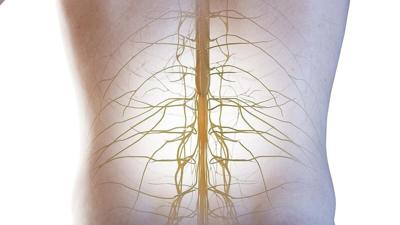
WEDNESDAY, May 28, 2025 (HealthDay News) — A grid of electrodes slapped on a person’s back might soon be able to help treat pain, spasms and paralysis, a new study says.
The electrodes deliver enough low-voltage electrical stimulation through the skin to change the short-term function of nerves in the spinal cord, researchers reported recently in the Journal of Neural Engineering.
The ability to modulate spinal nerves with exterior electrodes “offers a promising alternative for patients who are unable or unwilling to undergo invasive spinal stimulation procedures,” senior researcher Yasin Dhaher said in a news release. He's a professor of physical medicine and rehabilitation at UT Southwestern Medical Center in Dallas.
Implanted electrodes have shown enormous potential in treating paralysis, helping restore the ability to stand and walk in people with spinal cord injuries, researchers said in background notes.
The implants work by stimulating spinal cord nerves with electricity, but the surgery needed to place them is risky and requires lengthy recovery, researchers said.
Attempts to deliver pulses through electrodes placed on the skin haven’t been as successful, because the pads spread the current broadly across the back and little stimulation actually reaches the spinal cord, researchers said.
This new approach organizes a 4-inch-square pad of electrodes in a way that the electrical current can be delivered either straight or diagonally across the spinal cord.
Because spinal nerves run in many different directions, researchers figured this would give them a chance to better align the electrical pulses with the nerves of the lower back.
They tested their electrode pad on 17 healthy people, centering the pad on vertebrae located toward the bottom of the ribcage. That part of the spine controls a muscle called the tibialis anterior (TA) that runs along the skin and controls ankle flexing.
For their experiment, researchers delivered 40 milliamps of electricity, about half the level needed to power a smartphone’s flashlight.






While the voltage wasn’t enough to cause the ankle to flex, it did change the nerve cell’s excitability, or ability to fire, researchers found.
For up to a half-hour afterward, the treated neurons showed less excitability and people found it more difficult to flex their ankle, researchers found.
The inhibition grew more powerful when current ran at a diagonal rather than straight across the spine, researchers added.
Such inhibition could help treat muscle spasms and reduce pain signals, researchers said.
On the other hand, the new electrode pad also might be able to deliver pulses in a way that would make nerves more excitable, potentially enhancing patients’ ability to flex muscles.
For example, stimulating the same set of nerves to improve ankle flexing could be used to treat foot drop, a condition in which people drag their toes while walking, researchers said.
The research team has filed for a patent for the new electrode pad design, and continues to investigate its potential uses.
More information
Johns Hopkins Medicine has more on spinal cord stimulation.
SOURCE: UT Southwestern Medical Center, news release, May 21, 2025
What This Means For You
A new form of external spinal cord stimulation might be able to help treat people with chronic pain, muscle spasms or paralysis.
(0) comments
Welcome to the discussion.
Log In
Keep it Clean. Please avoid obscene, vulgar, lewd, racist or sexually-oriented language.
PLEASE TURN OFF YOUR CAPS LOCK.
Don't Threaten. Threats of harming another person will not be tolerated.
Be Truthful. Don't knowingly lie about anyone or anything.
Be Nice. No racism, sexism or any sort of -ism that is degrading to another person.
Be Proactive. Use the 'Report' link on each comment to let us know of abusive posts.
Share with Us. We'd love to hear eyewitness accounts, the history behind an article.