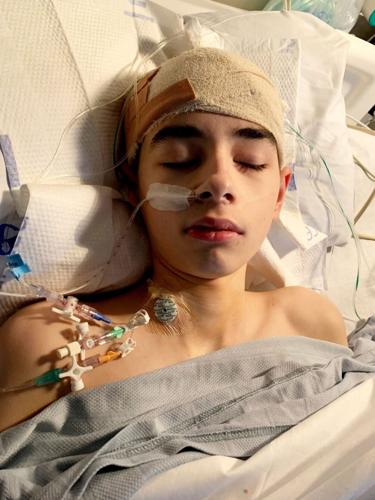

Alex Costa-Veiga, 16, before surgery to fit shunt. (Brain Tumour Research via SWNS)
By Lula White
A teenager was diagnosed with an aggressive brain tumor after his symptoms were originally dismissed as being just a stomach bug or anxiety.
Alex Costa-Veiga, 16, had spent more than a year battling unexplained sickness in the morning before he also began suffering from double vision.
Following an eye test, he was referred for an emergency scan and diagnosed with medulloblastoma, a rare and fast-growing form of brain cancer.
His family say the diagnosis came only after months of medical appointments, blood tests and ultrasounds failed to identify the cause of his worsening condition.
His morning vomiting was first dismissed as anxiety, when in fact it was a symptom of a brain tumor.

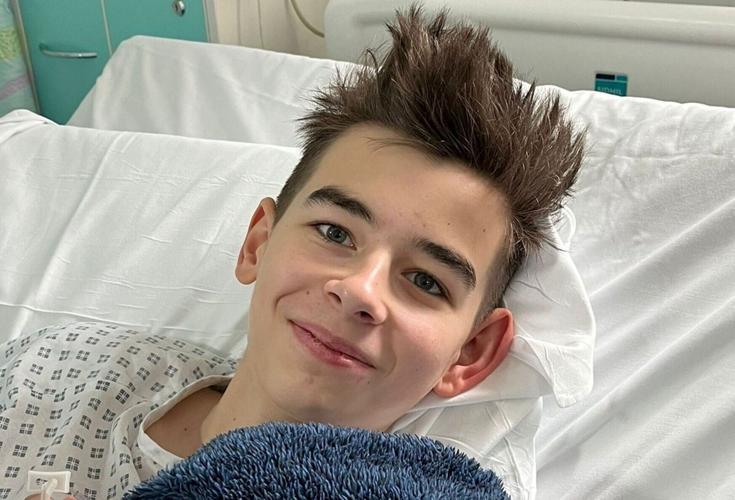
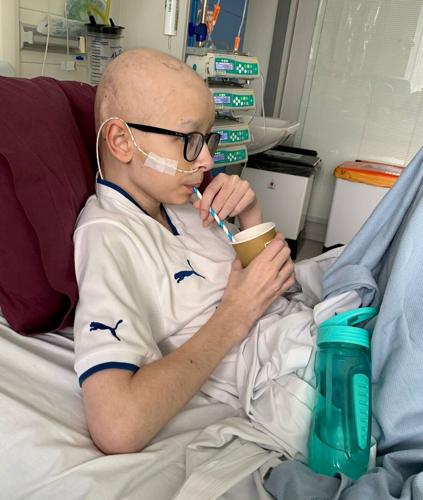
Alex Costa-Veiga, 16, recovering from surgery. (Brain Tumour Research via SWNS)
Mom Melanie Costa-Veiga, of Shrewsbury, Shropshire, said: "For over a year, they were looking into food intolerances and stomach issues.
"Nothing pointed to anything serious.
"It wasn't until Alex mentioned double vision and we went to the optician that everything changed."
Following the appointment, Alex was urgently referred for a CT scan at Princess Royal Hospital in Telford, where doctors found the tumor.
He was immediately transferred by ambulance to Birmingham Children's Hospital for specialist treatment.
Melanie said: "As soon as the consultant said the word 'mass', I knew it wasn't good.

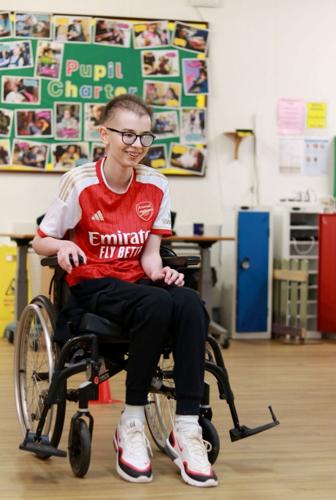
Alex Costa-Veiga, 16, on an eight week rehabilitation placement at The Childrens Trust. (Brain Tumour Research via SWNS)
"We had to wait for a doctor to accompany Alex in the ambulance when he was transferred to Birmingham.
"That's when I knew it was serious."
Doctors first carried out emergency surgery to insert a shunt and relieve pressure on his brain before Alex underwent a complex 10-hour operation to remove the tumor from his cerebellum.
By the time surgeons operated, the cancer had already started to spread.
Alex then faced months of grueling treatment, including radiotherapy, chemotherapy and intensive rehabilitation.
The treatment left him suffering major side effects, including posterior fossa syndrome, speech problems, severe fatigue and weakness down the left side of his body.





At one point, he was unable to talk or walk and relied on a wheelchair.
He later underwent specialist rehabilitation at The Children's Trust in Surrey and has gradually regained some mobility, now able to walk short distances with the help of a frame.

Alex Costa-Veiga, 16, having feeding tube fitted. (Brain Tumour Research via SWNS)
Alex also required treatment for vision problems and underwent corrective eye surgery after initially wearing a prism lens to help manage his double vision.
His cancer treatment additionally damaged his pituitary gland, affecting his growth hormones and leaving him needing hormone therapy.
The diagnosis in 2023 came shortly after Alex, then 14, had completed the first term of Year 10, forcing him to spend the rest of the academic year away from school while he underwent treatment.
Eventually returning to education on a reduced timetable because of exhaustion and ongoing rehabilitation, Alex decided to repeat Year 10 and cut down the number of GCSE subjects he would study.
Now, despite the challenges he continues to face, the 16-year-old is sitting GCSEs in math, English Language, biology, geography and religious studies.
He hopes to go on to study A-level biology, geography and computer studies.
Asked about his future ambitions, Alex said: "I would like to be a marine biologist or work with animals."

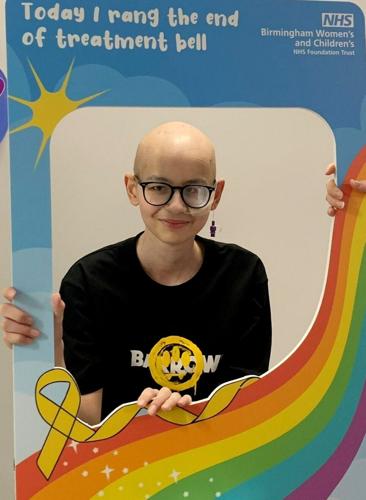
Alex Costa-Veiga, 16, at the end of his treatment in July 2024. (Brain Tumour Research via SWNS)
Melanie said: "Alex has worked so hard and we are incredibly proud of all he has achieved.
"It's been challenging balancing school work with his continued rehabilitation but he has made fantastic progress.
"It's been a difficult journey with a few bumps in the road, but Alex has stayed positive and determined to achieve, better days will come."
The family are now backing calls from Brain Tumour Research for increased funding into brain tumor treatment and research.
Melanie said: "People think once the treatment ends it's over, but it's not. There's still a long road ahead.
"We've met children on that ward who are no longer here. We count our blessings every day.
"We still need more answers and more research.
"There are only three options — surgery, radiotherapy and chemotherapy — and they are far too harsh for children.
"Other countries are developing kinder treatments and the UK must catch up."

(0) comments
Welcome to the discussion.
Log In
Keep it Clean. Please avoid obscene, vulgar, lewd, racist or sexually-oriented language.
PLEASE TURN OFF YOUR CAPS LOCK.
Don't Threaten. Threats of harming another person will not be tolerated.
Be Truthful. Don't knowingly lie about anyone or anything.
Be Nice. No racism, sexism or any sort of -ism that is degrading to another person.
Be Proactive. Use the 'Report' link on each comment to let us know of abusive posts.
Share with Us. We'd love to hear eyewitness accounts, the history behind an article.