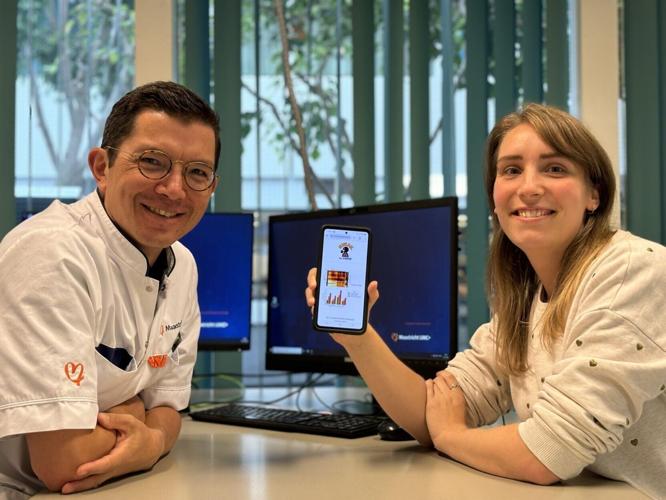





Sami Simons & Loes van Bemmel. (ERJ Open Research / Sami Simons via SWNS)
By Stephen Beech
Voice changes measured with a mobile phone can signal a potentially deadly asthma flare-up three days in advance, according to new research.
The high-tech app can also give a vital early warning of a flare-up in symptoms of chronic obstructive pulmonary disease (COPD), say scientists.
A flare-up of asthma or COPD, known as an exacerbation, is when symptoms such as difficulty breathing, coughing and phlegm become suddenly worse.
They can interfere with patient's everyday activities and, without prompt medical care, they can become dangerous.
Researchers say that, in future, it may be possible to use a daily voice check to monitor for the earliest sign of a flare-up, meaning potentially lifesaving treatment can be given as quickly as possible.

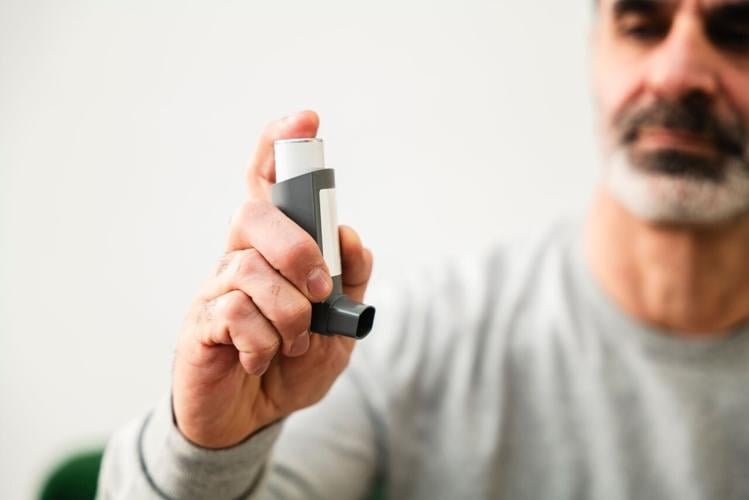
(Photo by Cnordic Nordic via Pexels)
Study leader Dr. Sami Simons said: "On top of their daily symptoms, many people with asthma or COPD suffer from sudden increases in symptoms called exacerbations.
"These can be frightening, and they can lead to longer-term deterioration and increase the risk of dying.
"People are often at home or work when exacerbations start, and they usually need to get into a hospital or clinic for testing.
"This means there's a delay and the patient's suffering is prolonged.
"Early on in my career I was told that the voice is different during a flare-up.
"Now, the rise of artificial intelligence means it's possible to perform sophisticated analysis to find patterns in audio recordings.
"Capturing voice via a mobile phone is the next logical step to detect deteriorations in asthma or COPD at home and on time."
The study included 38 people with COPD and 35 people with asthma, who were being treated in the Netherlands.
Over the course of 12 weeks, participants were asked to use a specially designed app to record and analyze their voice daily.

Sami Simons helped develop the app that can also give a vital early warning of a flare-up in symptoms of chronic obstructive pulmonary disease (COPD).
Each person would record themselves speaking a long "a" sound, then either reading out a short piece of text or answering a question.
They were also asked to complete a daily questionnaire to indicate whether their symptoms were flaring up.






Comparing the voice sounds with the data on symptom flare-ups, researchers found that, at the very beginning of a flare-up, people's voices deteriorated in terms of tone, or pitch, the number of pauses and voice quality.
The findings, published in the journal ERJ Open Research, showed that the measures improved as the flare-ups subsided.
Dr. Simons, of Maastricht University and a consultant respiratory physician at Maastricht University Medical Center, said: "We found that voice significantly changes during an exacerbation of asthma or COPD, and that this occurs as early as the first day that symptoms deteriorate.
"As the airways constrict during an exacerbation, the air that passes the vocal folds is limited.
"This weakens normal the normal vibration of the vocal folds, making it harder to keep the voice steady.
"As a result, the voice of someone with an exacerbation sounds 'breathier' and 'rough.'"
He added: "We were able to capture these changes in the home environment of patients with asthma and COPD using an app on their own mobile phone.
"Our research suggests that in the future people with asthma or COPD may use their voice to detect if they have an exacerbation and react accordingly."
The TACTICAS app (Telemonitoring for Asthma and COPD Through voICe AnalysiS) was co-designed with patients and a startup called Zana Technologies.

(Photo by Vitaly Gariev via Pexels)
It is currently only available for research purposes, but Dr. Simons and his team have created a website to explain how the voice technology works and how people can contribute to the research by donating their voice.
Building on their findings, the research team has now developed machine learning algorithms that can detect exacerbations based on voice changes as early as three days before symptoms show.
They are now testing the technology in two new studies: one in the Netherlands and one in Brazil.
The breakthrough was welcomed by the European Respiratory Society (ERS).
Dr. Marc Miravitlles, ERS vice president, said: "When symptoms of asthma or COPD suddenly flare up, we want patients to get treatment as soon as possible.
"Being able to spot a flare up, or even anticipate it by a few days, could be really valuable in terms of reducing symptoms such as breathlessness or coughing as well as lowering the risk of lung damage, hospital admission or death."
Dr. Miravitlles, of Vall d'Hebron University Hospital in Barcelona, Spain, added: "The idea of using a mobile phone to record and analyze patients' voices for signs of a flare up is very appealing.
"If follow-up studies are positive, this technology could allow better monitoring and care for patients with asthma or COPD via a mobile phone wherever they are in the world.
"This is a good example of how new technologies and AI could really improve the quality of life of our patients with chronic respiratory diseases."

(0) comments
Welcome to the discussion.
Log In
Keep it Clean. Please avoid obscene, vulgar, lewd, racist or sexually-oriented language.
PLEASE TURN OFF YOUR CAPS LOCK.
Don't Threaten. Threats of harming another person will not be tolerated.
Be Truthful. Don't knowingly lie about anyone or anything.
Be Nice. No racism, sexism or any sort of -ism that is degrading to another person.
Be Proactive. Use the 'Report' link on each comment to let us know of abusive posts.
Share with Us. We'd love to hear eyewitness accounts, the history behind an article.