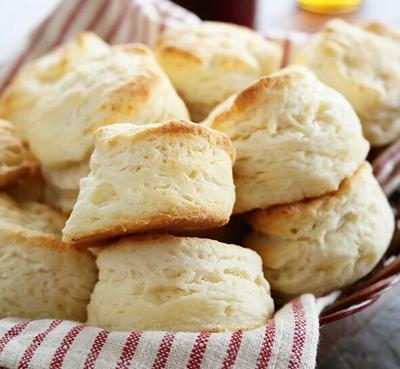
Making perfect, mile-high, tender, flaky biscuits is an art, for sure. But it doesn’t have to be super complicated. I’ve been making biscuits for something like 30 years, so I’ve picked up a few tips and tricks along the way to make the process, dare I say it … easy. Equipping yourself with these little nuggets of knowledge will turn you into a biscuit-making master.
Buttermilk biscuits are a popular breakfast staple in the South. These flaky, tender and slightly tangy biscuits are usually enjoyed as a side dish or for breakfast.
Buttermilk biscuits are versatile. You can enjoy them with jams, jellies, butters and honey. They make delicious breakfast sandwiches and are great buried in gravy, especially my sausage gravy.
How to substitute milk for buttermilk
Don’t have buttermilk on hand? No problem. While there may be a slight change in flavor, you absolutely can convert regular milk into a buttermilk substitute with the help of vinegar or lemon juice.
You will need 1 tablespoon of vinegar or lemon juice for every 1 cup of milk. After you measure your milk, remove one tablespoon from every 1 cup of milk (if your recipe calls for 2 cups of milk, remove 2 tablespoons of milk). Stir the milk and lemon juice or vinegar really well.
Let the mixture sit at room temperature for about 5 to 10 minutes. The milk will curdle slightly when it thickens. It will also develop a tangy flavor similar to buttermilk. Once your improvised buttermilk has thickened slightly, it is ready to use.
What type of flour to use
Let’s talk about flour. Southern cooks are quick to tell you there’s only one flour when it comes to making biscuits, and that’s White Lily (and no, this is not sponsored). White Lily flour is milled from a soft winter wheat, which gives it some distinct advantages in terms of biscuit making.
This wheat is low in protein, and protein is what creates gluten when it’s introduced with liquid. Gluten is what gives things like baguette and pizza dough their deliciously chewy texture.






But we don’t want chewy biscuits, so we want to do everything we can to reduce the gluten formation when making them. Starting with a flour that is lower in protein means there’s less gluten development. It’s a little insurance policy against gluten, if you will. Less gluten means tender, flaky, high-rising biscuits. Just how we like ’em.
How to convert all-purpose flour into self-rising flour
I much prefer to go with White Lily Self-Rising Flour because it already has the baking powder and salt well mixed in and saves me a few steps. I like to buy it in smaller bags and then store it in the freezer for a longer shelf life. (I also keep self-rising flour around to make my delicious Pecan Chewies.)
If White Lily All-Purpose flour is all you have around, simply add 1½ teaspoons of baking powder and ½ teaspoon of salt for every cup of flour.
How to measure flour
How you measure your flour is important. Here’s how to ensure the flour is ready for perfect biscuit results:
Sifting flour is great, but not necessary. Simply run a fork through it to lighten it up a bit.
Use a spoon to put the flour into a dry measuring cup.
Level off your flour along the rim of your measuring cup with the flat edge of a knife or a straight-edged surface.
Do not pack or jam the measuring cup with flour. Also, avoid scooping the flour with the measuring cup. This can throw off your liquid-to-flour ratio.
Easy Buttermilk Biscuits
Prep time: 20 minutes
Cook time: 15 minutes
Ingredients
2 cups White Lily Self-Rising Flour
½ cup cold unsalted butter
¾ cup cultured nonfat buttermilk
2 tablespoons unsalted butter, melted
Instructions
Preheat the oven to 450 degrees and line a baking pan with a silicone baking mat or a piece of parchment paper.
In a large bowl, measure the flour by spooning it into a dry measuring cup and leveling it off.
Cut the butter into the flour. You can use a pastry blender to cut the butter into pieces the size of a small pea. Or freeze the butter and grate it on a box grater, then stir the flour and grated butter together.
Add the buttermilk and stir until just combined. The dough should be like thick mashed potatoes, but not too sticky. Add a little more flour if too sticky, or a little more buttermilk if it won’t hold together.
Turn the dough out onto a floured surface and knead it a few times if it’s not holding together too well.
Flatten the dough out into a rectangle and fold it over on itself in a tri-fold fashion. This helps to create those flaky layers.
Continue lightly dusting the dough and the counter with flour to keep things from sticking.
Flatten it out into a rectangle again and tri-fold once more. You’ll want to do this about three times.
Flatten the dough out into a rectangle that’s about ¾ to 1 inch thick and use a floured, sharp 2- to 2½-inch biscuit cutter to cut the dough out using a quick up-and-down motion, being sure not to twist the cutter.
Transfer the biscuits to the prepared baking pan, placing them nearly touching for soft, tender edges or farther apart for crunchier edges.
Rework the dough and flatten it to cut out more biscuits. You should get between 10 and 12 biscuits.
Brush the tops with the melted butter and bake for about 15 minutes or until golden brown.
Nutritional information – calories: 198 kilocalories; carbohydrates: 19 grams; protein: 4 grams; fat: 12 grams; saturated fat: 7 grams; polyunsaturated fat: 1 gram; monounsaturated fat: 3 grams; trans fat: 0.5 grams; cholesterol: 31 milligrams; sodium: 18 milligrams; potassium: 28 milligrams; fiber: 1 gram; sugar: 1 gram; vitamin A: 354IU; vitamin C: 0.2 milligrams; calcium: 9 milligrams; iron: 0.2 milligrams.
This recipe originally appeared on SouthernBite.com. For more great recipes, visit the website or check out “The Southern Bite Cookbook.”

(0) comments
Welcome to the discussion.
Log In
Keep it Clean. Please avoid obscene, vulgar, lewd, racist or sexually-oriented language.
PLEASE TURN OFF YOUR CAPS LOCK.
Don't Threaten. Threats of harming another person will not be tolerated.
Be Truthful. Don't knowingly lie about anyone or anything.
Be Nice. No racism, sexism or any sort of -ism that is degrading to another person.
Be Proactive. Use the 'Report' link on each comment to let us know of abusive posts.
Share with Us. We'd love to hear eyewitness accounts, the history behind an article.