A Birmingham-based community organizing group is organizing in the Black Belt amid fears the current presidential administration will not prioritize the ongoing sewage issues plaguing the region.
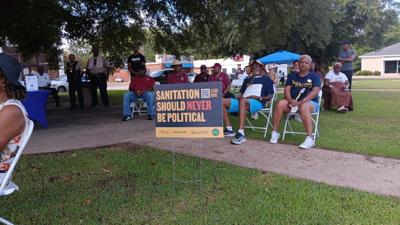
Faith in Action hosted two events in the past two months in Lowndes County, ground-zero for the wastewater crisis. A July meeting informed attendees about the problem and how the Trump administration terminated an agreement with Alabama to address the problem. The second, held last week, was a workshop to engage elected officials to solve the problem.
“We raised awareness, but now we have to be engaging public stakeholders so we can get to a resolution,” said Daniel Schwartz, executive director of Faith in Action Alabama, in an interview last week. “We will be having more public events, which is also important, but we also have these planning meetings to engage public officials.”
The workshop outlined a set of action items to execute an action plan that mobilized community members from the march and rally in July.
Several Black Belt communities have been plagued by a persistent raw sewage problem for years due to poverty, low population and a clay soil that can make septic systems ineffective.
Many homes have pipes that transport the waste into areas nearby, which can breed microbes and other parasites. Following a civil rights investigation, the U.S. Department of Justice and the Alabama Department of Public Health reached an agreement in 2023 to install sanitary systems.
DOJ at the time said ADPH had acted “in a consistent pattern of inaction and/or neglect concerning the health risks associated with raw sewage” and had threatened residents who could not afford proper sewer systems with prosecution under sanitation laws.
“Despite ADPH’s awareness of the issues and the disproportionate burden and impact placed on Black residents in Lowndes County, it failed to take meaningful actions to remedy these conditions,” the DOJ said in a statement at the time.
ADPH was directed to suspend criminal penalties and liens on property for households who could not afford to resolve their wastewater issue. It was also ordered to research the public health risk of the sanitation problem in Lowndes County; create a public awareness campaign, assess septic and wastewater management systems and develop a plan for improving the infrastructure.
“That is the part of the agreement that was really integral to pushing the installation of functioning, onsite septic systems in the area where there are these persistent issues with failing onsite septic systems,” said Chandra Taylor-Sawyer, an attorney with the Southern Environmental Law Center (SELC), who researches environmental issues, in an interview this month.






However, the Justice Department under Trump terminated the agreement earlier this year, citing an executive order that attacked diversity, equity and inclusion efforts by the federal government.
“The DOJ will no longer push ‘environmental justice’ as viewed through a distorting, DEI lens,” said Assistant Attorney General Harmeet K. Dhillon of the Justice Department’s Civil Rights Division in a news release. “President Trump made it clear: Americans deserve a government committed to serving every individual with dignity and respect, and to expending taxpayer resources in accordance with the national interest, not arbitrary criteria.”
The march and rally organized in July was meant to draw attention to not only the ongoing raw sewage crisis but also highlight how the current administration is potentially scaling back efforts to address raw sewage by terminating the agreement.
“The short term consequences will relate back to how motivated the state of Alabama is to seek additional funding for the installation of onsite septic systems who need them and cannot afford them,” Taylor-Sawyer said. “The pressure that was created from the agreement is no longer there.”
The state had already allocated some funding to address sewage issues in Lowndes County through the American Rescue Plan Act (ARPA). However, it was not enough to provide wastewater systems for all residents.
“The state can continue to use the information that was collected to take care of the residents in the state of Alabama when they know that so much harm is happening,” Taylor-Sawyer said.
Last week’s meeting built on the march and rally in July designed to keep the conversation about the problem ongoing.
“The people who have the problem don’t want to talk about it, and the people who don’t have the problem don’t want to talk about it,” said Letitia Watford, a resident of the Black Belt who attended the event in July. “And we all just wish it would go away, but it won’t go away without a lot of money. And we need to beat the drum until we get that money.”
Sen. Robert Stewart, D-Selma, who attended the rally in July, testified before Congress about the issue earlier this summer.
“I painted a picture of how the people of Lowndes County toil for justice, and they still have yet to receive the justice en mass of what they deserve, the environmental justice, the educational justice, the health care justice, and how all of this is related. We have gone from a war on poverty to a war on the poor, and we cannot take this lightly,” he said at the July event.
(0) comments
Welcome to the discussion.
Log In
Keep it Clean. Please avoid obscene, vulgar, lewd, racist or sexually-oriented language.
PLEASE TURN OFF YOUR CAPS LOCK.
Don't Threaten. Threats of harming another person will not be tolerated.
Be Truthful. Don't knowingly lie about anyone or anything.
Be Nice. No racism, sexism or any sort of -ism that is degrading to another person.
Be Proactive. Use the 'Report' link on each comment to let us know of abusive posts.
Share with Us. We'd love to hear eyewitness accounts, the history behind an article.