Key Points
- Several candidates campaigning for statewide office pledged to support repealing the grocery tax in Alabama. This includes both the Democratic and Republican candidates for Governor and Lieutenant Governor.
- Lawmakers in the past three years passed legislation to reduce the statewide portion of the grocery tax from 4% to 2%.
- Anti-poverty advocates called the tax “immoral” because of its regressive nature. Households in the lowest income brackets pay more of their income to the tax than wealthier households.
- Rep. Danny Garrett, R-Trussville, said he drafted a bill to repeal the grocery tax for the coming legislative session.
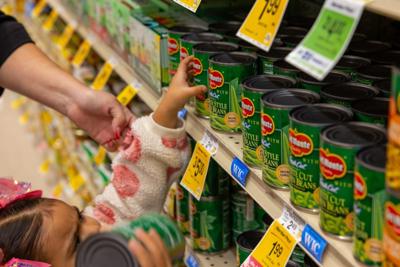
Repeal of Alabama’s grocery tax, once an effective political impossibility, has become a bipartisan issue in the fall campaign.
Long touted by anti-poverty groups and championed by Democrats, Republicans have sponsored efforts to reduce the tax over the past four years. John Wahl, the Republican nominee for lieutenant governor, made the issue central to his primary campaign this spring and Democratic gubernatorial nominee Doug Jones has centered it in his pitch to voters.
Last week, Republican gubernatorial nominee Tommy Tuberville, who had largely ignored the issue during his primary campaign, endorsed it in his first ad of the general election, saying “elimination” of the tax would be the first step in a broader tax-cutting program.
As of early Friday afternoon, Tuberville’s campaign website did not explicitly list cutting the grocery tax among his priorities. Messages seeking comment were left with Tuberville’s campaign on Thursday and Friday.
One of a handful
Alabama has taxed groceries since the sales tax was introduced in 1939. The state is one of eight that still imposes a levy on food, and until 2023 was one of an even smaller number that fully taxed it.
Efforts to eliminate the tax were complicated by the fact that it brought hundreds of millions of dollars into the state’s Education Trust Fund, which pays for most public education in the state, and disagreements over how to replace the lost revenue.
According to the Legislative Services Agency, in 2025 the sales tax rate on food brought $393.5 million to the Education Trust Fund. Through August, sales tax collections on food this year totaled $207.6 million. LSA expects total collections from the grocery tax for the year will be about $230 million, artificially lower because of a two-month sales tax holiday on food in May and June, which overlapped with state primary and runoff elections.
The cost to fully eliminate the remaining 2% state sales tax on food would be approximately $270 million.
“From an economic perspective, grocery taxes are effective at raising revenue because groceries are what we call inelastic goods in elasticity,” said Benjamin Meadows, an assistant professor of economics at the University of Alabama at Birmingham. “When we say that a good is inelastic in price, what that means is that when you change the price a little bit, people don’t change their behavior much.”
Anti-poverty advocates have long said the tax, which could rise up to 10% of a grocery bill in many parts of the state, hit low-income households particularly hard and contributed to food insecurity.
“Someone of limited means is going to pay more out of their paycheck proportionally than someone who is of adequate means,” Meadows said. “As you have less and less income, more of the income is devoted to that tax.”
But as other states have begun reducing or eliminating grocery taxes, the state has taken steps to do so. The Republican-controlled Legislature in 2023 reduced the state tax on groceries from 4% to 3%, and cut it to 2% in 2025. Local grocery taxes have been frozen but still remain in place.
Republicans have touted the move as a means of fighting inflation.
“I think the first thing we need to do on a state level is eliminate the rest of the state grocery tax,” said Sen. Andrew Jones, R-Centre, who led efforts to reduce the tax in the Alabama Senate.
Democratic counterparts said they had always supported eliminating the grocery tax. Former Rep. John Knight, D-Montgomery, a former chair of the House Ways and Means General Fund committee, fought for years to reduce the levy.
“Democrats have been advocating for eliminating the grocery tax for well over 20 years,” said Jones in an interview on Friday. “Republicans have been in control of the Legislature for 16 years, and they could have done it at any point.”





Jones, whose platform calls for fully eliminating the grocery tax, added that “there are people in this state that really need the break.”
Phillip Ensler, the Democratic nominee for lieutenant governor, said he has advocated for eliminating the grocery tax while he was a member of the House of Representatives and voted to reduce it in both 2023 and 2025.
“Everywhere I go in the state, it doesn’t matter if it is a bigger city or smaller town, Republican area or Democrat, there is overwhelming support to cut it because people are having a hard time, and we know that those few extra dollars on the grocery bill, it adds up,” Ensler said.
Though the lieutenant governor has little power to address the tax, the issue is one that Ensler and Wahl, the Republican lieutenant governor nominee, broadly agree on.
“I really have a heart for the people of Alabama, and I think there are a lot of people out there right now who are struggling to make ends meet,” Wahl said. “You have young families just working to put food on the table, seniors on fixed incomes who are having trouble just paying for basic necessities.”
‘A tax on survival’
Chris Sanders, a spokesman for Alabama Arise, an anti-poverty group that has long fought to eliminate the grocery tax, said the group was excited that “there is widespread, bipartisan support for untaxing groceries.”
“This is not a partisan issue,” he said. “It is a human issue, a moral issue, everybody has to eat to survive, and that makes the grocery tax a tax on survival.”
Rep. Danny Garrett, R-Trussville, who chairs the House Ways and Means Education Committee, which oversees levies like the grocery tax that go into the ETF, said in an interview Friday that a bill has been drafted to eliminate the remaining state portion of the grocery tax.
“What we said when we eliminated the first 50% that we thought we would be on a path to eliminate the remainder of it at some point,” Garrett said. “We have already drafted a bill; we have had a bill drafted a couple of months ago that would do that.”
Garrett’s plan to repeal the grocery tax altogether, however, does not include a provision to replace the lost revenue.
“We know the revenue growth, the projections on the budget,” Garrett said. “We can also look at expenses and things we have in the budget, so we have the wherewithal to repeal it.”
A constitutional amendment to fully eliminate the state grocery tax passed the Alabama House of Representatives in 2008, but failed to attract the necessary votes in the Senate. Both chambers were controlled by Democrats at the time. Subsequent efforts to address the issue got little traction until 2023.
Others have expressed concerns about the potential impact it would have on the ETF budget and proposed some alternatives. Alabama Arise, for example, wants to eliminate the federal income tax deduction, a longtime proposal from Democrats who called for eliminating the grocery tax.
“That is a highly skewed, highly upside-down tax break that overwhelmingly benefits the wealthy households in our state,” Sanders said. “For most people in Alabama, it is worth $100 or less, but for people at the very top of the income scale, it can be tens of thousands, potentially even hundreds of thousands of dollars, per year.”
Democrats, on the other hand, want to eliminate the CHOOSE Act, which provides tax credits of up to $7,000 per child to be spent on non-public school activities, including private school tuition.
“When we lift the caps off of the ability to have taxpayer money going to private schools for the wealthiest people in this state, I think we can offset this a good bit,” Jones said.
(0) comments
Welcome to the discussion.
Log In
Keep it Clean. Please avoid obscene, vulgar, lewd, racist or sexually-oriented language.
PLEASE TURN OFF YOUR CAPS LOCK.
Don't Threaten. Threats of harming another person will not be tolerated.
Be Truthful. Don't knowingly lie about anyone or anything.
Be Nice. No racism, sexism or any sort of -ism that is degrading to another person.
Be Proactive. Use the 'Report' link on each comment to let us know of abusive posts.
Share with Us. We'd love to hear eyewitness accounts, the history behind an article.