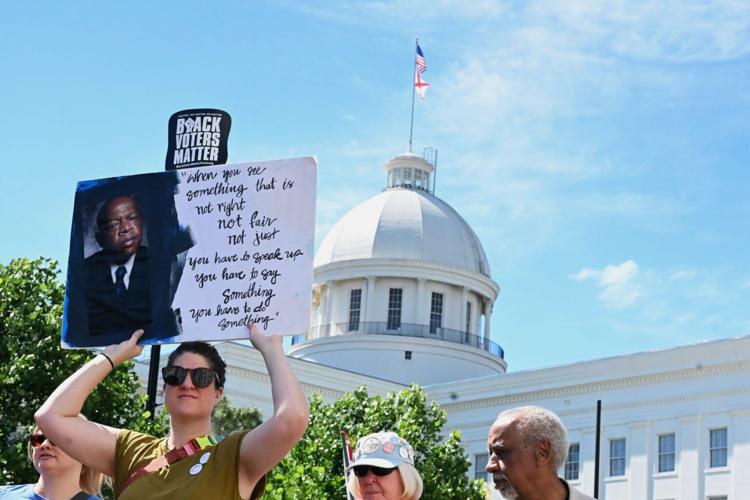

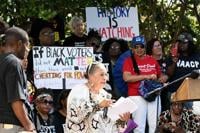
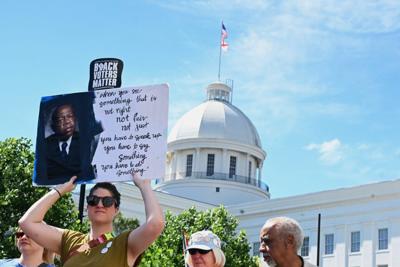
As Alabama legislators Monday convened for a special session on potential redistricting, at least 400 people turned out for a protest at Alabama State House, calling the session unconstitutional and demanding the state’s current maps be preserved.
Another event in Birmingham, which drew U.S. Rep. Terri Sewell, D-Birmingham; U.S. Sen. Cory Booker, D-New Jersey and former U.S. Sen. Doug Jones, a Democratic candidate for governor, drew about 150 people.
Lawmakers in the session will consider setting special primary election dates should the U.S. Supreme Court and the U.S. 11th Circuit Court of Appeals end injunctions against the state redrawing its congressional and state Senate districts.
The U.S. Supreme Court last week substantially weakened Section 2 of the 1965 Voting Rights in a case known as Louisiana v. Callais The court’s ruling prompted Secretary of State Wes Allen and Attorney General Steve Marshall to file emergency appeals in federal lawsuits on Thursday, seeking to lift a court order barring the state from redrawing its congressional maps until 2030.
The Supreme Court’s move led to calls from Republicans around the country to redraw congressional lines to add more GOP-leaning seats and concerns that such moves would rob Black southerners of congressional representation.
The rally, hosted by several non-profit organizations including the Southern Poverty Law Center, Black Voters Matter, Alabama Forward and American Civil Liberties Union (ACLU) of Alabama among others.
Carsie Evans, a protester at the event, said she showed up because of the Callais decision.
“Everybody’s vote matters. It doesn’t matter where you live, who you are, who you love or what color you are, your vote matters,” she said.

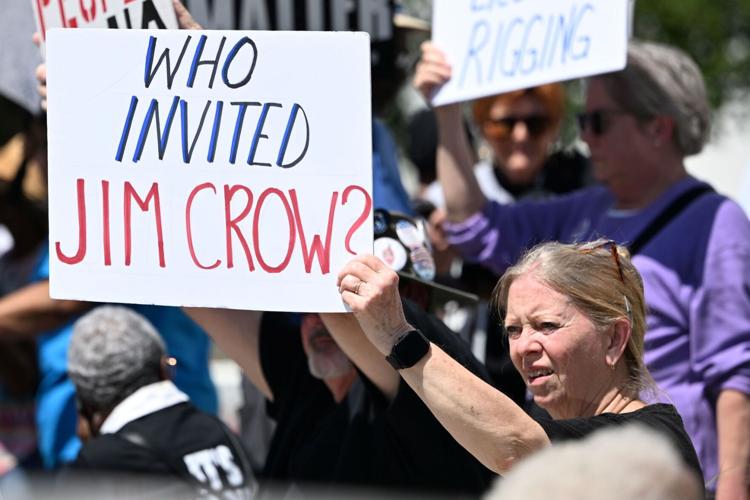
Carsie Evans of Anniston, Alabama holds a sign saying “Who Invited Jim Crow?” outside the Alabama Statehouse on May 4, 2026. The Alabama Legislature began a special session Monday that could result in changes to primary elections and current congressional legislative district lines. (Brian Lyman/Alabama Reflector)
Because of the injunction, ACLU of Alabama Executive Director JaTaune Bosby Gilchrist called the appeal unconstitutional and said it has already begun to disenfranchise voters.
“People are already participating in this election. And now, in the middle of that process, we are introducing confusion, shifting timelines, and creating instability,” she said during the protest. “That is not just disruptive—it is disenfranchisement. It undermines trust and puts voters at risk of being pushed out of a process they have already entered.”
Randy Kelley, chairman of the Alabama Democratic Party, said before the rally started that he wanted the Alabama Legislature to see how discontented people were with the decision to call a special session.
“We didn’t just get this right to vote as normal people would. We had to engage in direct action, conflict, confrontation and civil disobedience, and we plan on protecting our right to vote by whatever means necessary.”
Evans said while she doesn’t think Wednesday’s protest will have any particular effects on the outcome of the session, she hopes it will bring awareness to what’s happening.
“Perhaps public opinion will make a difference, and that’s why we’re here to be seen and let our views be known,” she said.
Deanna Reed, the Alabama state organizing manager for Black Voters Matter, a nonprofit organization that works to support Black voters and their rights, said the Legislature is trying to “run through that crack” the Supreme Court left when the Callais decision dropped.
“Let me be clear, because they want confusion. Even in this decision, the High Court has upheld Allen v. Milligan,” she said. “It upheld its earlier decision to prevent the people inside our house from redrawing voting maps until 2030.”
SPLC Alabama State Office Director Tefani English-Relf called the call for redistricting a distraction in her speech to the crowd.






“The pattern is always the same. They create a crisis, they blame Civil Rights and they grab power for themselves from Black people,” she said. “We will not rest until the full promise of our Democracy is felt by every voter.”

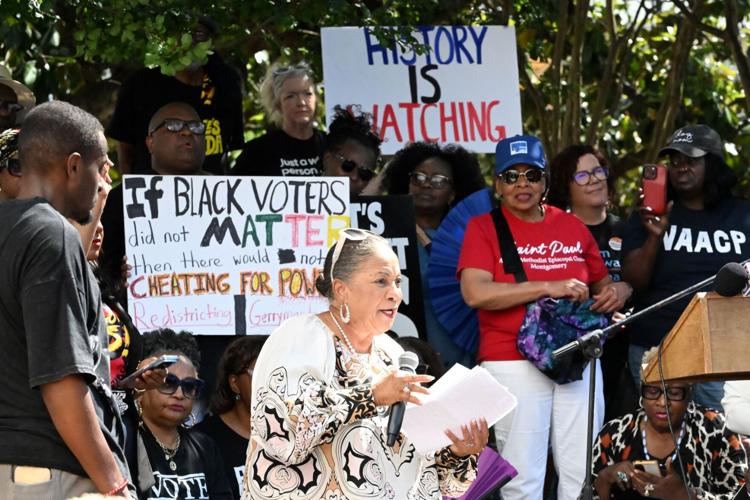
Sheyann Webb-Christburg (bottom center, holding microphone) speaks to a rally against redistricting on May 4, 2026 at the Alabama Statehouse in Montgomery, Alabama. The Alabama Legislature began a special session Monday that could result in changes to primary elections and current congressional legislative district lines. As an eight-year-old, Webb-Christburg marched over the Edmund Pettus Bridge on March 7, 1965 before law enforcement attacked protestors after they crossed, an event known as “Bloody Sunday” and a spur for the Voting Rights Act. (Brian Lyman/Alabama Reflector)
Sheyann Webb-Christburg, who as an eight-year-old in Selma was attacked by law enforcement on the Edmund Pettus Bridge on March 7, 1965, encouraged protesters to continue fighting for the right to fair elections.
“Now is the time more than ever for every generation to come together and fight back. To protest (for) the freedoms that others sacrificed, that others fought for,” she said. “We must not become discouraged.”
Birmingham
About 100 miles away, Rep. Terri Sewell, D-Birmingham hosted a conversation with U.S. Sen. Cory Booker, D-New Jersey. The event was billed as a discussion of national politics but became a de facto rally against the Legislature’s moves to reduce Black representation in Alabama’s congressional delegation.
In a discussion that lasted just over an hour, Sewell and Booker warned attendees to remain vigilant and steadfast amid what they consider efforts by Alabama Republicans to roll back the voting power of Black Alabamians.
“Moments like this are not a period, it is a comma,” Booker said of the justices’ ruling. “They voted a decision, but we get to decide our response. They rendered an opinion, but now we have to render history.”
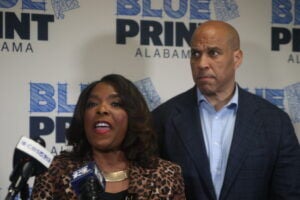
Rep. Terri Sewell, D-Birmingham speaks with members of the media on Monday in Birmingham before hosting a discussion with U.S. Sen. Cory Booker, D-New Jersey. She told reporters that state “will not go back” amid a U.S. Supreme Court decision that blunted the impact of the 1965 Voting Rights Act. (Ralph Chapoco/Alabama Reflector)
The senator cited numerous decisions from the U.S. Supreme Court that attacked civil rights, from 1896’s Plessy v. Ferguson, which ruled racial segregation unconstitutional, to 1944’s Korematsu v. United States, which upheld the internment of Americans of Japanese descent during World War II.
“The Supreme Court has never led history in this country,” Booker told the crowd. “It has always been the foot soldiers of democracy like those in this room.”
Sewell discussed President Donald Trump pushing Texas Republicans last summer to to redraw their U.S. legislative map in the party’s favor for the 2026 midterm elections.
One month later, the state convened two legislative sessions to reconfigure the congressional maps to create five additional Republican House seats. Texas’ move led to counterattacks from Democratic-led states. The U.S. Supreme Court’s recent ruling became the next logical conflict, with Alabama entering the fray after Republicans believed that the decision gave them license to oppose the injunction that required them to use the congressional map drawn by a special master until 2030.
In a news conference prior to the event, Booker and Sewell, along with former U.S. Senator Doug Jones, a candidate for the Democratic nomination for governor, sharply criticized Gov. Kay Ivey for calling the session.
“Right now, in Montgomery, Alabama, the Alabama Legislature and the leadership, down there in Montgomery, could not get down there quick enough to try to deny voters the right to vote and access to vote in Alabama,” Jones said during the news conference. “They could not get down there quicker.”
Sewell told Republicans in the state legislature to “do what is fair” and not create a map that produces an all-Republican congressional delegation.
“I would like to think that matters, representation does matter, and it does make a difference,” she said during the news conference. “I think it is important that we remind them of the horrific past that this state has endured. We are on the precipice of going backwards.”

(0) comments
Welcome to the discussion.
Log In
Keep it Clean. Please avoid obscene, vulgar, lewd, racist or sexually-oriented language.
PLEASE TURN OFF YOUR CAPS LOCK.
Don't Threaten. Threats of harming another person will not be tolerated.
Be Truthful. Don't knowingly lie about anyone or anything.
Be Nice. No racism, sexism or any sort of -ism that is degrading to another person.
Be Proactive. Use the 'Report' link on each comment to let us know of abusive posts.
Share with Us. We'd love to hear eyewitness accounts, the history behind an article.