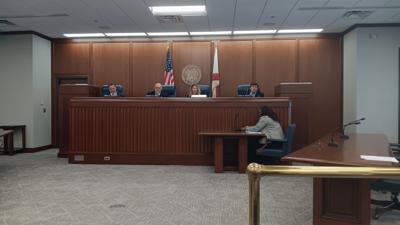
The Alabama Public Service Commission Tuesday approved a rate moratorium requested by Alabama Power.
The consent order imposes a two-year halt on increases to the fuel cost to generate electricity; the cost for operating Alabama Power’s power-generating plants; the cost of purchasing power from other companies, the cost of complying with government regulations and rate that guarantees a specific rate of return for the company, known as Rate Stabilization Equalization (RSE).
“We know budgets are tight, and power bills are a real concern for many families and businesses,” said Moses Feagin, Alabama Power’s executive vice president, chief financial officer and treasurer. “This commitment gives customers more certainty and predictability around electric rates at a time when many other household and business costs are rising.”
The move came amid growing concerns over affordability around the country, particularly as electricity rates continue to rise. In Georgia, where Alabama Power’s sister company Georgia Power operates, concerns over electricity rates led voters to elect two Democrats to that state’s Public Service Commission, the first time Democrats won a statewide constitutional office in Georgia since 2006.
Alabama historically has some of the highest residential power rates in the South.
Renewable energy advocates, while pleased with the rate freeze, do not believe they go far enough to provide relief for residents who pay for electricity.
“The rate is still generally high, especially for a southeastern state,” said John Dodd, policy manager for Energy Alabama, a nonprofit that advocates for more renewable energy use in Alabama, in an interview after the meeting. “We have one of the highest power rates in the southeast right now. Rate payers are not going to get any relief. They are not going to get any rebates either.”
The process to freeze electricity rates began when Alabama Power filed a request with the Public Service Commission at the end of November to fix several of the rates that it charges customers for its operations.
“Working with Commission staff, Alabama Power has considered its forecasted and estimated cost of service across cost years 2026 and 2027, respectively, and believes it can offer other commitments to provide customers with additional rate certainty in both 2026 and 2027,” Feagin said in the filing.
In exchange, the company asked the commission to allow it to apply the money that it would have used to refund customers from the Rate RSE to the Natural Disaster Reserve fund — dedicated to restoring utility services after a natural disaster — to “forestall an increase associated with Rate NDR” because of a current negative balance in the account.
“This would wipe out that negative balance, and as we have said, take that off the table and better position the company to deal with inevitable storm damages that got us to where we are that transpired last spring over the course of the last couple of springs,” said John Garner, executive director of the Alabama Public Service Commission.





The company also requested permission to use nuclear production tax credits to help offset the cost of the rate freezes.
Without the moratorium, electricity costs for residents would have increased at least in part to fund the purchase of the Lindsay Hill natural gas power generating station in Billingsley. Alabama Power said the plant was needed to address a forecasted surge in electricity demand from data centers in the state over the next few years.
Alabama Power requested the PSC to allow it to increase the monthly electricity rates on customers by $3.32 starting in the middle of 2027.
The Southern Environmental Law Center, a nonprofit that advocates on behalf of the environment, represented Energy Alabama and the Greater-Birmingham Alliance to Stop Pollution at the PSC to prevent Alabama Power purchasing the plant. SELC said that the company did not consider all the available alternatives before it chose to purchase the power plant in Billingsley and that it overestimated the electricity demand of data centers.
Groups such as Energy Alabama remain critical of the process that eventually led to the rate freeze that began when Alabama Power made the request in its filing.
“What I would have wanted to see is a comprehensive plan where the power company, rate payers, and the commission come together with a public rate case hearing and talk about what is really at the center of why rates are so high,” Dodd said. “What can we do to bring down this record-breaking profit that Alabama Power rakes in every year and lower the return of equity while simultaneously protecting the Natural Disaster Reserve Fund that they were talking about in the meeting.”
Prior to the start of Tuesday’s meeting, Energy Alabama submitted a petition signed by almost 700 people requesting that the PSC reject the proposal from Alabama Power to fix some of the utility rates.
“Cost recovery is simply pushed into future years, which could increase the total amount customers pay, particularly if deferred balances accrue interest,” said Energy Alabama Executive Director Daniel Tait said in an email along with the petition.
PSC President Cynthia Almond said in an interview after the vote that the PSC followed the process it had in place now.
“This is what we have to work with,” she said. “Who is to say what the future may hold, but right now, that is where we are, and that is the process that we go through. This is the law that we have to work within.”


(0) comments
Welcome to the discussion.
Log In
Keep it Clean. Please avoid obscene, vulgar, lewd, racist or sexually-oriented language.
PLEASE TURN OFF YOUR CAPS LOCK.
Don't Threaten. Threats of harming another person will not be tolerated.
Be Truthful. Don't knowingly lie about anyone or anything.
Be Nice. No racism, sexism or any sort of -ism that is degrading to another person.
Be Proactive. Use the 'Report' link on each comment to let us know of abusive posts.
Share with Us. We'd love to hear eyewitness accounts, the history behind an article.