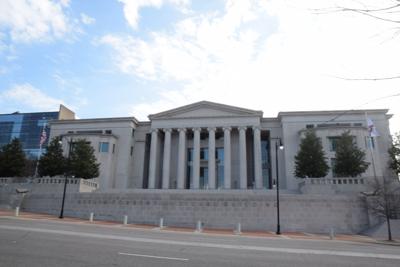
The Alabama Supreme Court Friday ruled that state law enforcement may arrest people who do not provide identification if they are not satisfied with the answers they provide about their identities.
The court ruled 6-3 that an Alabama law that requires people to provide their names, addresses and an explanation of their actions to law enforcement if they suspect someone of a crime also allows them to demand that they provide identification.
“Establishing a suspect’s correct identity furthers an important governmental function by allowing an officer to confirm whether a suspect is violating the law or by eliminating the suspect from suspicion,” Associate Justice William Sellers wrote in the majority opinion.
The crux of the case is a person’s Fourth Amendment right against unreasonable searches and seizures. The U.S. Supreme Court has ruled that the Constitution allows law enforcement to stop and detain someone to investigate, otherwise known as a Terry stop. An investigative stop must be temporary, not last “longer than is necessary” and be done in the least intrusive way as possible.
Sellers wrote that “the suspect bears the burden to completely identify himself or herself during a valid Terry stop; thus, failing to provide sufficient identifying information when demanded to do so violates Alabama law.”
Matthew Cavedon, director of the Cato Institute’s Project on Criminal Justice, who was involved in the lawsuit, said he is disappointed in the Alabama Supreme Court’s ruling.
“Alabama law does not say that Alabamians have to carry physical identification on them,” he said in an interview on Monday. “The Alabama Supreme Court decided to say that Alabama law simply reflects the outer limits of what the federal constitution allows officers to do, but there is no basis for that in the actual law at issue,” he said.
A message was sent to the Southern Poverty Law Center on Monday seeking comment.
The case stems from a lawsuit filed in 2022 by Michael Jennings, a pastor who lives in Childersburg. According to the lawsuit, Jennings, who is Black, was stopped by law enforcement officers while watering the flowers at a neighbor’s house. Another neighbor, who thought Jennings was not supposed to be there, called the police.





Law enforcement officers then stopped and questioned Jennings, who said he was supposed to be there because he was caring for his neighbor’s place while they were away from vacation.
Officers then asked for identification but “the man became very agitated and stated that he would not provide any identification,” the Alabama Supreme Court ruling said. Additional officers arrived and the situation escalated. Eventually, Jennings was placed under arrest and charged with obstructing a governmental function before the charges were dismissed.
Jennings then sued the officers and the city of Childersburg for false arrest in U.S. District Court for the Northern District of Alabama. He lost in district court, but the U.S. 11th Circuit Court of Appeals ordered remanded back to federal district court after it ruled the Alabama law “as prohibiting law-enforcement officers from requesting physical identification from a suspect.”
The federal district court requested the Alabama Supreme Court justices to rule on whether the state law requires a person to provide a name, address and explanation of the individual’s actions.
The Alabama Supreme Court relied on a case from Nevada in which law enforcement stopped and detained Larry Hiibel who refused to identify himself. The case eventually reached the U.S. Supreme Court and the justices ruled, 5-4, that law enforcement may require people to identify themselves during a Terry stop.
Sellers wrote that the Alabama law does not expressly authorize law enforcement to request additional information during a Terry stop, “nothing in the language or legislative history of the statute indicates any legislative intent to prohibit officers from asking questions regarding identity that would be permissible under the Fourth Amendment within the limited scope of a valid Terry stop.”
Associate Justice Brady Mendheim, Jr., joined by Chief Justice Sarah Stewart and Associate Justice Chris McCool, wrote a dissenting opinion. Mendheim wrote that he agreed with the majority opinion on the merits of the case, but said the court “is now presented with a question that will require us to state or infer either that the Eleventh Circuit Court of Appeals erred in Jennings I.”
“In other words, this case is postured such that this Court essentially is reviewing the decision of the Eleventh Circuit Court of Appeals in Jennings II rather than entertaining a question from that court regarding Alabama law for purposes of prospective application to the case,” Mendheim wrote.
Clarification: The story was updated to reflect that the affiliate on the case responded to a call seeking comment.

(0) comments
Welcome to the discussion.
Log In
Keep it Clean. Please avoid obscene, vulgar, lewd, racist or sexually-oriented language.
PLEASE TURN OFF YOUR CAPS LOCK.
Don't Threaten. Threats of harming another person will not be tolerated.
Be Truthful. Don't knowingly lie about anyone or anything.
Be Nice. No racism, sexism or any sort of -ism that is degrading to another person.
Be Proactive. Use the 'Report' link on each comment to let us know of abusive posts.
Share with Us. We'd love to hear eyewitness accounts, the history behind an article.