Amid ongoing federal and state attempts to limit access to vaccines or loosen vaccination requirements, data shows that Alabama has fallen below national averages for children being up to date on some vaccines.
The state is trailing the country for uptake of vaccines for whooping cough and Hepatitis B, while immunization rates against measles have swung above and below rates that experts consider necessary to attain herd immunity.
The vaccination rate for children aged 13-17 nationwide remained high in 2024, but it drops significantly in Alabama as children age. Where about 70% of 4-10-year-olds are up to date on vaccines statewide, only 25% of children 11-18 years old are up to date.
Experts say misinformation and struggles to access medical care around the state are playing a role.
“There were several insurance companies that didn’t even cover routine immunizations,” Dr. Norma Mobley, a Mobile-based pediatrician, said. “We at the AAP level, that was something that they really worked hard toward making sure that all children under insurance policies could receive routine, recommended vaccines.”
Mobley, president of the Alabama chapter of the American Academy of Pediatrics (AAP), has started to see cases of whooping cough, a highly contagious respiratory infection, despite a vaccine for the disease existing for nearly 30 years.
Statewide, 69% of Alabama’s 19-47-month-olds are up to date on the diphtheria-tetanus-pertussis (DTaP) vaccine, according to data from ADPH. Nationwide, 80.4% of children in the U.S. are vaccinated against whooping cough by the time they turn two in 2021, according to the CDC. The CDC recommends doses of the DTaP vaccine at one- and two-months-old.
Mobley said in an interview Tuesday that she has seen younger parents as more hesitant to vaccinate their children. That, along with how long it takes for a child to be fully vaccinated has led to the return of diseases that are no longer common, she said.
“If you’re going to give them the vaccines, you might as well just do them the way they’re scheduled,” Mobley said “You’re still going to poke them the same number of times, whether you do them a week apart or not.”
Misinformation from social media has also contributed to a decrease in vaccinations, especially for influenza vaccines, Mobley said.
“We had a lot of people reading sources saying that there’s a combination of the flu and the COVID vaccine,” she said. “That’s not true.”
Influenza

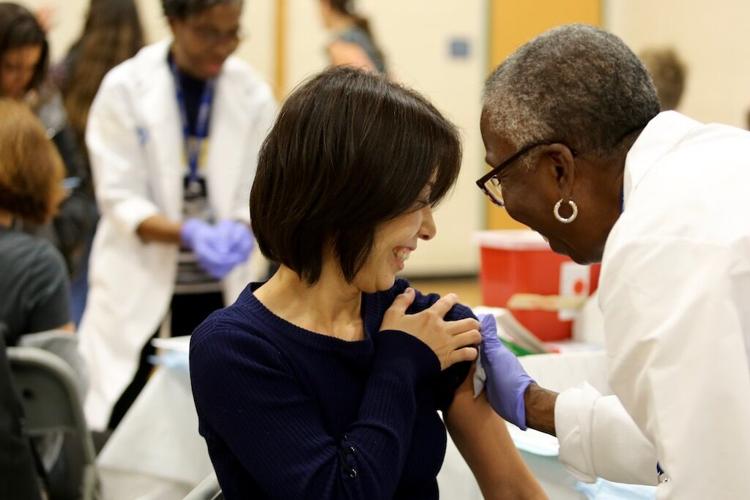
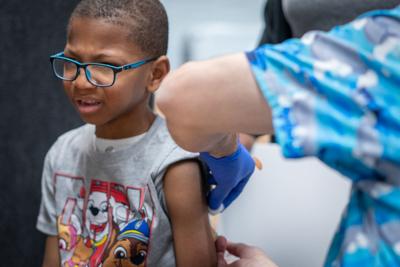
A woman receives a flu vaccination at a recent clinic in Cambridge, Mass., conducted by health care providers from the Cambridge Health Alliance. (Courtesy of the City of Cambridge)
According to the ADPH data, 6.3% of Alabamians 18 years old and under were vaccinated against influenza for the 2025-26 flu season as of Nov. 25. The season spans from Oct. 1 to Sept. 30, 2026, according to ADPH. In the 2024-25 flu season, 13.1% of children were vaccinated against influenza, according to the data. The CDC recommends a flu shot every year starting at 6-months-old, with some children needing two doses.
According to the ADPH data, about 345,000 adults have gotten the flu vaccine so far this season, which is about half of all adults that received the vaccine in the 2024-25 season.
Dr. Wes Stubblefield, district medical officer at ADPH, said the best way to combat misinformation on vaccines is a good patient-physician relationship.
“We want to make sure that our providers are having conversations with their parents, with their patients and parents, especially those that have questions about vaccines or or have not received vaccines in the past,” Stubblefield said in an interview Wednesday.
Efforts to loosen vaccination requirements have taken hold in the Alabama Legislature. A bill sponsored by Sen. Arthur Orr, R-Decatur, that would have allowed parents to declare their children religiously exempt from vaccines failed in the 2025 session, but Rep. Mack Butler, R-Rainbow City, pre-filed a similar bill for the 2026 legislative session, which starts in January.






HB 24 would allow parents or guardians to object to vaccination or testing requirements by submitting a written statement stating that the vaccination or testing conflicts with their religion as valid grounds for exemption from any school enrollment vaccine or testing requirement. It also specified that no additional forms, fees or documentation could be required of the parent, guardian or child for enrollment in any public K-12 school. The bill would have also extended these provisions to public colleges and universities.
Mobley said vaccinating children is ethical practice because it keeps children out of harm’s way.
“We take a vow when we graduate from medical school to do no harm,” she said. “If we know we’re holding back on something that could place that patient at risk, then to me, that’s placing them in harm’s way.”
Friday, the federal Advisory Committee on Immunization Practices voted to end a 35-year recommendation to vaccinate infants against hepatitis B virus (HBV) on the day they are born. The new recommendation is to only vaccinate infants whose mothers test positive for the disease or have not tested.
According to the Mayo Clinic, HBV is a viral liver disease that can be transmitted through sexual or blood contact with somebody who is not vaccinated or from a mother to her baby. It can cause liver failure, liver cancer and cirrhosis. For most, the disease lasts six months or less, but it can also be chronic.
According to the ADPH data, about 76% of 19-47-month-olds in Alabama are up to date on the HBV vaccine. It is one of two vaccines infants get the day they are born. According to the CDC, 91.4% of children in the U.S. were fully vaccinated against HBV by the time they turned two in 2021.
Measles

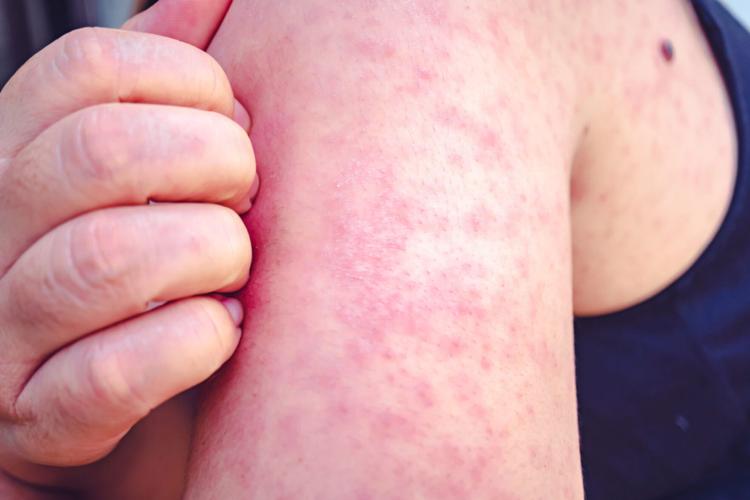
A woman scratches a measles rash. (Getty Images)
Amid outbreaks of the disease around the country, Alabama reported a confirmed case of measles this year, the first in the state since 2002. An unvaccinated child under five years old contracted the highly contagious disease while traveling outside the country. ADPH later said the child recovered.
Mobley said she has not seen any pushback against the MMR vaccine. According to the Centers for Disease Control, measles immunity has moved up and down in recent years. About 95.3% of Alabama kindergarteners were vaccinated against measles in the 2024-25 school year, more than the 95% considered necessary for herd immunity. But it was about 93.8% for kindergarteners the year prior.
“Herd immunity is 95% so we’re still pretty close. We’re doing a good job in our state in that regard,” she said.
According to the ADPH data, 77% of children under 10 are up to date on the MMR vaccine. According to Cleveland Clinic, children typically receive the second dose of the vaccine between four and six years old.
Some counties, especially in Dale, Henry and Houston in the Wiregrass, have significantly lower vaccination rates, according to the data. Mobley said there are small groups of parents throughout the state that are either skeptical, hesitant or against vaccinating their kids.
“The only thing that we try to make sure they do is go through the health department to obtain those exemptions so that it is documented through the registry, so we know who’s not immunized,” Mobley said of those who seek vaccine exemptions.
Stubblefield said that access to health care could contribute to it, especially in Wiregrass counties, like Dale, Henry and Houston. According to the data, 49% of 19-47-month-old children are up to date on vaccines in Dale County. Henry and Houston counties are at 53% and 52%, respectively, for the same age group. Statewide, 65% of the same age group is up to date.
“We also have some counties in Alabama that have very limited access to vaccinations in general, particularly in the south central and southwest part of the state,” he said.
This story is from alabamareflector.com.

(0) comments
Welcome to the discussion.
Log In
Keep it Clean. Please avoid obscene, vulgar, lewd, racist or sexually-oriented language.
PLEASE TURN OFF YOUR CAPS LOCK.
Don't Threaten. Threats of harming another person will not be tolerated.
Be Truthful. Don't knowingly lie about anyone or anything.
Be Nice. No racism, sexism or any sort of -ism that is degrading to another person.
Be Proactive. Use the 'Report' link on each comment to let us know of abusive posts.
Share with Us. We'd love to hear eyewitness accounts, the history behind an article.