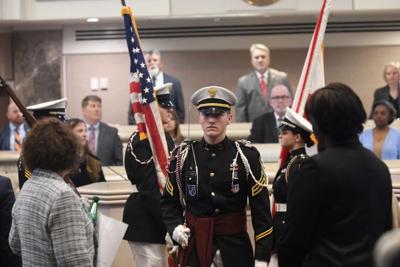
Alabama voters will decide in November whether to amend the state constitution to require school boards to adopt policies the daily recital of the Pledge of Allegiance in schools and student-led prayer, as well as the broadcast of the Star-Spangled Banner every week.
Amendment 3, sponsored by Rep. Reed Ingram, R-Pike Road, requires K-12 public schools to adopt policies on the Pledge of Allegiance to draft another policy that would allow for student-led prayer. The House of Representatives approved the measure on a 94-3 vote last spring; the Senate approved it 30-0.
Ingram said in an interview he tried for several years to get a bill related to school prayer and the Pledge of Allegiance approved in the Legislature.
The bill requires school districts to create a policy that requires students to “voluntarily” recite the Pledge of Allegiance toward the U.S. flag.
“We give the tax dollars for the kids to go to school, and we would like the kids to know that this is America and that is where your tax dollars are coming from,” Ingram said.
HB 511 also requires school districts to adopt a policy to allow prayer in school that is “initiated by and led” by a student.
“A lot of kids do not have the opportunity to have meals at home, just like they don’t have the opportunity to pray at home or go to church,” Ingram said in an interview Tuesday. “This gives them that opportunity.”
Alabama state law since 1976 has required schools to conduct the Pledge of Allegiance each day. Students can not be coerced into reciting it. In addition, students are already allowed to pray in public schools when not doing school activities or participating in instruction. Ingram said his amendment would protect both policies from lawsuits.
“The Pledge of Allegiance is the law now, but a lot of schools are not doing it,” Ingram said. “This takes it to a constitutional amendment where if there is any litigation, then it would eliminate the litigation in the future.” Ingram did not say which schools were not conducting daily recitals of the Pledge of Allegiance.
The legislation does not require students to participate in any prayer or the Pledge. Despite that, constitutional rights experts have expressed concerns with the provisions.
“This could run up against some U.S. Supreme Court decisions that have made things pretty obvious, some others that are a little less obvious, in part because, in my opinion, of how the amendments are worded,” said Steven P. Brown, a professor of political science at Auburn University.
The constitutional problems center on the participation of students in the activity. Brown cited the 1943 case of West Virginia State Board of Education v. Barnette, in which the justices issued a ruling 6-3 that public schools cannot force students to salute the American flag or recite the Pledge.
At the time, schools in West Virginia required all public-school teachers and students to participate in the pledge of allegiance and to salute the flag each day or face expulsion. Walter Barnette and other Jehovah’s Witnesses filed a lawsuit that stated saluting the flag violated their religious beliefs.






“If there is any fixed star in our constitutional constellation, it is that no official, high or petty, can prescribe what shall be orthodox in politics, nationalism, religion, or other matters of opinion or force citizens to confess by word or act their faith therein,” said Justice Robert Jackson in his opinion.
Brown also cited the U.S. Supreme Court case of the Santa Fe Independent School District v. Doe in 2000, when the justices decided that school districts cannot allow student-led, student-initiated prayer over the public address system before high school football games.
Before 1995, the high school permitted an elected student council to deliver a Christian prayer over the stadium loudspeaker. A Catholic family and a Mormon family, under a pseudonyms, filed a lawsuit that alleged the activity violated the Establishment Clause of the First Amendment that prohibits the government from establishing or endorsing religion.
“What is the oversight power of the school in something like this?” Brown said. “If you have a kid who stands up and wants to give a prayer to Satan, there is no question the school is going to step in.”
Brown is concerned about the editorial discretion the local government and the school would have in the situation. Conceivably, a student could want to lead a Muslim-based prayer.
“I don’t see that happening,” Ingram said. “It is going to be set up by the school boards. I see more of the Christianity and that type. I don’t know if anybody who said that or who would be excited to do that. I think that is a fear factor in a lot of people’s minds.”
The League of Women Voters of Alabama opposes the amendment.
“The overarching concern is that you are impinging on people’s rights,” said Kim Bailey, president of the League of Women Voters of Alabama. “You are not allowing people to make a choice as to what to do.”
Amendment 4, sponsored by Gerald Allen, R-Cottondale, would require school districts to play the first stanza of the national anthem.
A message was sent to Allen on Tuesday seeking comment.
Brown was not as concerned with this amendment, saying it did not require students to participate in the activity.
“I think that is different because it is passive, you are not requiring anybody to do anything,” Brown said.
(0) comments
Welcome to the discussion.
Log In
Keep it Clean. Please avoid obscene, vulgar, lewd, racist or sexually-oriented language.
PLEASE TURN OFF YOUR CAPS LOCK.
Don't Threaten. Threats of harming another person will not be tolerated.
Be Truthful. Don't knowingly lie about anyone or anything.
Be Nice. No racism, sexism or any sort of -ism that is degrading to another person.
Be Proactive. Use the 'Report' link on each comment to let us know of abusive posts.
Share with Us. We'd love to hear eyewitness accounts, the history behind an article.