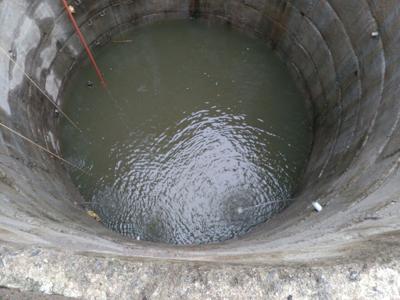

Private well water in the Black Belt has more fecal contamination than water supplied by water systems, according to research from the Centers for Disease Control and Prevention.
“Our results suggest that children in households in (the Black Belt) that are reliant on domestic wells may experience increased risks for enteric pathogen exposure compared with children in households with water supplied by utilities,” a report posted on the CDC website earlier this month says. “Elevated levels of fecal contamination in groundwater could be related to documented deficiencies in rural sanitation in the region.”
The report continues, “Elevated levels of fecal contamination in groundwater could be related to documented deficiencies in rural sanitation in the region.”
The report notes what residents of the Black Belt have known all along. The clay beneath the famous Black Belt prairie soil shrinks when it dries out and swells when it gets moist, creating vertical channels deep into the ground.
“Those conditions may lead to fecal waste transport from failing septic tanks and straight pipe discharges through soils to the water table, resulting in exposures through drinking water,” the paper says.
CDC researchers focused not on the water but on the folks who drink the water. Stool samples from 352 households in the Black Belt were collected to measure bacteria “that may be associated with water and sanitation,” the research paper says.






The goal of the research was to see if families that disposed of their sewage via “straight piping,” that is discharging their sewage above ground because the soil doesn’t accommodate septic tanks, have more pathogens in their stool than residents who have a sewer or septic tank. Straight piping is common in some rural areas and was the basis for a landmark environmental justice lawsuit in Lowndes County.
To their surprise, researchers said that they didn’t find more pathogens in the stool of families without a formal sewage disposal system. But the CDC study confirmed earlier studies that showed that families that rely on well water have more pathogens in their stool compared to families who get their water from a utility.
This study confirmed previous work in the Black Belt that “observed an increased concentration of fecal contamination in well water compared with piped municipal water,” according to the CDC report. “In a cross-sectional study of randomly selected households in Hale County, 20% of private wells were positive for fecal coliforms, compared with 8% of public water system specimens.”
The CDC report states, “In conclusion, our results suggest that children in households in this region that are reliant on domestic wells may experience increased risks for enteric pathogen exposure compared with children in households with water supplied by utilities. Elevated levels of fecal contamination in groundwater could be related to documented deficiencies in rural sanitation in the region, and water as a proximal exposure pathway merits further exploration.”
The report notes that new ways of delivering water and disposing of waste may overcome “the limitations of the current paradigm of each household being fully responsible for waste management despite the potential for collective impacts on public health.”
(0) comments
Welcome to the discussion.
Log In
Keep it Clean. Please avoid obscene, vulgar, lewd, racist or sexually-oriented language.
PLEASE TURN OFF YOUR CAPS LOCK.
Don't Threaten. Threats of harming another person will not be tolerated.
Be Truthful. Don't knowingly lie about anyone or anything.
Be Nice. No racism, sexism or any sort of -ism that is degrading to another person.
Be Proactive. Use the 'Report' link on each comment to let us know of abusive posts.
Share with Us. We'd love to hear eyewitness accounts, the history behind an article.