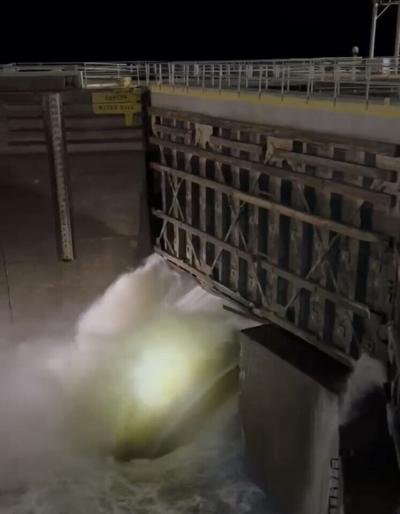


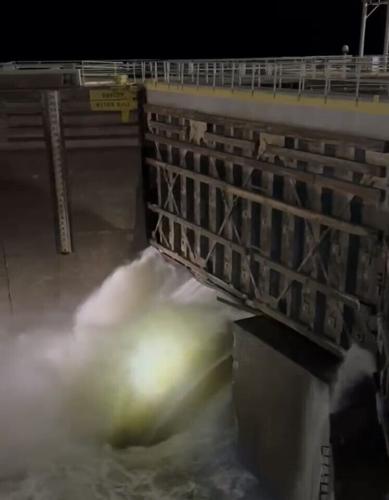
The Demopolis Lock is closed to traffic until further notice for maintenance and repairs because of a breach that occurred Jan. 16, the U.S. Army Corps of Engineers said Monday.
The breach was caused by a concrete sill failure. The question now is what caused that concrete to fail and how can it be repaired, officials said.
The Corps of Engineers maintains and operates the locks along the state’s waterways. On Jan. 19, the Demopolis Lock chamber was restored to upper pool elevation after successful miter of the lower miter gate. However, this only stopped the leak; it did not fix the problem, according to officials.
On Jan. 22, about 115 stakeholders joined a conference call hosted by the Corp of Engineers Mobile District Chief Nelson Sanchez to get an update. The group included tow boat companies, marinas, mining companies and a large number of other industries that rely on water routes to get products to their customers.
Project Manager Ryan Reich reported that earlier on Jan. 22 a team from the Corp of Engineers and Demopolis Mayor Woody Collins met at the lock. “We were able to access the sill area and get a little bit closer view,” Reich said. “We looked at the panels and the sheared concrete monolith.” Reich said sonar video was also taken.
Chief of Engineering Jason Krick echoed Reich. “We’re waiting on a multi-beam survey to get a better idea to see what’s going on under the water,” Krick said. He said that will help determine if there are any problems with the foundations. Krick said they do not believe there are any foundation issues, but they could not see it today.
After those reports, Sanchez reported that the Corp of Engineers is currently moving equipment to Demopolis. However, it looks like it will rain this week. Sanchez introduced James Hawthorne, who said the forecast for this week calls for “four to five inches of rain, and that includes Demopolis.” He added that the lock will likely rise to 40 feet Jan. 24 and up to 70 feet or more by Jan. 30.
Sanchez said although the weather will cause a slight delay, it will give plenty of time to get all the necessary equipment into place. Beams said the first crane should arrive Jan. 29, the next by the following Friday.
Corp of Engineer officials added that weather and moving equipment to Demopolis will take time, and it will take at least two days to pump the water out of the lock.






To assess the damage, the water must be pumped out of the lock, and can’t be done if the river rises as much as it is expected to rise.
Mike Beams, chief of technical support branch for operations in the Mobile district, said this has never happened before.“Nobody has ever lost concrete like this,” Beams said. “We’ve had miter gated come off and maybe a guide wall fall over, but nobody has ever had part of the chamber fall.”
Beams said the lock at Demopolis is turning 70 years old, but even so, it is unknown exactly why the concrete failed. A complete and thorough assessment is necessary to not only find a proper fix for Demopolis lock but also to discover potential problems and formulate plans to prevent the same thing happening at any other lock on the state’s waterways.
Sanchez said he and his people realize that time is of the essence because so many businesses and industries rely on river transportation. He said the Corp of Engineers will operate with expediency knowing that having river traffic at a standstill will affect the economy.
One Corp of Engineers official said the economic effect on companies that rely on the river could be as much as $2 million per month. An official from Parker Towing, a tow boat company out of Tuscaloosa County, expressed concern about the time it will take for repairs.
J.B. Holiday from American Consolidated Natural Resources’ Crimson Oak Grove mine, a coal mine near Birmingham, said, “Crimson Oak Grove will lose way more than a couple million dollars per month.” He said the company’s concern is that the lock could be shut down well into March.
At this early stage in the situation, there is no way for authorities to give a date for the work to be completed.
Beams and other Corp of Engineer officials said that they are considering all possibilities. Once the chambers are emptied and a thorough assessment can be made, they may be able to formulate a quick fix that will take less time to get river traffic flowing again.
But they also warn that a quick fix may not be possible depending on what they find once they get the water out of the way. Beams said he understands the economic impact and that industry wants to fix it fast. “You can do it fast, or you can do it smart,” Beams said. Beams said they are trying to do it smart, because “we don’t want to have to do it twice."
(0) comments
Welcome to the discussion.
Log In
Keep it Clean. Please avoid obscene, vulgar, lewd, racist or sexually-oriented language.
PLEASE TURN OFF YOUR CAPS LOCK.
Don't Threaten. Threats of harming another person will not be tolerated.
Be Truthful. Don't knowingly lie about anyone or anything.
Be Nice. No racism, sexism or any sort of -ism that is degrading to another person.
Be Proactive. Use the 'Report' link on each comment to let us know of abusive posts.
Share with Us. We'd love to hear eyewitness accounts, the history behind an article.