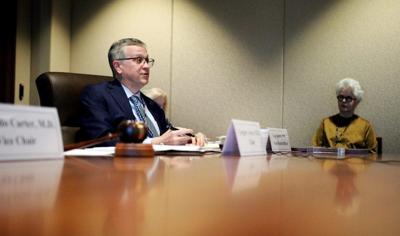
State Health Officer Dr. Scott Harris described to lawmakers on Wednesday the fiscal limbo in which the Alabama Department of Health finds itself as it awaits further federal directives and funding decisions from Washington.
About two-thirds of ADPH’s more than $1 billion annual budget comes from federal funding. In 2024, about 11% came from the state’s General Fund, Harris told members of the committees that approve General Fund spending every year.
Under the new Trump administration, health care priorities have changed and 2026 funding hasn’t been finalized.
Some current programs may not be funded, Harris said.
“Frankly, there is a lot of uncertainty in the next five weeks, waiting to see what a new continuing resolution looks like coming out of Congress,” Harris said.
“… We just don’t have a lot of clarity right this minute on what we’re going to have funding for soon.”
A U.S. House subcommittee is expected to start marking up that chamber’s version of a health care spending plan next week. It has to be finalized by the end of September.
Earlier this year, the Trump administration clawed back about $175 million in previously approved grants, Harris said. The largest pool of money was for the detection, prevention and response to infectious disease outbreaks.
“(That was money) we thought we had on a Monday that we didn’t have access to on a Tuesday,” he said.
Those programs have stopped.
Harris said the ADPH leadership is now reviewing the department’s existing programs and identifying what may not be funded beyond September.
“We really have spent a lot of time trying to figure out what Alabama Department of Public Health is mandated to do,” Harris said.
Those mandates include food safety and lodging inspections, maintaining health statistics and vital records, licensing of EMS providers and family health services.
A list of discretionary public health services, shared by Harris, included vaccines for children at county health departments, free STD testing at the county departments and a prenatal Hepatitis B program to prevent infections in newborns.
“We believe everybody ought to have access in their own county to these kinds of services,” Harris said.
Sen. Greg Albritton, chair of the Senate General Fund committee, later told Alabama Daily News the state can’t make up any lost federal funding, especially on a month’s notice.
$50 billion federal fund
Harris also discussed the new $50 billion rural hospital fund created in July under the “big, beautiful” law in response to other cuts, including to Medicaid. Questions remain there too.






Harris said Alabama can expect to get at least $100 million per year for five years, and up to $200 million per year. Questions still remain on how much the state will get and how it can be used. States will have to apply for at least some of the money and that application will come out of the governor’s office, Harris said.
Rep. Chris Sells, R-Greenville, asked if a definition of “rural” has been established. It has not.
“I think we have about five different definitions floating around (in the state),” Sells said about the definitions in various state statutes.
Rep. Paul Lee, R-Dothan, said he wanted any allocation of money to hospitals to include their “true financials.” He talked about two hospitals within five miles of each other in his district. One is doing well financially, one is barely hanging on. He’d like to know why.
In Alabama, 23 hospitals are at an immediate risk of closing. That’s about half of all rural hospitals in the state, according to a June report from the Center for Healthcare Quality and Reform. Lawmakers on both sides of the aisle acknowledged the need to keep hospitals open.
Sen. Linda Coleman-Madison, R-Birmingham, said there is no economic development in rural Alabama without health care infrastructure.
“This is an issue that we can’t afford to kick down the road anymore,” she said.
Sells said rural hospital closures are a statewide issue.
“It doesn’t matter if you live in a rural area or you live on Lake Martin, you’re gonna be affected,” Sells said. “Right now, you can barely get a room (in a Montgomery hospital).”
Albritton noted that other state agencies, including mental health and Medicaid, have talked about uses for this new federal funding stream.
He said it should be up lawmakers to decide how it is spent.
The Alabama Department of Finance on Wednesday said the state is awaiting guidance from the Centers for Medicare and Medicaid Services before developing a formal plan for the potential use of these funds.
CHIP ask to increase to $100M in 2027
Lawmakers will be asked in the 2027 budget to increase the state’s contribution by $15 million to $100.6 million for the Children’s Health Insurance Program, a low-cost health care program for children. Known as CHIP or ALL Kids, it has higher income requirements than Medicaid and offers working families low premiums for Blue Cross and Blue Shield coverage. This year, it reached more than 100,000 enrollees.
“CHIP is really how a government health care program ought to work,” Harris said.
But enrollment and health care cost increases are driving up the state’s share.
While lawmakers didn’t question the need for the program, some did question whether all of the expenses need to remain in the General Fund. In fiscal year 2024, it was a $54 million expense.
Albritton said budget leaders may need to look at taking some CHIP funding “from another budget.”

(0) comments
Welcome to the discussion.
Log In
Keep it Clean. Please avoid obscene, vulgar, lewd, racist or sexually-oriented language.
PLEASE TURN OFF YOUR CAPS LOCK.
Don't Threaten. Threats of harming another person will not be tolerated.
Be Truthful. Don't knowingly lie about anyone or anything.
Be Nice. No racism, sexism or any sort of -ism that is degrading to another person.
Be Proactive. Use the 'Report' link on each comment to let us know of abusive posts.
Share with Us. We'd love to hear eyewitness accounts, the history behind an article.