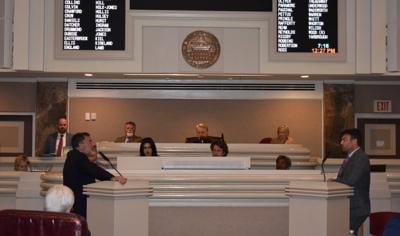
MONTGOMERY, Ala. – After a lengthy discussion and opposition from both sides of the aisle, the Alabama House passed on Thursday a bill to limit participation in primary elections to Alabamians registered with a political party.
House Bill 541, by Rep. Ernie Yarbrough, R-Trinity, sets up closed primary elections. Under the bill, Alabamians would choose their political party affiliation when they register to vote. If they don’t want to register with a political party, voters can remain “unaffiliated” but couldn’t vote in primaries.
Voters could change their chosen political party as many times as they would like between elections, up until 60 days before a contest. This “blackout window” exists so the secretary of state can provide the list of registered voters to county probate judges – the chief election officers in Alabama’s 67 counties – within the legally mandated period before an election, Yarbrough said.
Yarbrough said he introduced the bill to ensure that primaries help to elect candidates who most reflect a party’s platform and to curb “crossover voting.” He defined crossover voting as Democrats choosing to vote in the Republican primary for the candidate they view as weaker in an effort to give a Democrat a better chance of winning the general election.
“It’s incumbent upon us in the legislative process to do all we can to reinforce voter integrity in our system, and I think that’s exactly what this bill does,” Yarbrough said after his bill passed. “It gives people a clear choice, and they understand when they go to the polls what they’re voting for.”
The Legislature’s lower chamber passed the bill by a vote of 63-35, with four abstentions. Republican Reps. Terri Collins, Decatur, Tim Wadsworth, Arley, Phillip Rigsby, Huntsville, Bob Fincher, Woodland, Brett Easterbrook, Fruitdale, and Russell Bedsole, Alabaster, joined Democrats in voting no.
The bill now heads to the Senate. There are six days remaining in the 2026 legislative session.
Thirteen states – including Tennessee, Kentucky and Florida – have fully closed primary elections.
Debate about the bill on the House floor was lengthy, and both Democratic and Republican lawmakers spoke against the bill. These opponents questioned the need for the bill and argued that it would disenfranchise independents as well as people who don’t want to publicly label themself a Democrat or a Republican.
In rare Republican opposition to a party member’s bill, Speaker Pro Tem Chris Pringle, R-Mobile, the second in command for House Republicans, talked about how the bill would hurt Republicans and push independent voters away from the GOP. Pringle said Yarbrough “will drive this party into the dirt with this bill.”
“I was chairman of reapportionment, and you’re going to lose some of your members in here,” Pringle, who rarely speaks about bills, said on the floor. “You push this bill, we got some people in some purple districts, (U.S. Congressman) Gary Palmer being one of them. And those purple districts are going to go against the Republican Party, and they’re going to send Democrats down here and they’ll probably send another Democrat to the United States’ Congress from the state of Alabama.”
Several influential Alabama Republicans have previously expressed their support for closing primaries, including Speaker of the House Nathaniel Ledbetter, R-Rainsville, and Republican gubernatorial candidate and U.S. Sen. Tommy Tuberville, R-Ala.
The state Republican party and its newly elected chair Rep. Scott Stadthagen, R-Hartselle, also announced the bill as “the party’s top legislative priority this year.”
Pringle addressed during his floor comments what seems to be a growing divide between the statewide Alabama Republican Party and Republican members of the Legislature.
“I hope y’all understand what this means to the party,” Pringle said. “The party is asking us to commit suicide.”




Pringle amended the bill to clarify that absentee ballot managers would not be responsible for registering voters’ party affiliation. He ultimately voted in favor of the bill.
Rep. Robert Fincher, R-Woodland, also said closed primaries would “harden people’s stances” about politics, which could lead to more political division and less reaching across the aisle.
“We vote differently, but we’re a more congenial group than what you’re going to find in Washington DC. I don’t want us to become so hardened that we will reject others just because they happen to have a D or an R by their name.”
Fincher also said he doesn’t see crossover voting as an issue. He voted no on the bill.
Republican opposition to the bill is backed up by recent polling of GOP voters on the issue.
Fifty-seven percent of Republican primary voters said Alabamians should be able to choose which primary they vote in without registering with a party, according to a 3D Strategic Research poll of 400 Republican primary voters late last week.
Thirty-nine percent said voters should be required to register.
And 59% said since Alabama’s primaries are paid for by all taxpayers, all eligible voters, and not just party members, should have the right to participate in the primary of their choice, which would help make elections fairer and more representative.
In another question, 53% of voters agreed keeping primaries open to all voters is good for the Republican Party because it allows the party to grow, bring in new voters and build broader support for Republican candidates.
The poll has a margin of error or plus 4.9% in 95 out of 100 cases, 3D said.
The House Democratic Caucus stood in total opposition to the bill, with all 29 of its members voting against it. Numerous members of the caucus argued on the floor that closed primaries would discourage people from voting and that the bill would increase counties’ financial and administrative burden in running elections.
“We’ve always talked about freedom, freedom of choice, but right now we’re trying to box voters in to decide to put a label on them and having a political identity when many of the voters in this country don’t want to have a political identity,” House Minority Leader Anthony Daniels, D-Huntsville, told reporters after the bill passed, calling Thursday “a dark day in Alabama.”
Rep. Curtis Travis, D-Tuscaloosa, introduced an amendment to allow political parties to opt out of the bill and continue with open primaries. It failed.
If passed, the bill would become effective on Jan. 1, 2027. It would not affect the 2026 primary election on May 19. Voters would still not be able to change parties between the primary and any related runoff elections, as is the case under current law.

(0) comments
Welcome to the discussion.
Log In
Keep it Clean. Please avoid obscene, vulgar, lewd, racist or sexually-oriented language.
PLEASE TURN OFF YOUR CAPS LOCK.
Don't Threaten. Threats of harming another person will not be tolerated.
Be Truthful. Don't knowingly lie about anyone or anything.
Be Nice. No racism, sexism or any sort of -ism that is degrading to another person.
Be Proactive. Use the 'Report' link on each comment to let us know of abusive posts.
Share with Us. We'd love to hear eyewitness accounts, the history behind an article.