
For six decades, Bobby Thomas knew he had been there.
He remembered the tear gas, the sound of horses charging into the crowd and the determination that pushed thousands of marchers forward in the fight for equal voting rights. But until Saturday, the Selma native had never actually seen himself in the history he helped create.
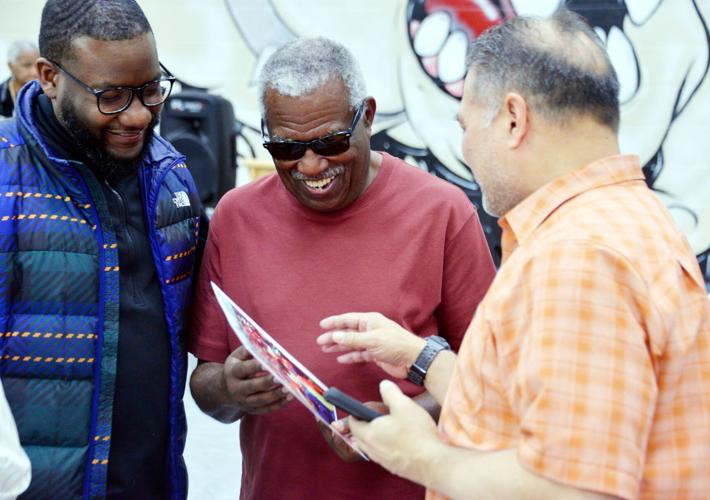
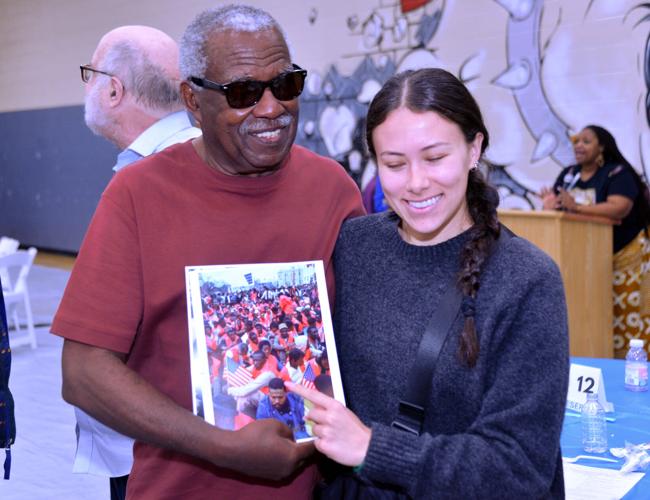
That changed when Thomas, now living in California, returned to Selma this weekend for the annual Selma Bridge Crossing Jubilee and discovered a photograph showing him among the young people who completed the historic Selma-to-Montgomery march in 1965. The photo was among dozens made available to foot soldiers at the annual Foot Soldiers Breakfast held at RB Hudson on Saturday.
A national agency, Proximity Partners, is helping the Living Archive of civil rights-era photographer Matt Herron identify protestors from his thousands of photos to document history. Herron died in 2020 and the photos were acquired by Stanford University libraries.
Proximity Partners has been documenting who is in the photos and giving many copies away by traveling throughout the Black Belt, starting with a community event in Marion in December. Eventually, select photos will be part of a permanent gallery in the reconstructed Little School House site being rebuilt by Marion in partnership with Auburn’s Rural Studio.
“I’m this one here,” Thomas said, pointing to a teenage boy holding an American flag in the photo taken in front of the Alabama State Capitol in Montgomery. Wearing a red protestor’s vest and determined look, he explained his “mind was on ‘we made it.’”
Thomas was just 17 years old that day. He stood only rows behind civil rights leader John Lewis on March 7, 1965, the day that would become known as Bloody Sunday.
“I was about the 15th row from John Lewis,” Thomas recalled. “When the tear gas came, all of us started dispersing.”
Alabama state troopers fired tear gas into the crowd as marchers crossed the Edmund Pettus Bridge, sending people scrambling.
“So when the horses came in, the people on the Selma side of the bridge didn’t know what was happening,” he said. “All of us turned around and started running back the other way.”
The gas clung to the demonstrators as they retreated toward those who had remained behind in Selma.
“We had so much tear gas on us that when we got back among the people who hadn’t crossed the bridge, they started feeling the effects too,” Thomas said.
Despite the violence that day, Thomas remained committed to the cause. Weeks later, he joined the successful Selma-to-Montgomery march that stretched roughly 54 miles along U.S. Highway 80.



The march was grueling. Outside Selma in Lowndes County, the highway narrowed from four lanes to two, forcing organizers to stagger participants. Youth marchers like Thomas were assigned to specific sections of the route.
“We weren’t the only ones demonstrating,” Thomas said. “But when the youth got involved, that’s when things really kicked off.”
As a senior at RB Hudson, Selma’s segregated Black high school at the time, Thomas and other students walked out of class in protest.
“We actually shut the school down,” he said.
Young activists were frequently arrested for demonstrating. Thomas said he went to jail repeatedly during the movement.
“We would go to jail in the morning and be back out in the afternoon demonstrating again,” he said.
Eventually, authorities began moving young protesters to jails outside the city in an effort to slow the demonstrations, he said.
Still, the movement continued – and ultimately succeeded.
After completing the march to Montgomery, the participants gathered at St. Jude’s parish before making their final walk to the steps of the Alabama State Capitol, where civil rights leaders addressed the crowd.
Thomas remembers receiving a red vest identifying those who had completed the entire march. Now, more than 60 years later, seeing himself in a photograph from that day brought those memories rushing back.
“Oh, I’m really excited,” Thomas said. “It documents the history.”
For the Selma native who once marched as a teenager so his parents could one day vote freely, the image is more than just a photograph. It is proof that he was there and that the sacrifices of young people helped change the course of American history. The Voting Rights Act of 1965 was passed in August just months after the fateful march.
Foot soldiers who find themselves in photos are encouraged to contact Michael DiMaggio at michael@proximitypartnership.com.
(0) comments
Welcome to the discussion.
Log In
Keep it Clean. Please avoid obscene, vulgar, lewd, racist or sexually-oriented language.
PLEASE TURN OFF YOUR CAPS LOCK.
Don't Threaten. Threats of harming another person will not be tolerated.
Be Truthful. Don't knowingly lie about anyone or anything.
Be Nice. No racism, sexism or any sort of -ism that is degrading to another person.
Be Proactive. Use the 'Report' link on each comment to let us know of abusive posts.
Share with Us. We'd love to hear eyewitness accounts, the history behind an article.