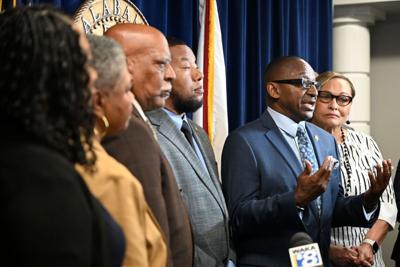
Opponents of last week’s special session are counting on a 2022 constitutional amendment to provide a legal challenge to the special primary election bills passed by the Alabama Legislature should Alabama be allowed to redistrict.
The amendment known as Amendment 4 during the election, requires any election law passed by the Legislature to be enacted within six months of a general election. About 80% of voters approved the amendment.
Throughout the special session, Alabama Democrats argued that Amendment 4 would be violated if SB 1, sponsored by Sen. Chris Elliott, R-Josephine, and HB 1 sponsored by Speaker Pro Tempore Chris Pringle, R-Mobile were passed. Under the amendment, the cutoff date for new election laws this year was May 3. The special session began on May 4 and Gov. Kay Ivey signed the new laws on May 8.
Under both pieces of legislation, a special primary election would be called by Gov. Kay Ivey in certain districts if the U.S. Supreme Court lifts an injunction preventing the state from redrawing its congressional lines before 2030, or if the U.S. 11th Circuit Court of Appeals overturns a district court ruling that required two Montgomery-area state Senate seats to be redrawn.
Emergency appeals in each court were filed by Secretary of State Wes Allen and Attorney General Steve Marshall earlier this month. The filings came after the U.S. Supreme Court substantially weakened Section 2 of the Voting Rights Act in the Louisiana v. Callais decision, though Justice Samuel Alito wrote in the ruling that it did not affect Alabama’s congressional redistricting case, known as Allen v. Milligan.
Bracy said after the House passed SB 1 Friday that the new primary law a “strict violation” of the Alabama Constitution.
“Anything that they were going to do that was going to impact the election this year, would have had to be done by May 3 of this year,” he said.
Republicans argued throughout last week’s debates that the amendment applied to general elections, not primaries.
“If you read it, it clearly states, you can’t change six months before a general election, okay? Not a primary,” Pringle said during the House General Fund committee meeting Thursday.
During debate on the Senate floor over HB 1, Sen. Merika Coleman, D-Pleasant Grove, also called the constitutional amendment into question.






“Because of the date that we started, and then you all ultimately passed the Senate District (bill), and now the date that you’ll pass this one, you will be in violation of Amendment 4,” she said.
Jerome Dees, policy director for the Southern Poverty Law Center of Alabama, said the bills will go against the state constitution.
“Whether or not a voter is in a particular district has an impact on the general election, whether or not a potential candidate is in a particular district that would be affected by the primary is also going to have an impact on the general the whole purpose of the primary is to set up the election,” Dees said.
Dees also said Alabama already has a history of complying with the amendment. In 2024, the Alabama Legislature passed HB 100, which dealt with the eligibility of voters who had been convicted of crimes of moral turpitude. The bill passed late in the session, past the six-month mark.
“The Attorney General, Steve Marshall issued a statement saying that his office, the AGs office, would not enforce HB 100 until after the November 2024 Election, because they felt the need to comply with Amendment 4,” Dees said.
The perceived violation could potentially spur lawsuits from organizations across the state.
Executive Director of the Alabama Civil Liberties Union of Alabama JaTaune Bosby Gilchrist said in a statement Friday afternoon that the organization could be planning a lawsuit against the Legislature for the ruling.
“For several years now, the court has been consistent: Alabama violated the 14th Amendment by intentionally discriminating against Black voters in its congressional and legislative maps,” Gilchrist said.
Senate Minority Leader Bobby Singleton, D-Greensboro, said after the Senate passed HB 1 Friday that the Legislature is in violation of the State Constitution and legal action would be taken.
“We’re definitely going to be filing actions in the state constitution based on the, (20)22 act that we passed on Amendment number 4,” he said.
(0) comments
Welcome to the discussion.
Log In
Keep it Clean. Please avoid obscene, vulgar, lewd, racist or sexually-oriented language.
PLEASE TURN OFF YOUR CAPS LOCK.
Don't Threaten. Threats of harming another person will not be tolerated.
Be Truthful. Don't knowingly lie about anyone or anything.
Be Nice. No racism, sexism or any sort of -ism that is degrading to another person.
Be Proactive. Use the 'Report' link on each comment to let us know of abusive posts.
Share with Us. We'd love to hear eyewitness accounts, the history behind an article.