A court-appointed special master Friday submitted two proposed maps redrawing an Alabama Senate district in the Montgomery area as part of an ongoing lawsuit alleging racial discrimination in state legislative districts.
In August, U.S. District Judge Anna Manasco ruled that the current map violates Section 2 of the Voting Rights Act, which prohibits voting laws or procedures that purposefully discriminate on the basis of race, color or membership in a language minority group. Manasco ordered new district lines to be drawn in Senate Districts 25 and 26, represented by Sens. Will Barfoot, R-Pike Road, and Kirk Hatcher, D-Montgomery, respectively.
After multiple check-ins with Manasco and lawyers with both sides, Gov. Kay Ivey said last month she would not call a special session to redraw the map, citing a similar case in the U.S. Supreme Court, Callais v. Louisiana.
Manasco then appointed the same team that redrew the state’s congressional districts in 2023 to remedy the state Senate issue. Richard Allen, the Special Master, recommended two maps to remedy the VRA violation.
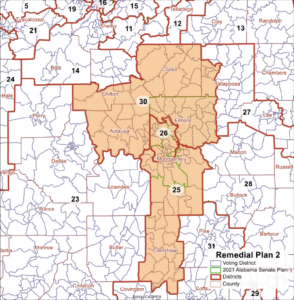
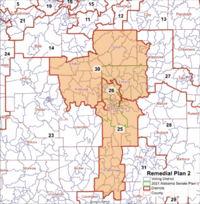
Remedial Plan 2 aligns more with the current State Senate districts and provides a better Voting Rights Act remedy, according to court-appointed Special Master Richard Allen. (Map from court documents)
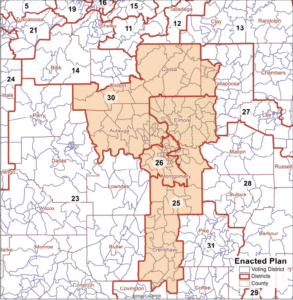
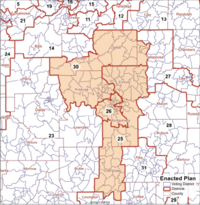
A federal judge ruled that the current State Senate districts in the Montgomery area violate Section 2 of the Voting Rights Act. (Map from court documents)
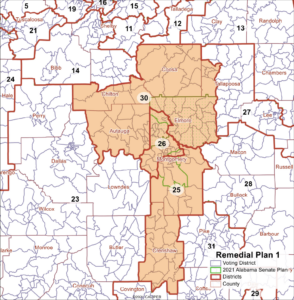
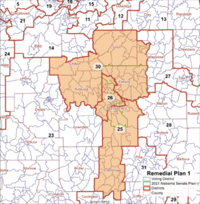
Remedial Plan 1 provides a weaker remedy to the Voting Rights Act violation than Remedial Plan 2, according to court-appointed Special Master Richard Allen. (Map from court documents)
The first map, Remedial Plan 1, reallocates South Montgomery in Senate District 26 to Senate District 25, leaving a tail of the south-western portion of Montgomery County in District 26. The northern part of the district is extended into Elmore County, which is currently in Senate District 30 represented by Sen. Clyde Chambliss, R-Prattville.






Remedial Plan 1 changes the Black voting-age population from 29% to 51.6% in Senate District 25, 66.1% to 49.7% in Senate District 26 and 23.6% to 20% in Senate District 30.
The second map, Remedial Plan 2, completely reallocates the southern portion of District 26 to District 25. It also extends northward into District 30, but not as far.
Remedial Plan 2 changes the Black voting-age population from 29% to 53.6% in Senate District 25, 66.1% to 48.3% in Senate District 26 and 23.6% to 19.1% in Senate District 30.
“Remedial Plan 2 even more closely aligns with the enacted plan than Remedial Plan 1 … Remedial Plan 2 also performs slightly better than Remedial Plan 1 as a Section 2 remedy,” Allen wrote.
The Supreme Court heard oral arguments in Callais v. Louisiana earlier this month, and seemed open to limiting the consideration of race in the redistricting process. A ruling from the high court could come anytime before June, which is why Manasco put Allen to work before a ruling.
In her original ruling, Manasco ordered a remedial map to be in place before the 2026 midterm elections. The qualifying period for candidates is in January.
This story is from alabamareflector.com.


(0) comments
Welcome to the discussion.
Log In
Keep it Clean. Please avoid obscene, vulgar, lewd, racist or sexually-oriented language.
PLEASE TURN OFF YOUR CAPS LOCK.
Don't Threaten. Threats of harming another person will not be tolerated.
Be Truthful. Don't knowingly lie about anyone or anything.
Be Nice. No racism, sexism or any sort of -ism that is degrading to another person.
Be Proactive. Use the 'Report' link on each comment to let us know of abusive posts.
Share with Us. We'd love to hear eyewitness accounts, the history behind an article.