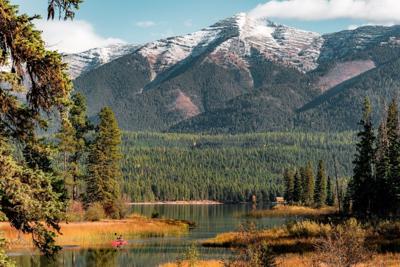

Flathead National Forest in Montana. Photo credit: Your Forests Your Future / US Forest Service
The U.S. Department of Agriculture prepares to rescind the 2001 Roadless Area Conservation Rule. If the proposal is finalized, it would eliminate a 25-year-old rule that protects some of the most undeveloped parts of America's national forests.
The agency originally set a September 21 deadline for public comments but recently extended the comment period by 15 days, through October 6.
"The Roadless Area Conservation Rule, enacted a generation ago, has proved to be one of our nation's most successful conservation measures; it protects important wildlife habitat for imperiled species, clean drinking water sources for millions of Americans, and world-class recreation opportunities," says Tim Preso, attorney at Earthjustice, a nonprofit public interest environmental law organization, in an email interview.
"The Trump administration falsely claims that rescinding the rule will help prevent wildfire, but the science shows the opposite is true. The public should see this rescind effort for what it is – yet another attack on public lands for the benefit of the timber industry – and call foul," Preso adds.
What the Roadless Rule Does and Why the USDA Wants to Rescind It
The Clinton administration adopted the Roadless Rule in 2001 to protect the ecological and social value of large, undeveloped areas within national forests, including wildlife habitat, clean water and recreation.
The rule originally limited new roads and timber harvesting on about 60 million acres,or roughly 30% of National Forest System lands. After Idaho and Colorado adopted their own state-specific rules, about 45 million acres remain under the federal rule.
On June 23, 2025, USDA Secretary Brooke L. Rollins announced plans to rescind the rule. More than a year later, on August 18, 2026, the Forest Service formally filed a proposal to rescind the Roadless Rule in full and released a draft environmental impact statement.
In the official statement, the USDA argues that the Roadless Rule has made it harder for local forest managers to respond to worsening wildfire risks.
The agency also says overgrown forests, insect outbreaks and disease have increased fire danger, while restrictions on road construction can limit access for forest treatments.
More than 40% of inventoried roadless areas have high or very high wildfire hazard potential, according to the Forest Service. Yet only 5% have received hazardous-fuel treatments since 2014.
The USDA says rescinding the rule would give local managers more authority to decide where roads or active forest management are necessary instead of applying the same restrictions nationwide.
However, the Forest Service’s own Draft Environmental Impact Statement acknowledges a potential trade-off. It states that “as the density of roads increases so does the probability, number, and frequency of wildfire ignitions.”
What Critics Say About the Proposal
"Scientists, wildland firefighters, and hundreds of thousands of Americans have fiercely opposed this attack on our public lands," says Abigail Dillen, president of Earthjustice, in an official statement.
"Earthjustice has successfully defended the Roadless Rule for a quarter century, and we are not going to stop now," Dillen adds.
Earthjustice disputes the USDA's wildfire argument and points to research published in January 2026. Researchers, Gregory H. Aplet, Phil Hartger and Matthew S. Dietz found that wildfire ignition density on national forest lands was about four times higher within 50 meters (164 feet) of roads than in inventoried roadless areas.
The Western Fire Chiefs Association also states that people cause nearly 90% of U.S. wildfires, with common sources including discarded cigarettes, unattended campfires, burning debris and equipment malfunctions. Vehicles can also ignite fires through hot exhaust pipes, worn brakes, exposed wheel rims or dragging chains.
Bobby McEnaney, director of land conservation at the Natural Resources Defense Council, an environmental advocacy group, argues in an interview for NRDC's YouTube channel that keeping large ecosystems intact gives land managers more options to respond to drought, wildfire and other climate pressures.






"Once you start carving them up, once you have the oil and gas industry coming in and building roads and building pipelines, you change that whole dynamic. You change your opportunity and your options to deal with these really bigger issues that are happening," says McEnaney.
McEnaney also argues the broader push to open public lands to development treats them too narrowly as economic assets. "They try to diminish the value of public lands. They try to talk about public lands as something on a ledger sheet, like all public lands are worth is what you get from them in terms of an economic transaction."
McEnaney calls this approach "really short-sighted," and argues that public lands have economic, recreational and ecological value that extends far beyond what can be extracted from them today.
Why Tourism Businesses Oppose the Rescind
"The Roadless Rule has long provided a practical balance for managing backcountry national forests. It protects these landscapes from development while still allowing for active management and a wide array of recreation," says Adam Cramer, CEO of Outdoor Alliance, a coalition of human-powered recreation organizations, in an official statement.
"Policies that successfully balance conservation, recreation, and management are rare, and the Roadless Rule is one of them. Rescinding the rule would undermine decades of successful land management and put some of the country's best backcountry recreation at risk," he adds.
The group estimates that the affected areas include more than 25,000 miles of trails, nearly 1,000 miles of whitewater and more than 10,000 miles of mountain biking routes.
In Alaska, Hunter McIntosh, president and executive director of nonprofit cruise operator The Boat Company, says rescinding the rule could also affect businesses that depend on the Tongass National Forest.
"Tourism and commercial fishing are two of the region's leading private-sector economies, and both depend on intact watersheds, wild salmon, scenery, wildlife and undeveloped landscapes," McIntosh says in an official statement.
"Timber production is not even remotely in the mix economically, and the administration's argument is especially absurd given that the Tongass is a rainforest and logging here is extremely complex and historically unproductive," McIntosh adds.
Why Speaking Up Before October 6 Matters
October 6 is not the date the Roadless Rule disappears, but the deadline to submit comments on the USDA proposal and its draft environmental analysis.
The Forest Service will review those comments before deciding whether to move forward with the proposed rule or make changes, if any, based on the comments.
USDA prefers electronic submissions through docket FS-2025-0001 or RIN 0596-AD66. The USDA also accepts comments mailed to the Director, Ecosystem Management Coordination, 201 14th Street SW, Mailstop 1108, Washington, DC.
"Now is the time for everyone who cares about these irreplaceable wildlands to speak up to support the Roadless Rule's essential protections for our nation's pristine public forests," says Tim Preso, attorney at Earthjustice.
"Once these lands are developed, their wild character will be gone forever. If you care about these lands, the time to defend them is now," Preso warns.
McIntosh also argues that "we've been down this road before" and knows what happens.
He recalls that before the Roadless Rule, companies clear-cut old-growth forests for pulp, while the federal government used long-term contracts and road construction to try to sustain the industry.
He says those policies cost taxpayers heavily and harmed salmon habitat through erosion and sediment runoff. McIntosh warns that rescinding the rule could revive the same model, using public money to support logging at the expense of tourism, commercial fishing and the forest itself.
Sponsored by Earthjustice. The Roam Report maintains full editorial independence. The brand did not review or approve our content before publication.
(0) comments
Welcome to the discussion.
Log In
Keep it Clean. Please avoid obscene, vulgar, lewd, racist or sexually-oriented language.
PLEASE TURN OFF YOUR CAPS LOCK.
Don't Threaten. Threats of harming another person will not be tolerated.
Be Truthful. Don't knowingly lie about anyone or anything.
Be Nice. No racism, sexism or any sort of -ism that is degrading to another person.
Be Proactive. Use the 'Report' link on each comment to let us know of abusive posts.
Share with Us. We'd love to hear eyewitness accounts, the history behind an article.