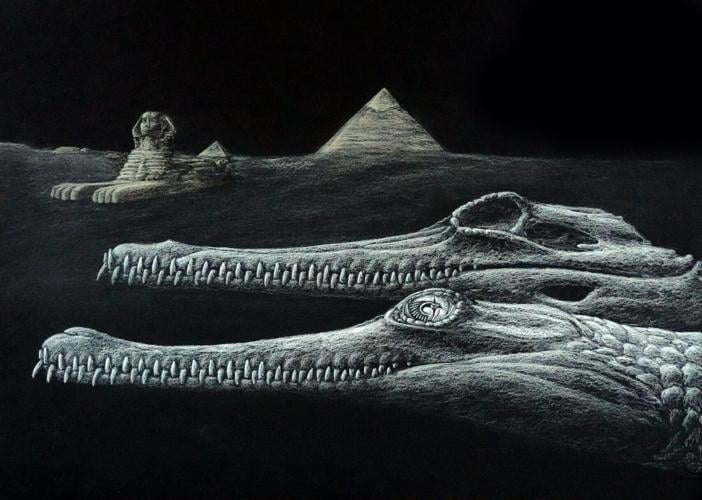

Reconstruction of the extinct Herugavialis cairensis with the Great Sphinx and pyramids depicted in the background. (Karim Zanaty via SWNS)
By Stephen Beech
A new crocodile species has been identified in rocks used to build the Great Sphinx.
And, just like the iconic Egyptian landmark, it's missing the tip of its snout.
Scientists say Herugavialis cairensis was discovered in the same rocks used to build the monument.
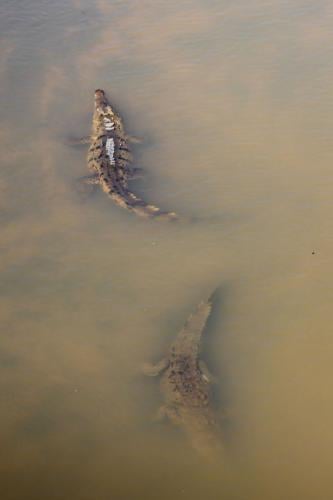
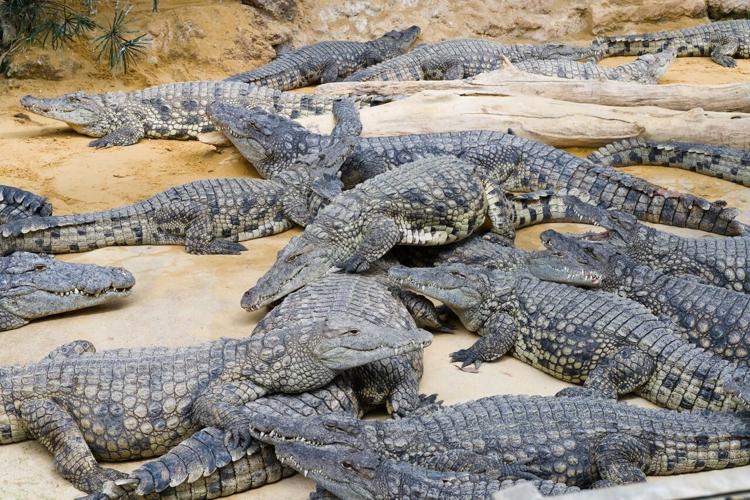
They explained that gavials are a group of crocodiles that are characterized by their long, thin snouts.
Today, they are found only in freshwater environments on the Indian subcontinent and in Southeast Asia.

(Photo by Tomáš Malík via Pexels)
There are just two living species: Gavialis gangeticus and Tomistoma schlegelii, known as the "false gharial."
However, the fossil record of gavials documents a near-global distribution, spanning more than 100 million years, with many species living in shallow marine environments.
In the 1920s, several fossils were recovered from the 45-million-year-old Mokattam Formation in Egypt.






Those fossils, including a nearly complete skull, were described as belonging to Tomistoma, because of their superficial resemblance to the false gharial.
But recent analytical advances in paleontology, including the use of CT scanning to look inside the skull, allowed an international team of researchers to identify several differences between the false gharial and the Mokattam Formation fossils.
Scientists from the U.K., Sweden, Germany and Egypt, led by Paul Burke, found that the skull of Herugavialis is relatively well preserved.

(Photo by Jean-Paul Wettstein via Pexels)
But one feature in particular caught their attention: the tip of its snout is missing.
Study co-leader Philip Mannion said: "Given this coincidence with the famously missing nose of the Great Sphinx, we decided to name the new crocodile after the Egyptian god Heru, who was possibly the inspiration for this iconic monument."
Mannion, of University College London, says Herugavialis was not the only crocodile in Egypt at the time.
The shallow marine environments that covered much of the region were also home to at least two other species of gavials, according to the study published in the journal Royal Society Open Science.
Lead author Burke, a researcher at the Swedish Museum of Natural History, added: "Throughout much of the last 50 million years, the Mediterranean region hosted a high diversity of crocodiles, including gavials.
"However, this diversity fluctuated over time, seemingly corresponding to changes in global temperature and sea level, before the loss of all crocodiles in this region as a result of the drying of the Mediterranean approximately 6 million years ago."
(0) comments
Welcome to the discussion.
Log In
Keep it Clean. Please avoid obscene, vulgar, lewd, racist or sexually-oriented language.
PLEASE TURN OFF YOUR CAPS LOCK.
Don't Threaten. Threats of harming another person will not be tolerated.
Be Truthful. Don't knowingly lie about anyone or anything.
Be Nice. No racism, sexism or any sort of -ism that is degrading to another person.
Be Proactive. Use the 'Report' link on each comment to let us know of abusive posts.
Share with Us. We'd love to hear eyewitness accounts, the history behind an article.