By Dean Murray
Bugs with backpacks could help search and rescue teams locate survivors.
Researchers say that by equipping common beetles with microchip backpacks victims could be found within hours instead of days following disasters such as building and mine collapses.
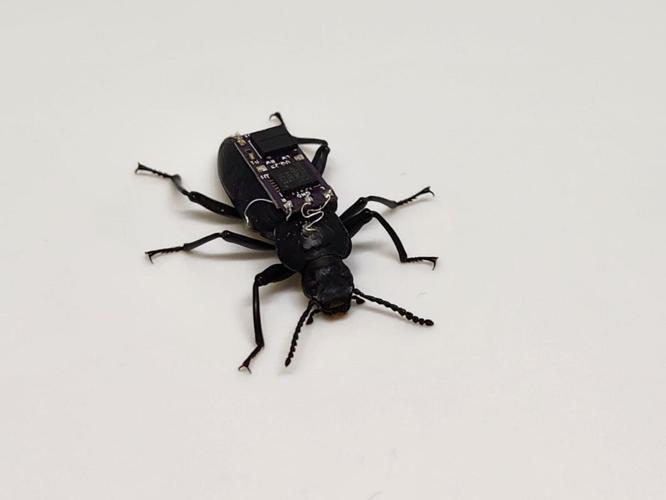
The University of Queensland’s (UQ) Dr. Thang Vo-Doan and Research Assistant Lachlan Fitzgerald have demonstrated that they can remotely guide darkling beetles (Zophobas morio) fitted with packs via video game controllers.
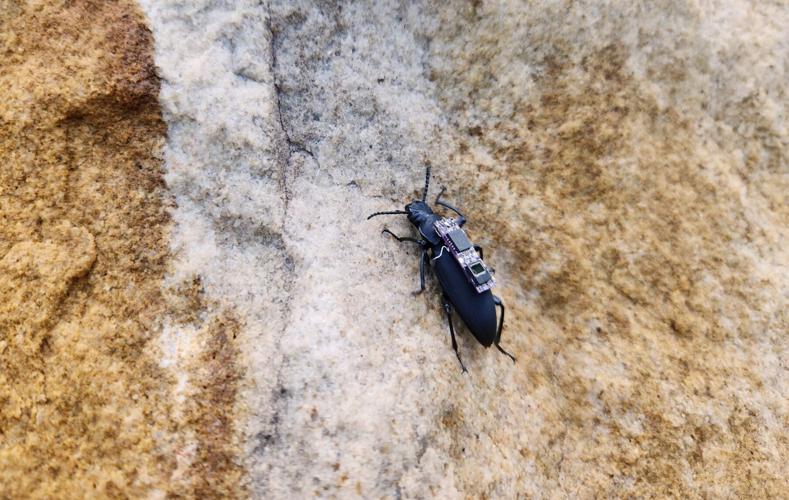
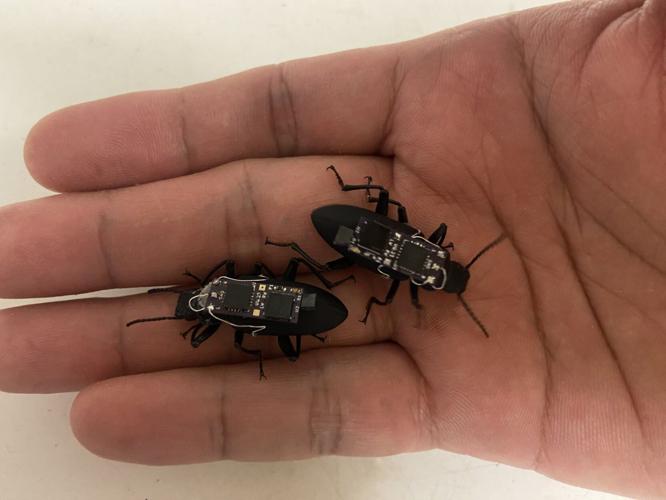
Dr. Vo-Doan said the removable backpacks prompted movement in specific directions through electrodes that stimulated the insect’s antenna or hardened forewings known as elytrons.

A Zophobas morio, or darkling beetle, equipped with a removable microchip backpack that researchers can use to prompt movement. (University of Queensland via SWNS)
“Beetles possess many natural gifts that make them the masters of climbing and maneuvering in small, complex spaces such as dense rubble, which are difficult for robots to navigate,” Dr. Vo-Doan said.
“Our work harnesses these gifts and adds programmable controls that allow for precise directional guidance, without affecting the lifespan of the beetle.”
The long-term project involves a team of researchers at the Biorobotics lab in UQ’s School of Mechanical and Mining Engineering, who hope to test the technology in a live situation within five years.

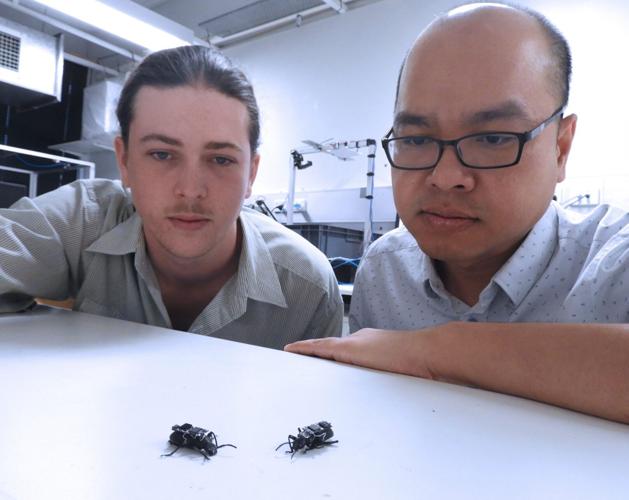
PhD scholar Lachlan Fitzgerald and Dr. Thang Vo-Doan. (University of Queensland via SWNS)




Fitzgerald said the latest research showing the beetles could be guided to move side-to-side and up vertical walls was a collaborative effort with UQ’s School of the Environment, the University of NSW and Singapore’s Nanyang Technological University.
“While robots at this scale have made strides in locomotion, the transition from horizontal surfaces to walls remains a formidable challenge for them,” Fitzgerald said.

A Zophobas morio, or darkling beetle, equipped with a removable microchip backpack that researchers can use to prompt movement. (University of Queensland via SWNS)
“This difficulty arises from the need for active foot pads, soft environmental interactions, and sophisticated sensing capabilities – all things that our cyborg insects possess naturally, that allows them to access any area that is required in a disaster environment.”
Dr. Vo-Doan said that while a tethered power supply had been used for the climbing test, the beetles had also demonstrated the ability to climb with a battery equivalent to its own body weight.
The team is refining designs to allow for cameras and a compact and efficient power system to enhance the beetle’s mobility and versatility.

(University of Queensland via SWNS)
“If people have been trapped under an extensive amount of rubble, you want to be able to find them as quickly as possible and start planning how to get them out,” Dr. Vo-Doan said.
“We hope to produce a tool that can easily move through chaotic environments to pinpoint a person’s exact location, provide clues to any injuries, and give rescuers a picture of what needs to be done to free them”.
The research is published in Advanced Science.

(0) comments
Welcome to the discussion.
Log In
Keep it Clean. Please avoid obscene, vulgar, lewd, racist or sexually-oriented language.
PLEASE TURN OFF YOUR CAPS LOCK.
Don't Threaten. Threats of harming another person will not be tolerated.
Be Truthful. Don't knowingly lie about anyone or anything.
Be Nice. No racism, sexism or any sort of -ism that is degrading to another person.
Be Proactive. Use the 'Report' link on each comment to let us know of abusive posts.
Share with Us. We'd love to hear eyewitness accounts, the history behind an article.