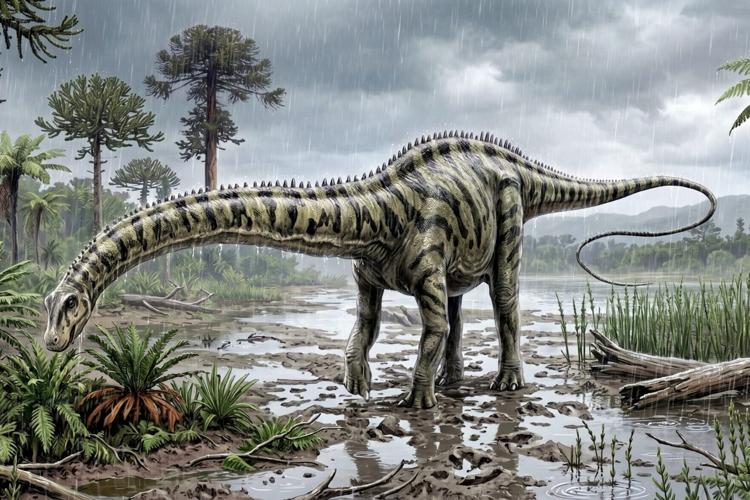
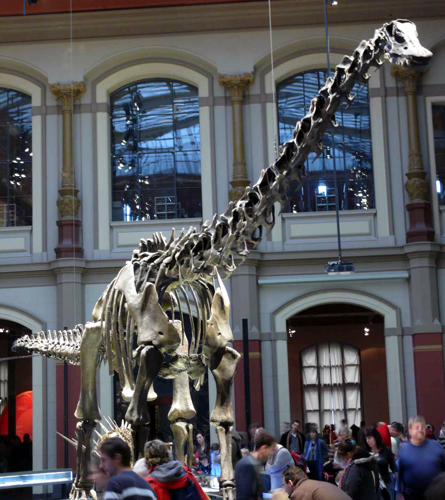
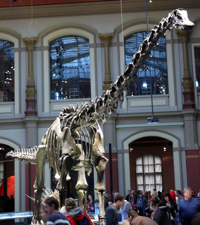

An illustration of the Diplodocus. (Carmelo López via SWNS)
By Stephen Beech
A fossilized Diplodocus has been found in Europe for the first time.
The discovery in Spain is the first time remains of the iconic long-necked dinosaur have been unearthed outside North America.
Scientists say the "remarkable" find, described in the Journal of Vertebrate Paleontology, represents one of the most complete dinosaur skeletons ever discovered in Europe.
Diplodocus is known for its enormous length of up to 25 meters (82 feet), long whiplike tail and relatively small head.
Since its discovery in the United States in 1878, and throughout the early 20th century, casts of Diplodocus skeletons have been displayed in natural history museums worldwide.
Its presence in exhibitions and audiovisual productions about dinosaurs has helped make it one of the best-known "terrible lizards" among the general public.
The new fossil specimen was unearthed at the La Tejeria site in El Castellar, Teruel.
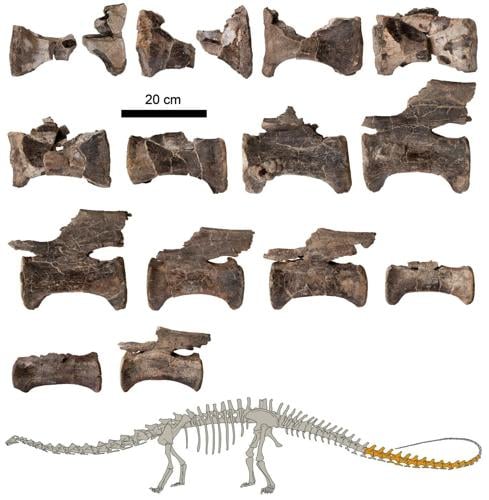
Paleontologists excavated 14 "exceptionally preserved" tail vertebrae and several chevron bones.
Until now, all confirmed Diplodocus specimens had come exclusively from the Morrison Formation in the western United States.
Study lead author Sergio Sánchez Fenollosa, a Ph.D. student at Fundacion Dinopolis in Teruel, said: "We are delighted with this discovery.

Tail vertebrae of the Diplodocus from El Castellar (Teruel, Spain), together with a figure indicating the studied fossils in dark. (Sergio Sánchez Fenollosa via SWNS))
"It was an exciting and continuous process of seeing the pieces of the puzzle gradually fall into place.
"From the early stages of the osteological study, we noticed strong similarities with several diplodocine sauropods.
"As we looked more closely at the anatomy, we began to identify a combination of features characteristic of Diplodocus species.





"Then, as we carried out different evolutionary analyses, they kept pointing in the same direction.
"With each new result, the picture became clearer: we were looking at a Diplodocus."
He added: "What is more, the outcome of the dig is some of the strongest paleontological evidence for episodes of dispersal and faunal exchange between the two continents across the proto-Atlantic Ocean during the Late Jurassic.
"Essentially, this discovery allows us to better understand Iberian Mesozoic ecosystems and the diversity of sauropod dinosaurs that inhabited the European Jurassic."
The research team says the Spanish Diplodocus dates to around 150 million years ago, at the end of the Jurassic Period.
They believe its presence in Europe provides "compelling" evidence that dinosaurs could migrate between North America and Europe during the Late Jurassic, likely crossing temporary land bridges that emerged as the proto-North Atlantic Ocean underwent regressive phases.

Gunnar Ries Amphibol via Wikimedia Commons
Study co-author Alberto Cobos, managing director of Fundacion Dinopolis, said: "The Diplodocus from El Castellar was approximately 25 meters long - comparable in size to its North American relatives, making it another of the giant sauropods of the Spanish Jurassic, alongside other sauropod dinosaurs from Teruel with characteristics very different from those of diplodocids, such as Turiasaurus and Losillasaurus, among others.
"The fossils of all these dinosaurs, including those of the new Diplodocus specimen, make Teruel a reference place for understanding this great diversity."
The fossil's remarkable state of preservation allowed researchers to identify distinctive anatomical features characteristic of Diplodocus.
These included large pneumatic cavities in the vertebrae, deep longitudinal grooves on the underside of the tail bones and distinctive forked chevron bones.
Using both traditional anatomical comparisons and advanced phylogenetic analysis, the research team confidently placed the specimen within the Diplodocus genus, specifically as a close relative of Diplodocus hallorum.
The fossils are currently on display in the dinosaur hall of the Museo Aragones de Paleontologia at Dinopolis in Teruel — a city in eastern Spain, situated between Madrid and Valencia.
The region of Spain where the find was made has previously yielded several dinosaur fossils including sauropods, theropods, stegosaurs and ornithopods.
The research team says it suggests that ancient coastal environments supported "complex and diverse" ecosystems.
(0) comments
Welcome to the discussion.
Log In
Keep it Clean. Please avoid obscene, vulgar, lewd, racist or sexually-oriented language.
PLEASE TURN OFF YOUR CAPS LOCK.
Don't Threaten. Threats of harming another person will not be tolerated.
Be Truthful. Don't knowingly lie about anyone or anything.
Be Nice. No racism, sexism or any sort of -ism that is degrading to another person.
Be Proactive. Use the 'Report' link on each comment to let us know of abusive posts.
Share with Us. We'd love to hear eyewitness accounts, the history behind an article.