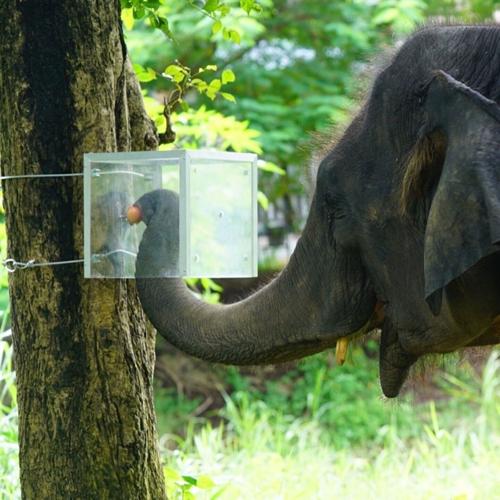
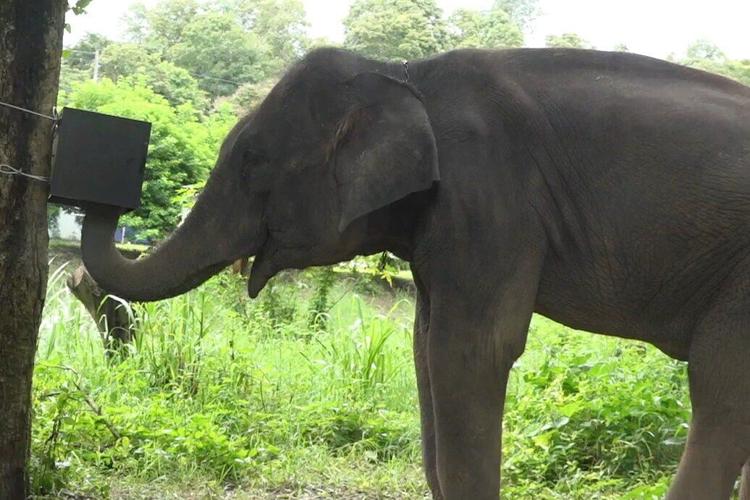

An elephant interacting with the familiarization box in behavioural study. (Hope et al., 2026, PLOS One via SWNS)
By Stephen Beech
Clever elephants can think before they act and resist impulsive behavior, reveals new research.
Experiments show Asian elephants are able to deny their impulses and choose a more rational course of action to solve problems.
Researchers say the study, published in the journal PLOS One, provides the first evidence of inhibitory control in the iconic species — offering insights into how they make decisions and adapt to changing environments.
The study adds to growing evidence that elephants possess sophisticated cognitive skills.
And the research team says it could ultimately aid conservation projects.
They explained that inhibitory control — the ability to resist an impulse in favor of more effective behavior — is an important part of decision-making and cognitive flexibility in humans and other animals.
It has previously been demonstrated in various bird and mammal species, often using a detour test in which subjects must ignore an obvious but ineffective path to a treat in favor of an indirect route.
In the new study, the American research team documented the first such behavior in elephants.
A total of 16 Asian elephants were tested at the National Elephant Institute in Thailand.

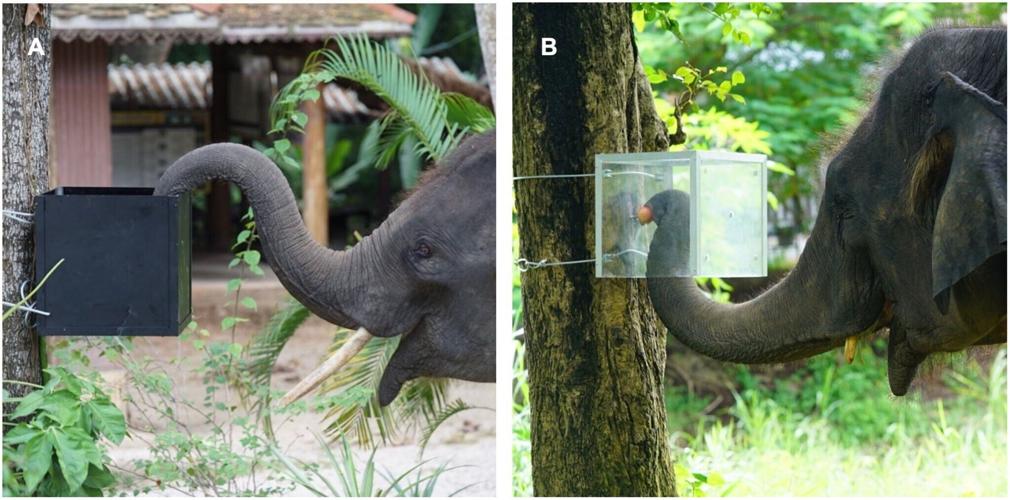
An elephant interacting with the familiarization box in behavioural study. (Hope et al., 2026, PLOS One via SWNS)
When presented with a transparent box with small holes through which they could see and smell fruit inside, the elephants consistently were able to resist the temptation to try to reach directly for the food and instead used an opening on the side of the box as they had been taught earlier.






When the box was later rotated, the elephants at first succumbed to the impulse to reach for the previous position of the opening before quickly correcting their behavior.
The adjustment was slower in older individuals, with one possible explanation being cognitive decline with age, although the research team noted that further studies will be needed to confirm that.
But they believe their findings could ultimately contribute to conservation strategies aimed at reducing conflict between elephants and people, particularly in areas of Asia where elephants and human communities increasingly share the same landscapes.
Study co-author Joshua Plotnik, from City University of New York (CUNY), has studied elephant intelligence, personality and social behavior in Thailand for nearly two decades, combining experimental research with conservation efforts.
His work examines not only what elephants can do, but also how their cognitive abilities and individual behavioral differences may influence interactions with people.
Plotnik's research has shown that elephants can recognize themselves in mirrors, console distressed companions, coordinate actions with partners and solve novel problems.

An elephant interacting with the familiarization box in behavioural study. (Hope et al., 2026, PLOS One via SWNS)
His team has also found that elephants living near human communities tend to be more willing to take risks and explore unfamiliar situations — behaviors that could help explain why some elephants repeatedly enter agricultural areas and come into conflict with people.
Plotnik said: "The more we understand about how elephants think, make decisions about risk, and adapt to human-driven environmental change, the better we can predict 'what they'll do next' and the better designed our strategies for human-elephant coexistence can be."
The researchers say that inhibitory control may be a "key" part of elephants' famed problem-solving and socializing skills.
They believe that understanding how elephants respond to barriers might also help with the development of more effective strategies to avoid human-elephant conflict.
Study co-author Sydney Hope, of Hunter College, New York, added: "We found that, when elephants were faced with a situation in which they needed to suppress an impulsive behavior, either the impulse to reach directly toward a food reward behind a transparent barrier or the impulse to continue using a previously effective technique, they were generally able to suppress the impulse.
"This ability may be important for elephants' social interactions or for other aspects of cognition, such as problem-solving."
(0) comments
Welcome to the discussion.
Log In
Keep it Clean. Please avoid obscene, vulgar, lewd, racist or sexually-oriented language.
PLEASE TURN OFF YOUR CAPS LOCK.
Don't Threaten. Threats of harming another person will not be tolerated.
Be Truthful. Don't knowingly lie about anyone or anything.
Be Nice. No racism, sexism or any sort of -ism that is degrading to another person.
Be Proactive. Use the 'Report' link on each comment to let us know of abusive posts.
Share with Us. We'd love to hear eyewitness accounts, the history behind an article.