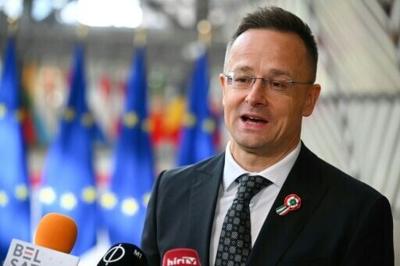
The European Union executive said on Monday reports that the Hungarian foreign minister had passed sensitive information about European Union negotiations to Russia were "greatly concerning".
On Saturday, the Washington Post newspaper quoted serving or former European security officials as saying Peter Szijjarto regularly called his Russian counterpart, Sergey Lavrov, during breaks in EU meetings to give "direct reports on what was discussed" and suggest possible courses of action.
Szijjarto has described the report as "fake news" and "senseless conspiracy theories".
But Hungary's minister for European affairs, Janos Boka, said "it is perfectly normal for the Hungarian foreign minister to speak by telephone with his Russian counterpart".
"What is less understandable is that his EU counterparts don't do the same," Boka said on his Facebook page.
Hungarian Prime Minister Viktor Orban is one of the few EU leaders to maintain close ties with Russia amid the war in Ukraine.
The US media outlet's report has raised hackles in Brussels, where many officials remain furious that Hungary continued to block a loan of 90 billion euros ($104 billion) to Ukraine at an EU leaders' gathering last week.
On Monday, the European Commission, the EU's executive arm, demanded clarity from Budapest.
"(A) relationship of trust between member states, and between them and the institution, is fundamental for the work of the EU," spokeswoman Anitta Hipper said.
"We expect the Hungarian government to provide the clarifications."
- 'Very serious' claims -
Germany described the allegations as "very serious".
"Discussions within the EU, including among EU foreign ministers, are confidential," a German foreign ministry spokesman said.
"We will not tolerate any violation of them," he added.






Orban has joined Szijjarto in lashing out at the allegations.
"Eavesdropping on a member of government is a serious attack on Hungary," Orban said on Facebook, adding that he had asked the justice minister to investigate.
The Post's article did not say anywhere that Szijjarto had been wiretapped.
- Tense EU-Hungary relationship -
The allegations come at a tense moment in relations between Budapest and the EU.
Orban has frequently tested EU leaders' nerves, blocking aid to Ukraine and travelling to Moscow to meet Russian President Vladimir Putin.
Today, European officials no longer hide their exasperation with Orban.
Following Thursday's summit, most EU leaders condemned Hungary's persistent block on the loan to Ukraine.
Their best hope, officials say privately, is the outcome of the Hungarian election on April 12.
Orban's party has been trailing in polls since last year.
Polish Prime Minister Donald Tusk said on X that the Washington Post report "shouldn't come as a surprise to anyone".
"That's one reason why I take the floor only when strictly necessary and say just as much as necessary," he added.
burs-cjc/raz/rmb/giv



(0) comments
Welcome to the discussion.
Log In
Keep it Clean. Please avoid obscene, vulgar, lewd, racist or sexually-oriented language.
PLEASE TURN OFF YOUR CAPS LOCK.
Don't Threaten. Threats of harming another person will not be tolerated.
Be Truthful. Don't knowingly lie about anyone or anything.
Be Nice. No racism, sexism or any sort of -ism that is degrading to another person.
Be Proactive. Use the 'Report' link on each comment to let us know of abusive posts.
Share with Us. We'd love to hear eyewitness accounts, the history behind an article.