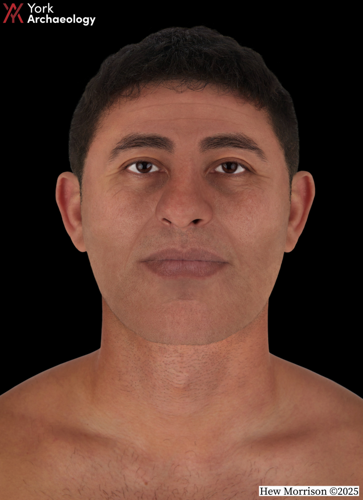
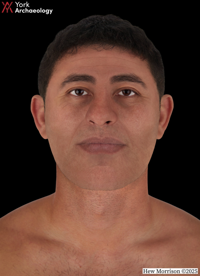

The Roman gladiator who was killed by a lion. (Hew Morrison via SWNS)
By Amy Reast
A forensic artist has recreated the face of the Roman gladiator who was mauled by a lion in York.
Last week, scientists revealed bite marks found on the pelvis of a skeleton discovered in a Roman cemetery in York was the first archaeological proof of gladiatorial combat with wild beasts.
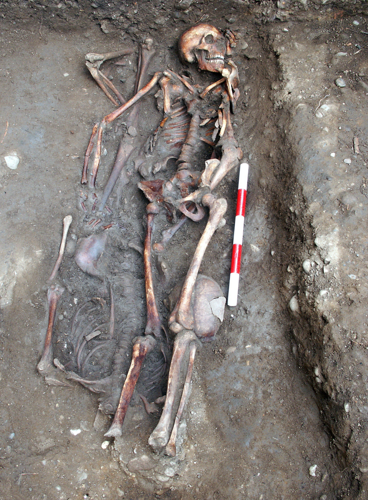
Likely to have been buried sometime between 200AD and 300AD, the skeleton of a man, aged between 26 and 35, was excavated from one of the world's best-preserved gladiator graveyards, known as Driffield Terrace.
Now forensic facial identification specialist Hew Morrison, 46, has used photos of the man's skull, and other data collected by scientists in York, to recreate the savaged man's face.
Working with charity York Archaeology, Hew noted a report on the bones revealed the man had southern European DNA and then digitally built his face using computer software, to reveal a young man with dark hair and eyes.
The man - known as 6DT19 - was one of 83 skeletons discovered.
Hew said: "What makes individual 6DT19 different from the other skeletons found at the site is quite remarkable.
"Throughout time there has been suggestions of humans having been put into a public arena to battle large animals - as seen in mosaics, stone carvings, pottery and ancient texts.
"But until now there had not been any cogent evidence of such activity."
New research led by Professor Tim Thompson from Maynooth University in Ireland has matched these marks with sample bites from large carnivores at a zoo, confirming that he was bitten several times by a lion.
The fact that this had not healed indicates that this occurred around the time of his death and may have been the cause, although he was also decapitated.





David Jennings, chief executive of York Archaeology, said: “What we do know is that bringing a lion to York would have been very expensive.
"Likely captured in North Africa, purchasing the animal would have cost up to 150,000 sestertii, the equivalent of four years’ wages for a laborer.
"A lion was the ultimate gladiatorial spectacle – the most expensive animal you could buy – so clearly there were some incredibly wealthy individuals in York sponsoring these bouts, which took place over a long period."

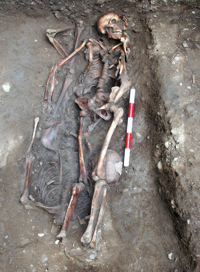
Human remains. (Hew Morrison/York Archaeology via SWNS)
Hew described how he was provided with an osteology report of the skeleton as well as information known about its background and photos of the skull.
Without ever having seen the skeleton in real life, he used the information to build up a digital image.
He said: "We know his skin and hair color and where he was in Europe - and I was provided with scale photos of the skull.
"I built a model of the face digitally, using the tissue depth based on his age, sex and ancestry.
"I digitally built the muscles of the face and then rendered the model with lifelike graphics taken from a number of human facial stock images.
"It took four or five days to do.
"I already knew about the skeleton, and I was really keen to do this when he opportunity arose.
"To work on any gladiator is interesting, but knowing the circumstances of his demise - it's one of the most interesting projects I've worked on."
Hew says it is a "world first" to find such strong evidence concluding a death by a lion attack.
The skeleton is on display at DIG: An Archaeological Adventure in St Saviourgate, York.

(0) comments
Welcome to the discussion.
Log In
Keep it Clean. Please avoid obscene, vulgar, lewd, racist or sexually-oriented language.
PLEASE TURN OFF YOUR CAPS LOCK.
Don't Threaten. Threats of harming another person will not be tolerated.
Be Truthful. Don't knowingly lie about anyone or anything.
Be Nice. No racism, sexism or any sort of -ism that is degrading to another person.
Be Proactive. Use the 'Report' link on each comment to let us know of abusive posts.
Share with Us. We'd love to hear eyewitness accounts, the history behind an article.